Introduction
Search "one person company Australia" and you'll hit a wall. Australia doesn't have that legal category. What it does have is the Proprietary Limited company, or Pty Ltd, which lets one person hold every seat at the table: sole director, sole shareholder, sole decision-maker.
Many US entrepreneurs struggle when they map familiar structures onto Australian law. A US LLC works one way. A sole trader setup follows different rules entirely. A Pty Ltd sits in its own category, with distinct residency rules and tax quirks.
This guide breaks down the legal structure, who's eligible, registration steps, real costs, tax obligations, and how a Pty Ltd stacks up against a US LLC.
Key Takeaways
- A Pty Ltd with one director and one shareholder is Australia's functional "one person company"
- US citizens can own 100% of a Pty Ltd remotely, but a resident director is mandatory
- Limited liability protects your personal assets in a way sole trader status does not
- ASIC registration typically takes days, not weeks, once documents are ready
- Cross-border advisors manage resident director requirements, ABN/TFN setup, and tax treaty planning
What Is a "One Person Company" in the Australian Context?
Australia has no ASIC category called "One Person Company." What you're actually looking for is a proprietary company limited by shares with a single director and a single member (shareholder). Same person, both roles, one entity.
Under the Corporations Act 2001, this company is a separate legal entity from its owner. That means it can:
- Enter contracts in its own name
- Own property and assets
- Sue and be sued independently of the founder
That last point matters. It's the whole reason people choose this structure over operating as a sole trader.
Proprietary Company Limits and Naming Rules
A Pty Ltd can have up to 50 non-employee shareholders and generally can't offer shares to the public. The name must include "Proprietary Limited" or the accepted short form, "Pty Ltd."
Limited Liability vs. Sole Trader Exposure
Here's the practical difference:
| Structure | Liability | Legal Status |
|---|---|---|
| Sole Trader | Personal, unlimited | Same legal entity as owner |
| Pty Ltd | Limited to unpaid share value | Separate legal entity |
If a Pty Ltd racks up debt or faces a lawsuit, the shareholder's personal assets generally stay protected. A sole trader has no such buffer.
ACN vs. ABN: Know the Difference
Two identifiers, two purposes:
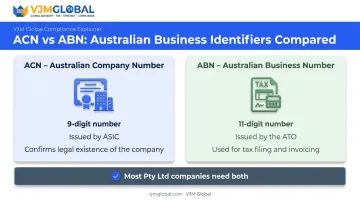
- ACN (Australian Company Number): A 9-digit number issued by ASIC when your company registers
- ABN (Australian Business Number): An 11-digit number issued by the ATO, used for tax and invoicing
Most Pty Ltd companies end up holding both. The ACN confirms your company exists legally. The ABN lets you actually transact and file taxes.
Can US Citizens and Businesses Set Up a One Person Company in Australia?
Yes. US citizens and companies can legally do business in Australia and own 100% of a Pty Ltd company without relocating. You need no visa, green card, or physical presence just to own the shares.
There's one catch, though, and it trips up a lot of solo founders.
The Resident Director Requirement
Under Section 201A of the Corporations Act, at least one director must ordinarily reside in Australia. A solo US founder who lives in Chicago or Austin can't be the company's only director unless they also satisfy Australian residency.
This is where most American founders get stuck. Their options:
- Move to Australia and personally satisfy the residency requirement (unrealistic for most)
- Engage a resident director service that appoints a qualified Australian resident while you retain 100% ownership
Option two is by far the most common path. It lets you keep full control as sole shareholder while meeting the letter of the law.
The FIRB Angle for New Companies
Foreign investors often assume Australia's Foreign Investment Review Board (FIRB) will slow down a brand-new business. Usually, it doesn't. According to FIRB's Guidance Note 7, starting a new ("greenfield") Australian business generally doesn't trigger notification or screening requirements for an ordinary private investor.
Exceptions exist:
- National security businesses require prior notification regardless of size
- Foreign government investors face a AUD $0 screening threshold, meaning approval is required before starting any business
For a typical US solo founder launching a consulting firm, agency, or e-commerce company, you can usually proceed without FIRB approval.
Visa Clarity: Ownership vs. Operation
Owning and registering the company doesn't require a visa. Living and working in Australia to run it day-to-day does. If you plan to relocate later, look into skilled or business innovation visa categories, though that's a separate conversation from entity setup.
VJM Global helps US-based solo entrepreneurs put a resident director arrangement in place so Section 201A is met without relocating. That covers the main structural barrier to owning an Australian Pty Ltd remotely.
Step-by-Step: How to Register Your One Person Company (Pty Ltd) in Australia
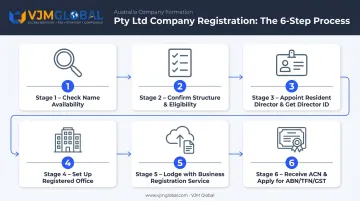
Registration isn't complicated once you know the sequence. Here's the full path:
Check name availability. Search ASIC's company name register and separately search IP Australia's trademark database. A clear ASIC name check doesn't mean you're free of trademark risk.
Confirm your structure. Decide on sole director/sole shareholder and verify it meets eligibility, including the resident director rule covered above.
Appoint your resident director and secure a director ID. Every director needs a Director ID through the Australian Business Registry Services before appointment. It's free, and it's permanent once issued.
Set up a registered office. Australian law requires a physical street address, not a PO Box, for official correspondence.
Lodge with the Business Registration Service. Submit your application, choosing between ASIC's standard "replaceable rules" or a custom constitution.
Receive your ACN and Certificate of Registration. Then apply for your ABN, TFN, and GST registration if your turnover will cross the A$75,000 mandatory threshold.
Non-resident founders typically need:
- Identity verification documents
- Proof of address
- Details for the appointed resident director
Formation advisors often bundle the registered office address with the resident director arrangement, since both are required for foreign owners.
Costs and Ongoing Compliance Obligations
Setup costs less than most people expect. Staying compliant is the part that requires ongoing attention.
One-Time Setup Costs
- ASIC registration fee: A$636 for a proprietary company with share capital
- Resident director service fees: Vary by provider, quoted per engagement
- Registered office setup: Often bundled with the resident director service
Recurring Annual Costs
Once registered, budget for:
- ASIC annual review fee: A$342
- Resident director renewal: Varies by provider if you use a third-party director
- Registered office maintenance: Often bundled with the director service
- Accounting and tax return preparation: Basic company accounts and AU tax filings
Compliance Duties You Can't Skip
Directors carry legal obligations that don't disappear after registration day:
- Update ASIC registers (directors, shareholders, share allotments) within 28 days of any change
- Lodge the annual review and pay the fee, typically due two months after your review date
- Pass a director's solvency resolution each year confirming the company can pay its debts as they fall due
- Report a negative or missing solvency resolution to ASIC within 7 days
Miss these deadlines and penalties stack up fast. Many US founders hand ASIC updates and annual reviews to a local compliance partner instead of tracking every due date from another time zone.
Tax Obligations for a US-Owned One Person Company in Australia
Your Pty Ltd's Australian tax obligations don't change based on who owns it. US ownership doesn't get special treatment, favorable or otherwise.
Corporate Tax Rates
According to the ATO's current company tax rate guidance:
- 25% applies to "base rate entities" with aggregated turnover under AUD $50 million, where no more than 80% of income is passive
- 30% applies to all other companies
Most solo-founder Pty Ltds qualify for the lower base rate, assuming they're actively trading rather than just holding passive investments.
GST Registration
Registration becomes mandatory once your GST turnover hits AUD $75,000, calculated on a rolling 12-month basis (current plus prior 11 months, or current plus projected 11 months). You have 21 days to register once you cross that line.
Voluntary early registration is worth considering: it lets you claim input tax credits on business expenses before registration is mandatory.
Personal Services Income (PSI) Rules
If you're a solo consultant or contractor running income through your Pty Ltd, watch for PSI rules. Income earned mainly (over 50%) from your personal skills or effort can trigger attribution back to you personally, along with PAYG withholding obligations.
You may self-assess as a personal services business if you:
- Pass the results test for at least 75% of your income, or
- Meet other tests while keeping under 80% of income from a single client
Get this wrong and you lose deductions you'd otherwise claim. Confirm the position with a tax adviser before assuming your structure qualifies.
The US Side: CFC Rules
Your Australian Pty Ltd may qualify as a Controlled Foreign Corporation (CFC) under US tax law. A sole US owner typically crosses the ownership thresholds that trigger CFC reporting—IRS Form 5471 filing obligations and potential GILTI exposure.
Getting CFC status and treaty interaction wrong can mean tax on the same income in both countries. VJM Global advises US owners of Australian entities on CFC reporting, GILTI exposure, and treaty planning so dual-jurisdiction rules are handled before filing season.
US LLC vs. Australian One Person Company: What's the Equivalent?
Short answer: there isn't a perfect match. The structural equivalent to a solo-owner US LLC is a sole-director, sole-shareholder Pty Ltd. The tax treatment, though, is a different story entirely.
The LLC Translation Problem
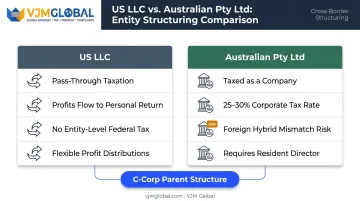
US LLCs are pass-through entities by default. Profits flow to the owner's personal return, and the entity itself pays no federal income tax. Australia doesn't work that way.
The ATO generally doesn't recognize a US LLC as a pass-through entity. Instead, it may classify it as a "foreign hybrid," taxed as a company under Australian concepts even though it's taxed as a partnership back home. This mismatch creates real risk of double taxation if you don't structure carefully.
There's a narrow exception under Division 830 of Australian tax law. Some US LLCs can qualify for partnership treatment in Australia if they meet every condition, including formation in the US and partnership taxation there. Qualifying isn't automatic.
A Cleaner Structural Path
Many advisors suggest incorporating the Australian Pty Ltd underneath a US C-Corporation parent, rather than directly beneath an LLC. This avoids the pass-through mismatch entirely, since a C-Corp is already taxed as a company on both sides of the Pacific.
The trade-off is clear:
- You give up LLC flexibility, such as easy profit distributions
- You gain cleaner treaty treatment and more predictable tax outcomes
Whether that trade makes sense depends on your revenue, growth plans, and exit strategy. Speak with a cross-border tax specialist before you file anything.
Frequently Asked Questions
Can US citizens do business in Australia?
Yes. US citizens can own and operate a business in Australia, including 100% ownership of a Pty Ltd company. A resident director is required, but you only need a visa if you're physically relocating to run the business yourself.
What is the Australian equivalent of a US LLC?
Australia has no direct LLC equivalent. A sole-director, sole-shareholder Pty Ltd is the closest functional match, though tax treatment differs significantly and requires careful cross-border structuring.
Do I need to be an Australian resident to own a one person company there?
No. Ownership doesn't require residency. However, at least one director must ordinarily reside in Australia under Section 201A of the Corporations Act.
How long does it take to register a one person company in Australia?
ASIC registrations are typically processed within a few business days when you use online lodgement and submit complete documentation upfront.
What is the minimum number of directors and shareholders required for a Pty Ltd?
One person can serve as both sole director and sole shareholder, provided the residency requirement for the director role is satisfied, either personally or through a resident director service.
Can I use a virtual or registered agent address instead of a physical Australian office?
A registered office address must be a physical Australian street address; PO Boxes don't qualify. Virtual office or registered agent services can fulfill this requirement for non-resident founders who lack their own local address.