Australia ranks among the world's most business-friendly economies. According to the final World Bank Doing Business 2020 rankings, Australia placed 14th out of 190 economies globally — and with 19 free trade agreements in force covering markets from China to India to the UK, it offers genuine commercial reach into the Asia-Pacific region and beyond.
This guide walks through every practical step — from choosing the right structure to ongoing compliance — so you know exactly what's involved before committing resources.
Key Takeaways
- Most businesses register as a Pty Ltd (proprietary limited company) for limited liability and growth flexibility
- Foreign founders must appoint at least one Australian-resident director for any Pty Ltd
- ABN registration is free; ASIC Pty Ltd registration costs $636
- GST registration is mandatory once annual turnover hits $75,000, with a 21-day window to register
- Post-setup compliance — BAS lodgements, STP payroll reporting, and annual ASIC reviews — is an ongoing obligation
What Does Starting a Business in Australia Actually Involve?
Starting a business in Australia means choosing a legal structure, registering with the right authorities, and meeting ongoing compliance obligations — before you make your first sale.
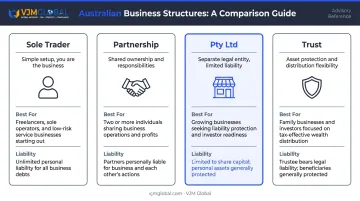
The four main structures are:
| Structure | Best For | Key Consideration |
|---|---|---|
| Sole Trader | Solo operators, early testing | Unlimited personal liability |
| Partnership | Two or more founders sharing profits | Complex liability, shared risk |
| Pty Ltd (Company) | Growth-oriented, capital-raising businesses | Separate legal entity, limited liability |
| Trust | Asset protection, family businesses | More complex to administer |
Foreign founders have two additional options worth knowing: a branch office (an extension of the parent company, meaning the parent carries full liability) and a representative office (useful for market testing only — it cannot conduct commercial activity). For any operational business, a Pty Ltd is the standard choice.
That structure choice matters more than most founders expect. A sole trader can be registered in a day with minimal cost, but offers no liability protection. A Pty Ltd takes longer and costs more upfront — but it's the foundation most investors, lenders, and commercial landlords require.
Why Start a Business in Australia?
Australia offers more than just political stability and rule of law. The structural economics — market access, trade agreements, and investment climate — make a strong case on their own.
Economic fundamentals:
- Top 20 global economy by GDP, with a 12th-place ranking by nominal GDP size (per DFAT data)
- Ranked 14th globally for ease of doing business (World Bank Doing Business 2020)
- Attracts the 15th-highest amount of foreign direct investment globally
Market access advantages:
- 19 active free trade agreements — including China (ChAFTA), India (ECTA), Japan (JAEPA), the US (AUSFTA), and the UK (A-UKFTA)
- Strong proximity and logistical connections to Southeast Asian markets
- Government investment promotion through Austrade, with active support for inbound foreign investment
Competitive landscape: Australia's consumer and business markets are quality-driven. New entrants who deliver reliably — particularly in services — can win customers without competing on price alone.
What to Know Before You Start
Many first-time founders underestimate the administrative load in the early stages. Product development, customer conversations, and brand building all compete for attention alongside a steady stream of compliance tasks from day one.
Set realistic expectations on these four fronts:
- Most businesses take several months to stabilise revenue. Plan for at least 6–12 months of financial runway before expecting consistent income.
- ASIC registration, ABN, GST, business name, licences, and insurance are all separate steps — missing one creates compliance gaps.
- A resident director is mandatory for a Pty Ltd. FIRB approval may also apply depending on sector and investment size; thresholds are indexed annually and vary by country, industry, and investor type.
- Understand superannuation and Fair Work requirements before hiring your first employee — these are not optional extras.
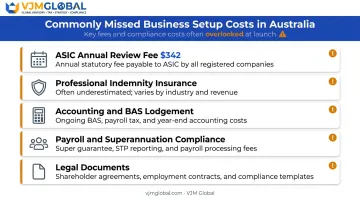
Commonly missed cost areas:
- Annual ASIC review fee: A$342 for a proprietary company
- Professional indemnity or public liability insurance
- Ongoing accounting, BAS lodgement, and bookkeeping costs
- Payroll and superannuation compliance
- Legal documents — shareholder agreements, employment contracts, terms and conditions
How to Start a Business in Australia — Step by Step
The sequence below matters. Skipping or reordering steps — particularly around validation, legal setup, and tax registration — is one of the most common sources of early-stage problems.
Step 1 – Validate Your Business Idea and Market Fit
Before registering anything, confirm you're solving a real problem for a specific group of Australian customers who will pay for the solution.
- Define who experiences the problem, how frequently, and what they currently use to address it
- Test demand through direct customer conversations, a small pilot, or competitor analysis
- Validate pricing — not just whether people are interested, but what they'll actually pay
A common mistake: assuming demand from overseas markets will automatically transfer to Australia. Local pricing expectations, consumer behaviour, and competitive dynamics can differ substantially.
Step 2 – Choose Your Business Structure
The right structure depends on your situation:
- Sole trader — fast and low-cost to set up, but unlimited personal liability. Suitable for early-stage testing.
- Partnership — shared responsibility between two or more people, but joint liability is a real risk.
- Pty Ltd — required if you plan to raise capital, bring in co-founders, or manage liability exposure. The most common structure for growth-oriented businesses.
- Trust — complex to administer; mainly used for asset protection and family business arrangements.
For foreign investors: a branch office carries full parent company liability; a Pty Ltd is the standard operating entity.
One mistake to avoid: setting up as a sole trader for speed, then converting to a Pty Ltd later. The switch triggers additional costs and administrative steps. Assess long-term requirements before choosing.
Step 3 – Register Your Company with ASIC and Get Your Director ID
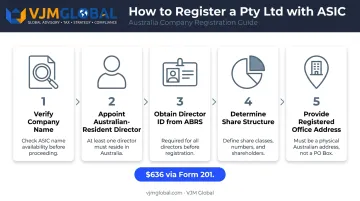
To register a Pty Ltd, you'll need to:
- Choose a company name and verify availability on ASIC's register
- Appoint at least one director who ordinarily lives in Australia — this is a legal requirement for all Australian proprietary companies
- Obtain a Director Identification Number (DIN) from the Australian Business Registry Services (ABRS) — each director must apply personally before being appointed
- Determine your share structure
- Provide a registered office address in Australia
ASIC will issue a 9-digit Australian Company Number (ACN) upon registration. Note that your registered company name and your trading business name are two separate things — if you operate under a different name, that name requires separate registration.
ASIC registration for a Pty Ltd costs $636 via Form 201.
Step 4 – Apply for an ABN and Tax Registrations
Your Australian Business Number (ABN) is an 11-digit identifier required for invoicing, tax dealings, and most business registrations. ABN registration is free through the Australian Business Register and can only be completed after the company exists.
Key tax registrations that follow:
- GST registration — mandatory once annual turnover reaches or is expected to reach $75,000. Once you cross this threshold, you have 21 days to register.
- Tax File Number (TFN) — sole traders use their personal TFN; companies, trusts, and partnerships need a separate business TFN.
- PAYG withholding — must be registered before you make your first employee payment.
- Superannuation Guarantee — employers must contribute 11.5% of eligible employees' ordinary time earnings for the 2024–25 financial year, rising to 12% from 1 July 2025 onwards.
Step 5 – Register Your Business Name, Open a Bank Account, and Secure Licences
Three practical tasks that often get delayed — and shouldn't be:
Business name registration: If you trade under a name different from your company's legal name, register it separately with ASIC. Costs $47 for one year or $108 for three years. For a .com.au domain, you'll need a valid ABN or ACN to meet auDA's eligibility rules.
Business bank account: Partnerships, companies, and trusts must maintain a separate bank account for tax purposes. Mixing personal and business finances compromises your limited liability protection and complicates tax reporting.
Licences and permits: Use the Australian Business Licence and Information Service (ABLIS) to identify every licence, permit, and registration required for your industry and state or territory. Operating without required approvals can result in fines or forced closure.
Step 6 – Set Up Financials, Insurance, and Legal Documents
Financial infrastructure to put in place:
- Accounting software and invoicing processes
- Payroll and superannuation setup
- A consistent process for BAS lodgement
Good record-keeping from day one reduces the burden at tax time and supports better business decisions throughout the year.
Insurance to obtain:
- Public liability — covers third-party injury or property damage claims
- Professional indemnity — essential for service businesses
- Workers' compensation — mandatory if employing staff in most states and territories (schemes vary by state)
Legal documents before you trade:
- Shareholders Agreement (if there are multiple founders)
- Employment Contracts for any hires
- Terms and Conditions for customers
- Privacy Policy if collecting personal data
VJM Global provides BAS preparation, PAYG setup, bookkeeping, and management reporting services for Australian businesses — covering the financial infrastructure side of this step directly.
Step 7 – Go to Market and Build Trust
Start with two or three customer acquisition channels appropriate to your target audience: Google Search, LinkedIn, local networking, or referrals. Focus on credibility signals before committing budget to paid advertising.
What Australian customers check before engaging a business:
- Google reviews and ratings
- Professional website with clear service descriptions
- Case studies or demonstrable results
- Social proof (testimonials, recognisable clients)
Set up basic tracking from launch: know where enquiries come from, what converts, and what the average customer value is. This makes early decisions about marketing spend far more grounded.
In Australia, customers consistently research online before making contact — launching without a digital presence puts you at a structural disadvantage from day one.
Step 8 – Monitor Compliance, Review Performance, and Stabilise
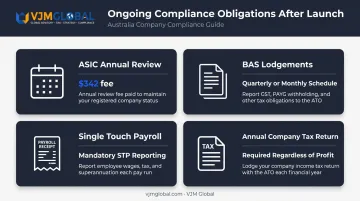
Ongoing compliance obligations after launch:
- ASIC annual review — pay the annual review fee ($342) and confirm company details
- BAS lodgements — quarterly for businesses with GST turnover under $20 million; monthly if turnover exceeds $20 million
- Single Touch Payroll (STP) — mandatory payroll reporting through STP-enabled software for all employers
- Annual company tax return — required regardless of whether the business made a profit
Financial performance metrics to track:
- Revenue versus forecast
- Gross and net margins
- Cash runway
- Customer retention rate
Stabilise before scaling. Fix operational gaps, confirm pricing is sustainable, and verify the business model is performing as expected before adding headcount or entering new markets.
VJM Global's accounting and compliance support covers Australian GST, BAS lodgement, payroll processing, and year-end financial reporting — so these obligations don't become a distraction as your business scales.
Conclusion
Starting a business in Australia follows a logical, manageable sequence — provided you don't rush registration at the expense of validation, and don't underestimate the compliance obligations that begin the moment you start trading.
Long-term success in the Australian market comes down to a few non-negotiables: the right legal structure from the start, clean financial records, and consistent compliance. Most businesses that struggle don't fail for lack of ambition — they fail because the back-end was never properly set up. Get the foundations right, and everything else becomes easier to build on.
Frequently Asked Questions
How much does it cost to set up a business in Australia?
ASIC Pty Ltd registration costs AUD $636, ABN registration is free, and business name registration costs $47 for one year or $108 for three years. Additional costs vary depending on whether you engage an accountant or adviser for legal documents and tax setup — these fees are separate from government charges.
Do I need an ABN if I earn less than $75,000?
The $75,000 threshold applies to GST registration, not the ABN. Any entity conducting business in Australia needs an ABN — most businesses apply from the start to enable invoicing and dealings with suppliers and government bodies.
Can a foreigner start a business in Australia?
Yes. Foreign founders can register a Pty Ltd in Australia, but must appoint at least one director who ordinarily resides in Australia. Depending on the investment size, sector, and investor's country of origin, FIRB notification or approval may also be required — thresholds are indexed annually and vary by sector.
What is the difference between an ABN and an ACN?
An ACN (Australian Company Number) is a 9-digit number issued by ASIC when a company is registered — it applies only to companies. An ABN (Australian Business Number) is issued by the ATO and applies to all business types. Companies will have both; sole traders and partnerships only need an ABN.
How long does it take to register a company in Australia?
ASIC company registration can be completed online in as little as one business day once all director IDs are in place. The full setup process — including ABN, tax registrations, bank account, and relevant licences — typically takes two to four weeks in total.
What taxes does a business in Australia need to pay?
The main taxes a registered business must account for:
- Company income tax: 25% for base rate entities (turnover under $50M); 30% for all others
- GST: 10% on taxable supplies once registered
- PAYG withholding: applied to employee wages
- Superannuation guarantee: currently 11.5% for 2024–25, rising to 12% from 1 July 2025