The interest isn't limited to big corporations. Tech founders, hospitality investors, renewable energy players, and remote-first consultants are all exploring what it takes to set up shop there.
This guide walks through entity choice, registration steps, tax rules, and compliance requirements specific to a US citizen or company starting a business in Iceland.
TL;DR
- Get a kennitala (Icelandic ID number) and register with Skatturinn (RSK), Iceland's tax authority
- Choose sole proprietorship (einstaklingsfyrirtæki), private limited company (ehf.), or a branch of your US entity
- Non-EEA citizens need a work permit to be self-employed; ownership alone doesn't grant work rights
- Registration takes days to weeks; visa or residency approval can extend the timeline to months
What Starting a Business in Iceland as a US Founder Involves
Starting a business in Iceland means legally registering an entity with Skatturinn and obtaining identification for that entity. For individuals planning to work there, this typically means a kennitala tied to a residence permit.
As a US citizen, you're classified as a non-EEA national. That distinction matters more than most founders expect. A non-EEA citizen generally cannot work in Iceland as a self-employed individual — a work permit tied to an employer is usually required before you personally start working.
Common structures available to foreign founders:
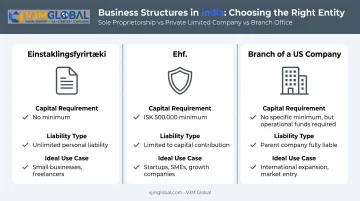
- Einstaklingsfyrirtæki — sole proprietorship, no capital requirement, full personal liability
- Ehf. (einkahlutafélag) — private limited company, ISK 500,000 minimum capital, limited liability
- Branch of a US company — registers your existing US entity's presence in Iceland
What to Know Before You Start a Business in Iceland
Many US founders assume Icelandic company formation mirrors setting up an LLC back home. It doesn't. The differences show up mostly in immigration requirements and bureaucratic steps that simply don't exist in the US system. Use this section to set realistic expectations for the process, not to judge whether your idea will succeed.
Residency and Documentation Hurdles
Before registering as self-employed or forming a company where you'll personally work, non-EEA citizens usually need a residence/work permit. This isn't optional paperwork; it's a legal precondition. Key logistics to plan around:
- Ehf. companies need ISK 500,000 in paid share capital; sole proprietorships need none
- Electronic ehf. filings often clear in 3–5 working days; paper filings usually take 2–3 weeks
- Residence/work permit approval can take up to 180 days on a standard application
- Tourism, food service, and fisheries need sector permits on top of basic registration
- A small Iceland-only test is a different project than a venture built to scale across the EEA Document translation is less of an issue than most founders assume. Branch filings accept English, Icelandic, Danish, Swedish, or Norwegian documents, so US paperwork often doesn't need translation at all.
Why Start a Business in Iceland from the USA (When It Makes Sense)
Iceland isn't a universal fit. Under the right conditions, though, it can be a smart strategic move.
Where Iceland Delivers Real Advantages
- EEA market access: Participate in the EEA single market without separate EU incorporation
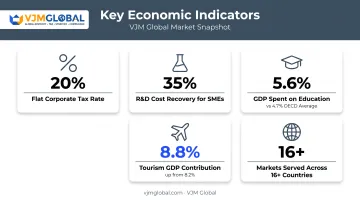
- Competitive corporate tax: Ehf. companies pay a flat 20% corporate tax rate
- R&D incentives: Qualified SMEs can recover 35% of eligible research costs, with larger companies eligible for 25%
- Educated workforce: Iceland invests 5.6% of GDP in education versus a 4.7% OECD average, according to the OECD's Education at a Glance 2025 report
- Growing tourism sector: Tourism contributed 8.8% of GDP in 2025, up from 8.2% the year before, per Statistics Iceland
Strong entry points for foreign founders include:
- Technology and data infrastructure
- Renewable energy
- Tourism and hospitality
- Sustainable fisheries (ownership restrictions apply—research separately)
If your goal is a niche product to test in a small, sophisticated market before scaling EU-wide, Iceland's size works in your favor. If you need immediate scale, treat it as a launchpad, not a destination.
Step-by-Step: How to Start a Business in Iceland from the USA
Here's the practical sequence, built around what actually trips up US founders: assuming US LLC rules apply, skipping the residency step, or underestimating documentation timelines.
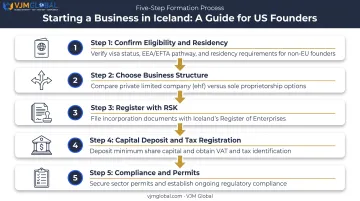
Step 1 – Confirm Eligibility and Secure Residency Documentation
Determine early whether you'll need a residence/work permit. If you're only holding shares or sitting on a board, you may qualify for a system ID instead of full residency. This identifies you for filing purposes but grants no work rights.
If you plan to personally work in the business, apply for the appropriate permit before doing anything else. Short stays under 90 days have narrow exceptions, but these don't function as a general self-employment loophole.
Common miss: Assuming Icelandic ID rules mirror the US SSN/EIN process. They don't. A kennitala is tied to residency status, not simply business registration.
Step 2 – Choose Your Business Structure
| Structure | Capital | Liability | Best for |
|---|---|---|---|
| Sole proprietorship | None | Full personal liability | Very small, low-risk operations |
| Ehf. | ISK 500,000 | Limited to share capital | Outside investment, scaling plans |
| Branch | No separate minimum stated | Parent company exposure | Extending an existing US entity |
Match the structure to your funding plans and risk tolerance. A sole proprietorship might work for testing a small idea, but it's the wrong choice if you're planning to raise capital or hire aggressively.
Common miss: Choosing a sole proprietorship structure for a business plan that clearly needs outside investors later — reorganizing after the fact adds cost and delay.
Step 3 – Register Your Company Name and Entity with RSK
Search and reserve your business name through the Icelandic Company Registry, then submit the appropriate form:
- RSK 17.21 for ehf. formation
- RSK 17.25 for sole proprietorship business-name registration
- RSK 17.62 for a system ID if you're a nonresident founder, director, or board member
Common miss: Submitting incomplete founder or shareholder details, which stalls processing regardless of whether you filed electronically or on paper.
Step 4 – Handle Capital Deposit, Banking, and VAT/Tax Registration
For an ehf., deposit the full ISK 500,000 in share capital before registration completes. You'll also need a corporate bank account, and pre-clearing your KYC documents directly with your chosen bank can save weeks, since foreign founders often face extra verification steps.
Tax registration essentials:
- Register for VAT using Form RSK 5.02 if turnover is expected to exceed ISK 2,000,000 annually
- Ehf. companies pay a flat 20% corporate tax
- Sole proprietors face progressive personal rates of 31.49%, 37.99%, and 46.29% depending on income bracket (2026 figures)
Common miss: Underestimating how long bank KYC review takes for a foreign-owned entity, especially when beneficial-ownership documentation is incomplete.
Step 5 – Set Up Compliance, Permits, and Cross-Border Structuring
Secure any sector-specific licenses your business needs — tourism operators register with the Icelandic Tourist Board, food businesses need municipal health authority approval, and fisheries require Directorate of Fisheries permits.
Then build out ongoing compliance:
- Bookkeeping and invoicing that meet Icelandic retention standards
- Payroll registration if you're hiring local employees
- Cross-border tax coordination if you're maintaining US filing obligations simultaneously
This is where many founders bring in a formation and compliance partner. VJM Global supports foreign founders with entity registration, tax and VAT filings, and ongoing bookkeeping across 100+ countries, using each market's own regulators and statutory instruments.
For an Iceland setup, that means local paperwork and filings are handled against Icelandic requirements so you're not learning compliance from scratch while running the business.
Common miss: Assuming US accounting practices satisfy Icelandic bookkeeping and document-retention requirements. They generally don't, and the gap tends to surface at tax time, not during setup.

Early Decisions and Common Pitfalls for US Founders
Most delays US founders hit in Iceland trace back to two things: underestimating the non-EEA immigration process, and not planning for how long document review actually takes. It's rarely about effort.
Areas that catch people off guard:
- Dual US–Icelandic tax residency brings foreign-tax-credit analysis, transfer-pricing work, and forms (W-8/W-9) most founders don't expect
- In-person banking checks and permit processing often add weeks beyond the registration paperwork itself
- Icelandic-language sources dominate some regulatory questions, and English government translations aren't always consistent
- Scaling past a solo setup turns payroll and employment-law compliance into a separate workstream
For founders who want to hire in Iceland before committing to a full local entity, an Employer of Record arrangement can be the more practical first move. It lets you bring on staff under Icelandic employment law without incorporating immediately — useful while you're still validating the market.
Frequently Asked Questions
Can I work in Iceland as a US citizen?
As a non-EEA citizen, you generally need a residence/work permit to work or run a business in Iceland long-term. Short stays under 90 days have limited exceptions, but these don't function as general work authorization.
What are the top 3 industries in Iceland?
Technology and renewable energy, tourism and hospitality, and fisheries/sustainable agriculture are the leading sectors for foreign business opportunities, though fisheries carries ownership restrictions.
Is it cheaper to live in Iceland or the USA?
Iceland's cost of living runs higher than most US regions. Numbeo data puts consumer costs about 46% above the US average. Lower corporate tax rates can offset some of this for businesses, not for personal living expenses.
Do I need a local Icelandic bank account to start a business?
Yes. A corporate bank account is required for capital deposit and daily operations. In-person verification is common, though some banks allow certain KYC steps electronically if you already hold Icelandic ID.
How long does it take to register a business in Iceland from the USA?
Registration itself can take as little as 3-5 working days electronically, or 2-3 weeks on paper. Visa and residency approval for US citizens can extend the overall timeline to months.
Can a US company open a branch in Iceland instead of forming a new entity?
Yes. Branches of foreign companies register through the Company Registry, generally taking about 2-3 weeks and carrying a registration fee of ISK 276,500.