
More Americans are looking at Africa now because the population is young, mobile adoption is climbing fast, and consumer demand in many sectors hasn't been picked over the way US markets have. The interest isn't coming from one group either. Diaspora entrepreneurs, SMEs hunting for new markets, individual investors, and remote-first founders are all asking versions of the same question.
This guide walks through market selection, legal setup, and execution, step by step, for a US-based founder starting from scratch.
Key Takeaways
- Kenya, Nigeria, South Africa, Ghana, and Egypt are the five most accessible African markets for US entrepreneurs
- Entity registration can take a day (Egypt), but banking, tax, and licensing add weeks
- Foreign ownership and repatriation rules vary by country—verify each market separately
- Local partners, accountants, and counsel cut risk more than a fast launch ever will
What Does It Mean to Start a Business in Africa as a US Entrepreneur?
Starting a business in Africa means establishing a legal presence in a specific country—usually by registering a local entity or forming a joint venture with a local partner—so you can operate and sell there. That is not the same as exporting from the US.
Exporting rarely requires local registration. Starting a business does. It typically means:
- Obtaining a local tax identification number
- Complying with that country's company registrar and sector regulators
- Meeting local reporting obligations, sometimes from day one
Common entry formats include:
- Wholly foreign-owned local entity: full incorporation, full control
- Joint venture with a local partner: shared equity and shared risk
- Branch office: an extension of the US company, registered locally
- Remote operation via Employer of Record (EOR): hire local staff without incorporating
What to Know Before You Start a Business in Africa
Africa isn't one market. It's 54 countries with 54 separate regulatory systems, and many US entrepreneurs underestimate that complexity until they're mid-registration.
Before committing, get honest answers on these points:
- Time and travel: Due diligence and relationship-building often need in-market time you can't fully outsource
- DIY vs. local partners: Legal, accounting, and compliance work is almost always faster and safer with local professionals than going it alone
- Realistic timelines: Registration can be fast—Egypt’s one-day LLC process and Nigeria CAC’s 24-hour target—but banking, tax registration, and licensing usually stretch the full runway to months
- Remote vs. physical presence: Some models run fine with a local partner or EOR; others need boots on the ground
- Test vs. scale: A lightweight market-entry test is a very different commitment than a fully compliant, scalable local entity
Why Start a Business in Africa? (When It Makes Sense)
Expanding into Africa works under the right conditions. Population size alone does not guarantee success.
Demographics and demand:
- Africa's youth population is projected to more than double to over 830 million by 2050, expanding both the labor force and the consumer base
- Sub-Saharan African internet usage rose from 19% in 2016 to 41% in 2021, reshaping retail, fintech, and agritech demand
- Many sectors have far less competitive saturation than equivalent US or European categories
Market access:
The African Continental Free Trade Area (AfCFTA) covers roughly 1.3 billion people and $3.4 trillion in combined GDP. That's real market potential, but it's not automatic regulatory passporting. You still register and comply country by country.
Natural advantages:
Diaspora ties and existing trade relationships give some US entrepreneurs a genuine head start. In markets like Nigeria, Ghana, and Kenya, cultural fluency and local networks cut through a lot of the usual friction.
Choosing the Right African Market for Your Business
Market selection is one of the highest-stakes calls you'll make early on. Regulatory environments, tax structures, and consumer behavior differ sharply by country. Picking a market on GDP size alone is a common—and costly—mistake.
Factors That Matter
- Registration and stability — Use current World Bank B-READY indicators; older Doing Business rankings are outdated
- Sector fit — Kenya for tech, Nigeria for consumer scale, South Africa for manufacturing, Egypt and Ghana for trade access
- Infrastructure — Power, logistics, and banking access vary widely, even inside one country
- Currency and repatriation — Confirm rules before you commit; this is where many plans stall
| Country | 2026 GDP growth projection | Repatriation guidance |
|---|---|---|
| Kenya | 4.5% | Capital and profit repatriation guaranteed under investment law |
| Nigeria | 4.1% | Certificate of Capital Importation supports FX access |
| South Africa | 1.1% | Must go through an SARB-authorized dealer bank |
| Egypt | 4.6% | Foreign investors may transfer profits in foreign currency without restriction |
| Ghana | 4.8% | Current rule pending enacted investment-bill confirmation |
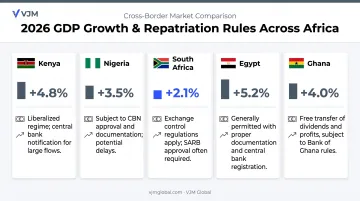
The common miss is choosing "the biggest economy" instead of the best sector and regulatory fit. Rank markets by how your model handles registration speed, infrastructure risk, and profit repatriation—not headline GDP.
How to Start a Business in Africa from the USA – Step by Step
Treat each stage as a checkpoint, not a formality. Founders who skip ahead usually hit the same walls:
- Skipping local legal counsel
- Underestimating compliance timelines
- Ignoring currency risk
- Assuming US contracts hold up unchanged abroad
Step 1 – Research the Market and Validate Demand
Don't assume pan-African demand. A product that works in Lagos may flop in Nairobi. Conduct in-country research, or partner with a local research firm, to confirm:
- Who your target customer actually is in that specific country
- What the competitive landscape looks like on the ground
- Whether pricing and delivery expectations match your model
Common miss: treating "Africa" as one market instead of validating country by country.
Step 2 – Choose Your Legal Structure and Entity Type
Your options generally include a wholly-owned subsidiary, a joint venture, a branch office, or hiring remotely through an Employer of Record without incorporating at all.
Common entity routes in the five most-used entry markets:
- Kenya: Private Limited Company, LLP, or foreign company branch, registered through eCitizen and the Business Registration Service
- Nigeria: Private Company Limited by Shares or Public Limited Company through the Corporate Affairs Commission, plus NIPC registration for foreign-owned entities
- South Africa: Private Company (Pty) Ltd or an external company branch, through CIPC
- Egypt: LLC route through GAFI
- Ghana: Company Limited by Shares through the Registrar General's Department, requiring at least one Ghana-resident director
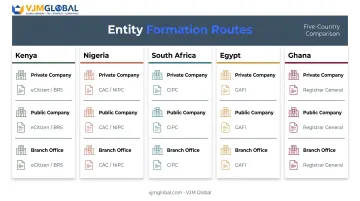
Foreign ownership rules vary by country and sector, so confirm caps and sector limits case by case. VJM Global's entity formation team handles Kenya, Nigeria, South Africa, Egypt, and Ghana through each country's own regulator—not a single template applied everywhere.
Step 3 – Register the Business and Secure Compliance Basics
Once you've picked a structure, registration generally follows this pattern:
- Name reservation — search and reserve your business name with the local registrar
- Incorporation filing — submit constitutional documents (Memorandum and Articles of Association, or equivalent)
- Tax registration — obtain your tax identification number (KRA PIN in Kenya, TIN in Nigeria and Ghana, tax card in Egypt)
- Sector licensing — secure any additional permits your industry requires, such as import/export, food safety, or fintech licenses
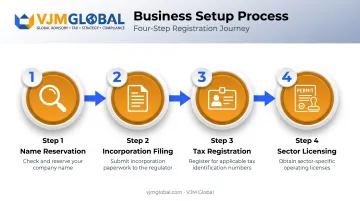
Common miss: delaying tax registration until after revenue starts, which triggers penalties almost every time.
Step 4 – Set Up Banking, Accounting, and Tax Compliance
Opening a local business bank account is where currency repatriation rules actually become relevant, not just theoretical. South Africa requires transactions through an SARB-authorized dealer bank; Egypt allows unrestricted profit transfer in foreign currency for registered investors.
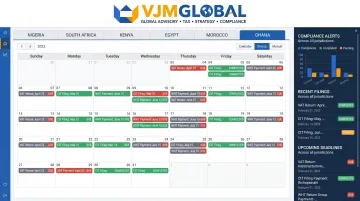
Filing cadences also differ:
- South Africa requires monthly EMP201 payroll declarations plus annual CIPC returns
- Kenya has corporate income tax, VAT, and withholding tax obligations tied to KRA filing schedules
- Nigeria, Egypt, and Ghana each run their own statutory calendars through FIRS, ETA, and GRA respectively
Multi-country accounting and tax support helps US founders stay on top of more than one filing calendar. VJM Global provides that coverage across these African jurisdictions so statutory deadlines don't slip while you run the business.
Step 5 – Build Local Partnerships and Hire Talent
A local partner or advisor who understands cultural and regulatory nuance is worth more than most founders expect. You'll also need to decide:
- Hire through your local entity — full control, full compliance obligation
- Use an Employer of Record — test the market and hire compliantly without incorporating first
EOR coverage across Kenya, Nigeria, South Africa, Egypt, and Ghana typically includes:
- Legal employer role
- Compliant local contracts
- Payroll processing and statutory contributions
- Offboarding support
Pricing is usually per employee, per month.
Step 6 – Launch, Monitor, and Scale
Set up sales and marketing channels that match local, mobile-first digital behavior rather than porting over your US playbook unchanged. Then track:
- Compliance deadlines across every filing cadence
- Financial performance against your original business case
- Customer feedback and repeat purchase patterns
Common miss: expanding into a second African country before the first one is stable. One market done well beats two markets done half-well.
Conclusion
Starting a business in Africa from the USA depends on country fit for your sector, following that market's regulatory process instead of guessing, and relationships with people who already know the terrain. Validation and compliance matter more than launch speed.
Long-term success comes from steady refinement after you enter, not from waiting for one perfect setup. When regulatory complexity gets heavy, a firm that already works inside that country's systems, such as VJM Global across Kenya, Nigeria, South Africa, Egypt, and Ghana, removes much of the avoidable risk.
Frequently Asked Questions
Which African country is best for someone from the USA to start a business?
Kenya, Nigeria, South Africa, Ghana, and Egypt lead on ease of registration and market size. The right choice really depends on your industry and target customer, not a general ranking.
What are the most profitable businesses to start in Africa?
Agribusiness, fintech, e-commerce, logistics, and consumer retail see the strongest demand signals. The African food and agribusiness market alone could reach $1 trillion by 2030, according to the African Development Bank.
Do I need a local partner to start a business in Africa as a foreigner?
It's not always legally required, but a local partner or advisor makes navigating regulations, banking, and cultural nuance easier in nearly every African market.
How long does it take to register a business in an African country?
Registration itself can be fast, as little as one day in Egypt or 24 working hours in Nigeria, but banking, tax activation, and licensing typically extend the full process to a few months.
Can I run an African business remotely from the USA?
Yes—many models work remotely with local partners, digital tools, and Employer of Record hiring. Retail and manufacturing still usually need a physical presence.
What are the biggest risks of starting a business in Africa from abroad?
Regulatory complexity across 54 different systems, currency fluctuation, infrastructure gaps, and misjudging local demand without proper in-country validation come up most often.