Introduction
Building a full overseas office is slow, costly, and often unnecessary just to test a new market. That's why many US entrepreneurs are skipping that step, pairing remote leadership with a formally registered entity abroad instead. This model lets them enter faster and spend less while still building something legally solid.
India is a common target. US-India goods and services trade hit $212.3B in 2024, up 8.3% from the prior year, with US services exports climbing 15.9%. That kind of growth signals real commercial opportunity, well beyond casual interest.
This hybrid approach appeals to founders because it lowers capital risk, speeds up market testing, and keeps the door open to scale later. Solo founders, ecommerce sellers, tech startups, and established SMEs are all exploring it, not just companies with deep pockets. This guide breaks down what a hybrid setup abroad actually involves, from legal structure and tax registration to daily operations.
TL;DR
- A hybrid setup pairs a legal entity abroad with remote-first operations—skipping a full office buildout
- Your choice of subsidiary, branch, or liaison office determines tax exposure and allowed revenue activity
- Permanent establishment risk and dual-country compliance trip up more founders than daily operations
- Basic registration can take weeks; full compliance readiness usually takes a few months
- A local advisory partner reduces friction, but skipping tax residency checks remains the costliest mistake founders make
What Is a Hybrid Business Setup Abroad?
A hybrid business setup abroad combines a formally registered legal entity, whether that's a subsidiary, branch, or liaison office, with remote or distributed operations. It's not a full-scale physical office staffed entirely by an in-country team.
The value is straightforward: you get legal and tax standing in a new market while keeping overhead low through virtual registered offices, outsourced back-office functions, and remote hiring. This structure delivers compliance and lean operations at the same time.
Common structural formats founders use:
- A private limited subsidiary with a virtual registered office instead of a full physical headquarters
- A branch or liaison office paired with a remote-first operating team back in the US
- An outsourced accounting and compliance partner handling local filings while the founder runs strategy from home
Here's how the three main entity types compare on the ground:
| Structure | Liability | Tax Treatment | Can Earn Revenue in India? |
|---|---|---|---|
| Subsidiary (WOS) | Limited to shareholding | 25% to roughly 42%, depending on turnover | Yes, broadly |
| Branch Office | Unlimited (parent liable) | Up to 40% | Only within RBI-approved activities |
| Liaison Office | N/A, no commercial activity | Not taxed in India | No |
Why This Differs From Pure Remote Work
Don't confuse this with hybrid "work" policies about where employees sit each day. A hybrid business setup abroad is about entity structure and market entry, not desk arrangements.
Working remotely from another country and setting up a hybrid business structure abroad are two entirely different questions. One is a personal or employment arrangement. The other creates a registered, taxable presence with legal obligations regardless of who's logging in from where.
Why Consider a Hybrid Business Setup Abroad?
This model works under specific conditions, not as a guaranteed shortcut. Consider it when you want a real legal foothold without committing to full infrastructure on day one.
The core benefits:
- Lower fixed costs than a full physical office, freeing capital for product, marketing, or hiring
- Faster market entry since you're not waiting to build out complete in-country infrastructure before you're legally operational
- Access to specialized local expertise in accounting, tax, and legal matters without full-time hires in each function
- Reduced risk exposure, since you can validate demand before committing to a bigger physical footprint
The retention data on hybrid models is more convincing than the savings claims:
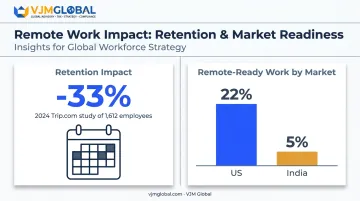
- Retention jumps: A 2024 randomized trial involving 1,612 employees at Trip.com found that two work-from-home days per week cut quit rates by one-third, with no measurable hit to performance or promotions
- Remote-ready tasks vary by market: McKinsey's analysis found 22% of US work could be done remotely three to five days a week without productivity loss, versus just 5% in India
Pick which roles stay remote based on the actual task, not a blanket assumption.
What to Know Before You Start: Legal, Tax & Compliance Essentials
Most founders underestimate cross-border compliance complexity, not the effort of running the business day-to-day. That gap causes more delays and penalties than anything else.
The Six Areas That Matter Most
Six areas to get right before you launch:
- Entity registration: incorporation, tax IDs (PAN/TAN), and licenses each carry their own timelines and documentation requirements
- Permanent establishment (PE) risk: under the India-US tax treaty, service activity beyond 90 days or a dependent agent signing contracts can trigger PE status without a fixed office
- Employment law compliance: statutory benefits, notice periods, and termination rules differ from at-will US norms
- Data protection: India's DPDP Act applies to data processed in India and to overseas processing tied to serving Indian customers
- Insurance and risk coverage: cross-border operations often need adjusted policies that a domestic-only plan won't cover
- Visa and travel requirements: founders visiting periodically typically need a business visa, with its own document and timing rules
Why Sequencing These Steps Matters
None of these steps is optional, and skipping one rarely saves time. It simply moves the cost to a later, more expensive stage.
This is exactly where an experienced local advisory partner earns its fee. Firms like VJM Global, which supports US businesses setting up and staying compliant in India, help founders sequence these steps correctly instead of discovering gaps after the fact.
How to Set Up a Hybrid Business Abroad: Step by Step
This breaks the process into practical stages. The most common mistakes involve skipping tax residency checks early or underestimating what dual-country compliance costs over a full year.
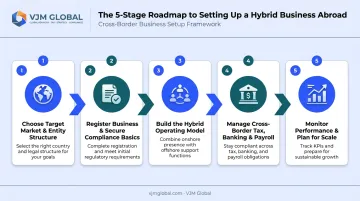
Step 1: Choose Your Target Market and Entity Structure
Evaluate market demand, competition, and how easy the target country makes it to register and operate. Then decide between a subsidiary, branch office, or liaison office based on your actual business goals, not just how quickly each one can be set up.
Common miss: choosing a structure purely for speed, then discovering the tax or liability implications don't fit your long-term plan.
Step 2: Register the Business and Secure Compliance Basics
Complete incorporation, tax registration, and any required licenses. Set up a registered or virtual office address to satisfy local legal presence requirements, since most jurisdictions require one even for a lean operation.
Common miss: delaying statutory registrations like GST until after operations already begin, which creates a compliance backlog and potential penalties.
Step 3: Build the Hybrid Operating Model
Decide what stays remote (leadership, sales, product) versus what needs local presence (compliance, banking relationships, customer-facing roles). Outsource accounting, payroll, and tax filing to a local specialist, such as VJM Global's cross-border accounting team, instead of building an in-house finance team from scratch.
Common miss: trying to manage local compliance directly from the US without local expertise, which tends to end in missed filings or penalties.
Step 4: Manage Cross-Border Tax, Banking, and Payroll
Set up local banking, cross-border payment flows, and a filing cadence that matches both countries' deadlines. Coordinate US and local tax obligations so nothing falls through a gap between the two systems.
Common miss: overlooking transfer pricing documentation for intercompany transactions between the US parent and the local entity, which regulators scrutinize closely.
Step 5: Monitor Performance and Plan for Scale
Track compliance deadlines, financial performance, and market traction before committing further resources. Use those signals to decide when, or if, to transition from hybrid to a fuller physical presence.
Common miss: scaling up physical presence before the hybrid model has proven itself financially and operationally.
Common Mistakes to Avoid
Even well-funded founders stumble on the same handful of issues:
- Underestimating dual-country compliance costs: tax filings, statutory audits, and renewals in both countries add up faster than expected
- Cheapest-advisor bias: choosing based on price over genuine cross-border experience often leads to costly compliance errors down the line
- Assuming remote-first operations remove the need for a properly structured local entity — they don't; the entity's obligations exist regardless of where staff sit
Prioritizing structural clarity and proactive compliance from day one, paired with an advisor experienced in dual-country filings, prevents these costly missteps.
Frequently Asked Questions
Can I work remotely from another country?
Generally yes, but it depends on your visa status, local labor law, and your employer's policies. This is separate from setting up a formal hybrid business entity, which involves registration and tax obligations regardless of remote work rules.
What is the easiest country to set up a business in?
Ease depends on your criteria: registration speed, cost, or tax treaty benefits. Markets like India offer strong opportunity for US founders, especially when supported by experienced local advisors who know the process.
What is a hybrid structure in international business?
It's a business model that combines a formally registered local entity, such as a subsidiary or branch, with remote or outsourced operations. This approach skips the need for a full physical office and a complete in-country staff.
Are hybrid work environments good for business?
Research shows hybrid models can improve retention and cut costs without hurting productivity. This applies mainly to internal operations within a hybrid business setup, not to the entity structure itself.
How long does it take to set up a hybrid business abroad?
Basic entity registration can take a few weeks, while full compliance readiness, including tax IDs and licenses, typically takes a few months. An experienced local partner can shorten this considerably.
Do I need a local director or partner to register a business in India as a foreigner?
Yes, an Indian subsidiary needs at least one director who meets residency requirements. Firms like VJM Global assist with nominee director arrangements and other compliance steps foreign founders need to meet this rule.