But here's the problem: choosing between an LLC and a corporation, finding a registered agent 8,000 miles away, and getting an EIN without a US Social Security Number isn't straightforward from Noida or Bangalore. Most guides are written for US residents who can walk into a bank branch.
This guide covers why South Dakota works, the exact formation steps, real costs in dollars, licensing requirements, and how a firm like VJM Global handles the cross-border pieces that trip up founders working remotely.
Key Takeaways
- South Dakota charges no personal or corporate income tax (bank franchise tax applies only to financial institutions)
- Filing Articles of Organization or Incorporation costs $150 online, plus $55–$70 for annual reports
- LLCs and corporations must appoint a registered agent with a South Dakota street address
- Indian founders need an EIN (phone, fax, or mail—not online), a US bank account, and local compliance support
Why Start a Business in South Dakota
South Dakota isn't just tax-free on paper. The Tax Foundation's 2026 State Tax Competitiveness Index ranks it #2 overall among all US states, with a #1 ranking on both the corporate-tax and individual-income-tax components.
That said, the "no franchise tax" claim needs a caveat. Financial institutions doing business in South Dakota must file a bank franchise tax return, with a minimum tax of $200 per return. If you're not running a bank or lending business, this won't affect you.
What makes ongoing compliance cheap:
- No corporate or personal income tax filings at the state level
- Annual report fees capped at $55 online (or $70 on paper)
- No general franchise tax for standard LLCs and corporations
- Filing and annual reports handled entirely through the Secretary of State's online portal, no physical visit required
This last point matters if you're filing from India. You can search names, file formation documents, and submit annual reports without ever stepping into South Dakota.
Best Businesses to Start in South Dakota
Low taxes and remote filing are only part of the draw. The state also steers support toward specific growth sectors.
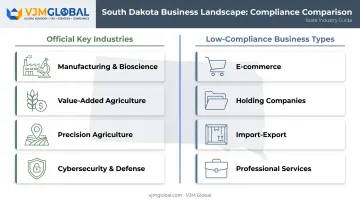
South Dakota's Governor's Office of Economic Development lists these as official key industries:
- Manufacturing and bioscience
- Value-added agriculture and livestock development
- Precision agriculture
- Cybersecurity and defense
Value-added agriculture stands out for foreign-owned businesses. The state actively courts investment in processing, packaging, and export-ready agricultural products.
Beyond the official list, South Dakota's low compliance burden also suits:
- E-commerce and online service businesses that need a US legal presence
- Holding companies structured to own IP or investments
- Import-export operations using South Dakota as a US registration base
- Professional services firms serving American clients remotely
Step-by-Step Process to Start a Business in South Dakota
Formation is straightforward if you follow the sequence below. Most remote filings clear in a few business days once your name, registered agent, and documents are ready.
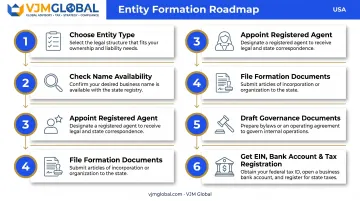
1. Choose Your Entity Type
For Indian founders, an LLC is usually the default choice. It offers liability protection, pass-through taxation, and minimal ongoing paperwork. A corporation makes more sense if you're planning to raise venture capital or issue shares to multiple investors.
Sole proprietorships technically exist but offer zero liability protection. That's a real risk when you're managing a business from another continent and can't quickly respond to legal issues.
2. Check Name Availability
South Dakota's Secretary of State provides a free online search tool. Naming rules are specific:
- LLCs must include "LLC," "L.L.C.," "Limited Liability Company," or similar
- Corporations must include "Corporation," "Incorporated," "Company," "Limited," or an approved abbreviation
3. Appoint a Registered Agent
This is the step Indian founders most often underestimate. South Dakota law requires a registered agent with an actual street address in the state (not a P.O. box). Since you won't have a physical presence there, you'll need a commercial registered agent service, typically costing $100-$300 per year.
4. File Formation Documents
Submit Articles of Organization (LLC) or Articles of Incorporation (corporation) through the Secretary of State's online portal. Online filing costs $150; paper filing adds a $15 processing fee, bringing it to $165.
5. Draft Governance Documents
- LLCs need an Operating Agreement (not filed with the state, but essential for banking and legal clarity)
- Corporations need Bylaws and initial board resolutions
6. Get an EIN, Open a Bank Account, Register for State Taxes
This step is where remote founders hit the most friction. Handle it in three parts:
- EIN: The IRS states that applicants without a US principal place of business cannot use the online EIN application. Apply by phone, fax, or mail. If the responsible party has no SSN or ITIN, enter "foreign" or "N/A" on Form SS-4 line 7b.
- US bank account: Use the EIN plus your formation documents and passport. Non-resident-friendly fintechs and some online banks support video KYC; many traditional banks still expect in-person verification.
- State taxes: South Dakota has no state personal or corporate income tax. If you sell taxable goods or services into the state, register for sales tax with the Department of Revenue; otherwise ongoing state tax filings are minimal.
Registration, Licensing and Compliance Requirements
Registering with the Secretary of State is mandatory for LLCs and corporations. Sole proprietors operating under a name that shows their true surname generally don't need to register, though this exemption is narrower than many assume.
When you'll need additional licenses:
| Situation | Requirement |
|---|---|
| Physical presence in South Dakota | Sales tax license required |
| No physical presence, but revenue over $100,000 in-state | Sales tax license required |
| Certain professions (legal, medical, contracting) | Additional professional licensing |
Sales of tangible goods, digital products, and many services fall under South Dakota's 4.2% state sales tax rate.
Annual reports are due on the first day of your formation anniversary month. Miss it by two months, and you'll face late fees, with continued delinquency risking administrative dissolution. This is a filing that's easy to forget when you're managing compliance across two countries, which is exactly where a local partner earns its keep.
Cost to Register a Business in South Dakota
Here's the South Dakota Secretary of State fee breakdown most founders actually pay:
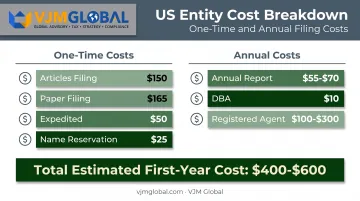
One-time formation costs:
- Articles of Organization/Incorporation (online): $150
- Paper filing: $165
- Expedited processing: additional $50
- Name reservation (120 days): $25
Ongoing annual costs:
- Annual report (online): $55
- Annual report (paper): $70
- DBA filing (if applicable): $10
- Registered agent service: $100–$300/year
State filing fees are only part of the picture for Indian founders. Cross-border setup usually adds professional support in a few areas (fees vary by provider):
- US bank account setup assistance
- Cross-border tax advisory (India FEMA/RBI compliance plus US filings)
- EIN application help for the IRS phone/fax process
Budget roughly $400–$600 for the first year in state fees and registered agent costs, before professional service fees.
How VJM Global Simplifies US Business Formation for Indian Entrepreneurs
Setting up a South Dakota LLC from India means coordinating several moving pieces at once. You need a registered agent, an EIN application that can't go through the standard online path, a US bank account, and ongoing annual filings—while keeping Indian-side tax and FEMA obligations in sync.
VJM Global brings 30+ years in tax, audit, and advisory work, with CPAs and Chartered Accountants who handle US entity formation through each state's own regulators and filing systems.
Support includes:
- Business name availability checks and entity type guidance
- Registered agent coordination
- EIN application handling for founders without a US SSN
- US bank account setup assistance
- Ongoing annual report and compliance filing management
The firm has served 500+ American business owners and maintains a 95% client retention rate.
For founders with operations in both India and the US, VJM Global links US entity compliance with Indian-side FEMA, GST, and ROC filings—so you are not juggling two disconnected advisors across two time zones.
Frequently Asked Questions
How much does it cost to register an LLC in South Dakota?
Online filing costs $150; paper filing is $165. Budget another $55–$70 per year for annual reports, plus third-party registered agent fees if you hire one.
What do you need to do to start your own business in South Dakota?
Choose an entity type, confirm name availability, appoint a South Dakota registered agent, file formation documents, and get an EIN. Then secure any state or local licenses your industry requires.
Do I need to register my business in South Dakota?
LLCs and corporations must register with the Secretary of State. Sole proprietors operating under their true surname usually do not need a separate filing; a trade name (DBA) typically does.
Do I need a business license in South Dakota?
You'll need a sales tax license if you have physical presence in the state, or if your in-state revenue exceeds $100,000 annually without physical presence. Certain professions require additional local or professional licenses.
What is the best business to start in South Dakota?
Value-added agriculture, livestock development, and precision agriculture are officially recognized growth sectors. E-commerce, holding companies, and professional services also work well given the state's low compliance costs.