The confusion is understandable. Indian founders grow up with the Companies Act, 2013, and its Private Limited structure. The US equivalent isn't one entity, it's two: the LLC and the C-Corporation, each suited to different founders and different goals.
This guide walks through what these structures actually mean, the exact registration steps from India, the documents you'll need, how FEMA governs your fund transfers, and the mistakes that trip up most first-time filers.
Key Takeaways
- No US entity is called a "Private Limited Company"; LLC and C-Corp are the closest matches
- Indian nationals can own 100% of a US LLC or C-Corp and register fully remotely, with no visa
- Delaware C-Corps suit VC-backed startups; Wyoming LLCs suit Indian service businesses and consultants
- FEMA governs India-to-US transfers: Liberalised Remittance Scheme for individuals, ODI for companies
- Foreign-owned US entities must file IRS Form 5472/1120 yearly even at zero revenue, or face steep penalties
What Does "Private Limited Company" Mean When Registering in the USA?
Under the Companies Act, 2013, "Private Limited Company" bundles together three things Indian founders take for granted: limited liability, defined shareholders, and a separate legal identity from its owners. In the US, that bundle doesn't come pre-packaged into one entity. It splits across the LLC and the C-Corporation, and picking the wrong one early creates expensive problems later.
Can an Indian company do business in the USA at all? Yes, without restriction. Delaware's General Corporation Law explicitly permits incorporation "without regard to such person's or entity's residence, domicile or state of incorporation". Most other states follow the same principle.
An Indian individual or an existing Indian Pvt Ltd company can both own and run a US entity fully, from India, with no local presence required.
One structure is off the table, though: S-Corp status isn't available to Indian founders. The IRS bars nonresident alien shareholders from S-Corp ownership entirely, so that leaves the LLC and C-Corp as your only real options.
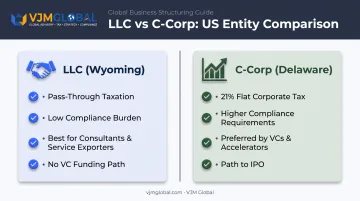
LLC (Limited Liability Company)
An LLC offers pass-through taxation and considerably lighter compliance than a corporation, which makes it the natural fit for:
- Indian consulting firms and freelance service exporters
- Digital agencies billing US clients directly
- Founders not planning to raise outside equity funding
Wyoming is the most common state choice here, thanks to its low filing and annual costs. A foreign-owned single-member LLC is treated as a "disregarded entity" for US tax purposes, meaning the LLC itself doesn't pay federal income tax.
Don't mistake "disregarded" for "ignored." The IRS still requires annual reporting on that entity, which we'll cover shortly.
C-Corporation
Structurally, the C-Corp is the closest match to an Indian Pvt Ltd: a separate legal entity with shareholders, a board of directors, and issued stock. Choose this structure if you plan to:
- Raise capital from US investors or VCs
- Apply to a US accelerator
- Pursue an IPO or public listing later
Most US VCs won't invest in an LLC at all.
The federal corporate tax rate for C-Corps is a flat 21%, set under the 2017 Tax Cuts and Jobs Act. Delaware remains the dominant incorporation state for C-Corps, largely because investors, lawyers, and accelerators are already familiar with its corporate law and court system.
Step-by-Step: How Indian Businesses Can Register a Private Limited Company (LLC/C-Corp) in the USA
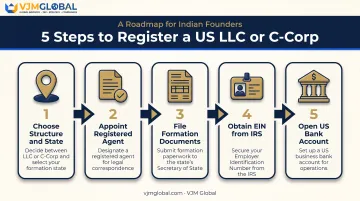
Step 1: Choose the Structure and State
Decide between LLC and C-Corp based on your funding plans and tax strategy before you file anything. Switching structures later means dissolving one entity and forming another, with real legal cost attached.
State choice matters nearly as much. Delaware and Wyoming are the two most common picks for non-resident founders:
| Factor | Delaware | Wyoming |
|---|---|---|
| LLC formation fee | $110 | $100 |
| Corporation formation fee | $109 minimum (varies with stock) | $100 |
| Annual LLC charge | $400 flat tax | Greater of $60 or 0.0002% of assets |
| Annual corporation charge | $50 report fee + $175/$400 minimum franchise tax | Greater of $60 or 0.0002% of assets |
| Investor familiarity | High (default for VC-backed startups) | Lower (better for bootstrapped businesses) |
Wyoming wins on ongoing cost. Delaware wins on investor recognition. Pick based on where your business is actually headed.
Step 2: Appoint a Registered Agent
Every US state legally requires a registered agent, an entity with a physical US address that can receive legal and tax documents on your company's behalf. This isn't optional paperwork; without one, the state won't process your filing, and for Indian founders without any US presence, it's non-negotiable.
Published registered agent fees typically range from $25 to $125 per year, depending on the provider and the level of service bundled in (mail forwarding, compliance alerts).
Step 3: File Formation Documents
- LLCs file Articles of Organization with the Secretary of State
- C-Corps file a Certificate of Incorporation instead
Both can be filed online directly or through a formation service. Don't stop at the state filing, though.
Draft your Operating Agreement (LLC) or Bylaws and shareholder resolutions (C-Corp) early. Banks and investors will ask for these before they work with you—scrambling later only slows the process.
Step 4: Obtain an EIN from the IRS
This step trips up more Indian founders than any other. Your EIN (Employer Identification Number) is your company's tax ID, and you need it to open a bank account, hire, or file taxes. The problem: the IRS's online EIN portal requires a US Social Security Number or ITIN, which most Indian founders don't have.
Without one, you have three options:
- Call the IRS International line at 267-941-1099 (not toll-free), available 6:00 a.m. to 11:00 p.m. Eastern, Monday through Friday
- Fax a completed Form SS-4 to 304-707-9471
- Mail Form SS-4 to the IRS's EIN International Operation in Cincinnati, Ohio
On the form itself, an ineligible responsible party enters "foreign" or "N/A" on line 7b instead of an SSN.
This is where a lot of founders get stuck on hold or send an incomplete form back and forth for weeks. Specialist firms familiar with cross-border formation, such as VJM Global (New York and Noida), handle registered agent appointment and EIN applications for Indian founders end-to-end. You avoid IRS phone queues from a different time zone.
Step 5: Open a US Business Bank Account
Traditional US banks still often require an in-person branch visit to open a business account—a real obstacle when you're filing from Mumbai or Bangalore.
Fintech banking platforms have largely closed this gap. They accept remote applications from non-resident Indian founders who can provide:
- Formation certificate
- EIN confirmation letter
- Identity verification
Compare a few options before committing. Fees and verification timelines vary considerably.
Documents and Eligibility Checklist for Indian Founders
The good news: forming a US entity from India requires far less paperwork than incorporating in India itself.
Eligibility at a glance:
- Non-US residents and non-citizens can form a US company (LLC or C-Corp)
- No US SSN, ITIN, or visa is required to incorporate
- You must appoint a registered agent with a physical address in the state of formation
- At least one director or member is enough in most states—no local US partner required
For an individual founder, you'll typically need:
- A notarised or apostilled copy of your passport
- Proof of your Indian residential address
- A recent photograph for company filing records
For an existing Indian Pvt Ltd company investing as a shareholder, add:
- Certificate of incorporation of the Indian entity
- A board resolution specifically approving the US investment
What you don't need:
- A US Social Security Number (SSN)
- An ITIN at the time of incorporation
- A physical US address or office of your own
The only mandatory US address is your registered agent’s—a paid service, not a place you need to live.
Tax, Compliance and Cross-Border Fund Transfer Rules for Indian Owners
This is the section where most DIY registrations go wrong, not at incorporation, but afterward.
Funding the Entity from India
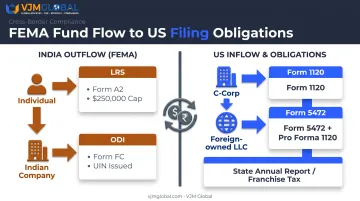
If you're an individual funding your US company, the transfer must go through an Authorised Dealer bank under FEMA's Liberalised Remittance Scheme (LRS). You'll complete Form A2 with your PAN details, and the transfer counts against your annual LRS cap of USD 250,000 per person.
If an existing Indian company is investing rather than an individual, LRS doesn't apply. The transfer falls under FEMA's Overseas Direct Investment (ODI) framework instead. Your designated AD bank files Form FC with the RBI before the first remittance so a Unique Identification Number can be issued.
US Filing Obligations You Can't Skip
- C-Corps must file Form 1120 every year, whether or not the company earned a rupee (or dollar) of income
- Foreign-owned single-member LLCs must file Form 5472 alongside a pro forma Form 1120 whenever a reportable transaction occurs, including at formation
Miss Form 5472 and the penalty starts at a flat $25,000 fine, with another $25,000 added for every 30-day period you remain non-compliant after an IRS notice. Zero revenue does not mean zero filing obligation, and this is the single most expensive misunderstanding among first-time founders.
State-Level Obligations
- Delaware: Corporations owe a $50 annual report fee plus a minimum $175–$400 franchise tax, due March 1. LLCs owe a flat $400 annual tax, due June 1.
- Wyoming: Both entity types owe the greater of $60 or 0.0002% of in-state assets, due on the anniversary month of formation.
Miss these deadlines repeatedly, and the state can administratively dissolve your entity, which then complicates everything from banking to future fundraising.
Treaty Relief
The US-India Double Taxation Avoidance Agreement (DTAA) reduces the risk of paying tax twice on the same business profits. That protection matters most once your US entity generates revenue and cross-border profit flows begin.
VJM Global supports Indian founders with FEMA and ODI advisory, Form 5472 compliance, and DTAA-based tax structuring across both jurisdictions.
Common Mistakes Indian Businesses Should Avoid
A few missteps show up repeatedly when Indian founders set up in the US. Steer clear of these:
- Choosing a structure without future funding in mind. Founders often pick an LLC for simplicity, then find target investors will not touch it. Reincorporating mid-fundraise wastes time and legal fees.
- Sending money informally. Wiring funds to the US entity without proper LRS or ODI routing creates FEMA exposure in India and IRS questions in the US about where the capital came from.
- Assuming zero revenue means zero filings. A dormant US entity still owes its annual state report and, for foreign-owned structures, Form 5472. Many founders learn this only after a penalty notice.
- Confusing ownership with the right to work in the US. Owning and running a US entity from India is legal. Working physically in the US needs a separate visa; incorporation grants none of that.
Frequently Asked Questions
Can an Indian company do business in the USA?
Yes. US incorporation law places no restriction on foreign ownership or residency, so Indian individuals and Indian companies can both fully own and operate a US entity without any local presence requirement.
What is a private limited company in the US?
There's no such entity in US law. Indian founders should think of the LLC or C-Corporation as the closest structural equivalents, since both offer limited liability and a separate legal identity.
Which is better for an Indian founder — LLC or C-Corp?
A Wyoming LLC suits Indian service businesses and consultants who want low compliance and pass-through taxation. A Delaware C-Corp suits startups planning to raise US venture capital or eventually go public.
Do I need to visit the USA to register my company?
No. Formation, registered agent appointment, and EIN application can all be completed remotely from India. Some bank account openings may still require an in-person visit.
How do I legally transfer funds from India to fund my US company?
Individuals must use the LRS route through an Authorized Dealer bank with Form A2 and their PAN. Indian companies investing as a shareholder must instead follow the ODI route under FEMA.
What compliance is required after the US company is formed?
Expect annual IRS filings (Form 1120 for C-Corps, Form 5472 for foreign-owned LLCs), plus state annual reports and franchise tax. Owners also face ongoing FEMA reporting obligations back in India.