The good news: US law places no restrictions on foreign ownership of American companies. An Indian national living in India can legally form and operate a US business without ever boarding a flight to New York.
The complexity lies elsewhere — in choosing the right structure, understanding visa boundaries, moving money across borders legally, and keeping up with US compliance obligations that don't pause just because the company has no revenue yet.
This guide walks through every stage of that process, specifically for Indian founders.
Key Takeaways
- Indian nationals can register a US LLC or C-Corp entirely from India — no visa or US visit required to incorporate
- C-Corps (Delaware) suit VC-backed startups; LLCs (Wyoming) suit leaner, service-based operations
- India is not an E-2 treaty country, so the most common entrepreneur visa is unavailable to Indian nationals
- Fund transfers from India to your US company fall under LRS/FEMA rules, with an annual cap of USD 250,000
- Foreign-owned US LLCs must file Form 5472 with a pro forma Form 1120 each year; missing this filing triggers a $25,000 IRS penalty
Can an Indian National Start a Business in the USA?
Yes — straightforwardly and legally. Delaware's General Corporation Law explicitly permits incorporation by any person "without regard to such person's or entity's residence, domicile or state of incorporation." The same principle applies to LLCs. Foreign ownership of US entities is unrestricted.
Formation vs. Working in the US
This distinction is the one most Indian founders get wrong:
- Forming a US company — requires no visa, no US address, no US citizenship
- Working inside the US for that company — requires a valid US work visa
Many Indian founders run their US entities entirely from India. They handle sales, operations, and strategy without ever needing to relocate. The visa question only becomes relevant when a founder wants to physically work on US soil.
Three Practical Requirements
To get the company operational, every Indian founder needs:
- A registered agent with a US address (legally mandatory in every state)
- An EIN (Employer Identification Number) from the IRS — the business equivalent of a tax ID
- A US business bank account — achievable remotely through fintech platforms, though some traditional banks still require an in-person visit
The bank account is the one step that requires the most effort for non-residents — everything else clears without a US visa.
Choosing the Right Business Structure: LLC vs. C-Corp
Two structures are available to Indian founders: the LLC and the C-Corporation. S-Corps are off the table entirely — the IRS explicitly bars nonresident alien shareholders from S-Corp ownership.
LLC: Simpler, Lower Cost, Better for Services
An LLC works well when:
- The business is a consulting firm, agency, or service provider
- You're not planning to raise VC or angel funding
- You want minimal compliance overhead
- Pass-through taxation fits your structure (profits flow to the owner's personal return)
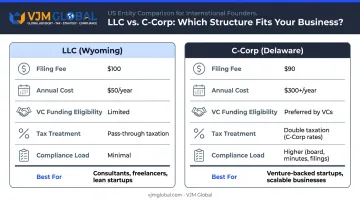
Wyoming is the popular LLC state for Indian founders — a $100 filing fee, $60 annual license tax (or 0.02% of Wyoming assets, whichever is greater), and minimal ongoing requirements.
One tax note: a foreign-owned single-member LLC is treated as a disregarded entity for US tax purposes, but it carries IRS reporting obligations covered in the compliance section below.
C-Corp: The VC-Ready Structure
A C-Corp is the right choice when:
- You're building a venture-backed startup
- You plan to issue stock options or bring on US investors
- You want accelerator eligibility (Y Combinator and most US accelerators require C-Corp structure)
- An eventual IPO is on the roadmap
Delaware dominates here — 66.7% of Fortune 500 companies and 81.4% of US-based IPOs in 2024 chose Delaware as their corporate home. The minimum filing fee is $109, with an annual franchise tax starting at $175.
C-Corps pay a flat 21% federal corporate tax rate on taxable income. The US-India Double Taxation Avoidance Agreement (DTAA) provides some relief through its Article 7 provisions, which address business profits and permanent establishment rules. The actual tax outcome for any founder depends on their individual circumstances and requires a CPA or tax advisor review.
Quick Comparison
| Factor | LLC (Wyoming) | C-Corp (Delaware) |
|---|---|---|
| Filing fee | $100 | $109+ |
| Annual cost | $60+ | $175+ franchise tax |
| VC funding | Not preferred | Required by most investors |
| Tax treatment | Pass-through | 21% flat corporate rate |
| Compliance load | Low | Moderate–High |
Visa and Immigration Options for Indian Entrepreneurs
One detail most generic guides overlook: India is not an E-2 Treaty Investor country. The E-2 visa — frequently cited as the go-to path for entrepreneur-immigrants — is simply not available to Indian nationals, which makes it irrelevant for most founders reading this.
If you want to physically work in the US for your business, these are the realistic options:
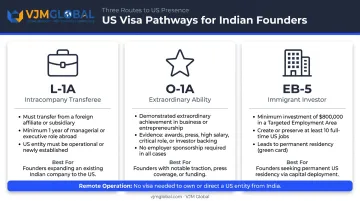
L-1A (Intracompany Transferee)
Best for founders who already run an Indian company and want to set up a US subsidiary.
- Requires at least one continuous year of employment with the Indian entity within the preceding three years
- The founder must be transferring in a managerial or executive capacity
- Practical path: establish the Indian entity first, operate it for a year, then open the US subsidiary and transfer
O-1A (Extraordinary Ability)
For founders with demonstrable national or international recognition in their field.
- Evidence can include major awards, published research, media coverage, judging panels, speaking at significant conferences, or high compensation relative to peers
- No investment requirement — but the "extraordinary ability" bar is genuinely high and requires careful petition preparation
EB-5 (Immigrant Investor)
A permanent residency pathway, not a temporary visa.
- Standard investment: $1,050,000; in a Targeted Employment Area: $800,000
- Must create or preserve at least 10 full-time US jobs
- India's EB-5 backlog is significant. The June 2026 Visa Bulletin shows a Final Action Date of May 1, 2022 for unreserved India categories — meaning multi-year wait times are realistic
The Remote Operation Option
Most Indian founders don't start with a visa at all. They incorporate the US entity, operate it remotely from India, and revisit relocation only once the business justifies it. This is a legitimate, widely-used path:
- No US visa required to own or direct a US LLC or C-Corp from India
- Revenue can be earned, invoiced, and received through the US entity
- Founders apply for a visa later — typically L-1A or O-1A — once operations are established
For visa-specific guidance, consult a qualified US immigration attorney. Visa eligibility depends on individual circumstances.
How to Start a US Business from India: Step by Step
Most steps in this process are completed entirely online. Two areas require extra attention: the EIN application for non-residents and cross-border fund transfer compliance under FEMA.
Step 1 – Choose Your Structure and State
Make this decision before filing anything. Switching structures after incorporation involves legal costs and paperwork. Use the LLC vs. C-Corp comparison above as your starting framework, then confirm with a tax advisor.
Make this decision before filing anything — switching structures after incorporation involves legal costs and paperwork. Use the LLC vs. C-Corp comparison above as your starting framework, then confirm with a tax advisor.
Key factors that shape this decision:
- Tax treatment: LLCs default to pass-through taxation; C-Corps are taxed at the entity level
- Investor expectations: Venture-backed startups typically require a C-Corp (usually Delaware)
- Operational simplicity: LLCs have fewer compliance requirements and no mandatory board structure
- State selection: Wyoming and Delaware are the most common choices for non-resident founders
Step 2 – Appoint a Registered Agent
Every US state requires a registered agent — a US-based person or service that receives legal documents on behalf of your company. For Indian founders without a US address, this is non-negotiable.
Registered agent services typically cost $50–$436 per year, depending on the provider:
- Harvard Business Services — ~$50/year for Delaware
- Northwest Registered Agent — $125/year for Wyoming
Step 3 – File Formation Documents
- LLC: File Articles of Organization with the Secretary of State
- C-Corp: File a Certificate of Incorporation
Both can be filed online or through a formation service. Filing fees: $100 in Wyoming, $109 minimum in Delaware.
You don't always need to file an Operating Agreement (LLC) or Bylaws and shareholder resolutions (C-Corp), but banks and investors will ask for them. Draft these before you open a bank account.
Step 4 – Obtain an EIN
An EIN is required for banking, hiring, and tax filing. It's free from the IRS — but non-residents face a specific obstacle.
The problem: Indian founders without a US SSN or ITIN cannot use the IRS online EIN application. That portal requires a US-based responsible party with a valid US taxpayer identification number.
The solution:
- Phone: Call the IRS International line at 267-941-1099, Monday–Friday, 6 a.m.–11 p.m. Eastern Time
- Fax/Mail: Submit Form SS-4 by fax to 304-707-9471 or mail to IRS EIN International Operation, Cincinnati, OH 45999
- On Form SS-4, if the responsible party has no SSN or ITIN, write "foreign" or N/A in the relevant field
Phone is fastest — you typically receive the EIN on the same call.
Step 5 – Open a US Business Bank Account
Traditional banks like Chase generally require in-person branch visits for business account opening. That's a real barrier for founders based in India.
The practical alternatives:
- Mercury — accepts US companies with founders worldwide; no US citizenship or residency requirement
- Relay — accepts US-registered businesses owned by non-US residents with required documentation
Some founders make a short US trip specifically to open a bank account at a traditional bank, which also allows them to meet potential partners or customers in the process.
Step 6 – Transfer Capital Under LRS Compliance
This is where many Indian founders make a costly mistake. Sending money from India to fund your US company isn't as simple as a wire transfer.
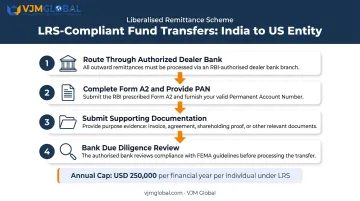
Under India's Foreign Exchange Management Act (FEMA), Indian residents can remit up to USD 250,000 per financial year under the Liberalized Remittance Scheme (LRS).
Permitted uses include opening foreign currency accounts, purchasing property abroad, and making investments in overseas entities.
The compliance process:
- Route the transfer through an Authorized Dealer bank in India
- Complete Form A2 and provide your PAN
- Provide supporting documentation (company formation documents, investment rationale)
- The bank conducts due diligence before processing
Amounts above the USD 250,000 limit, or transfers that don't fall within permitted categories, require RBI approval. Sending funds informally — without proper documentation — creates tax and compliance exposure in both India and the US.
Ongoing Compliance for US Businesses Owned by Indian Nationals
Forming the company is the easy part. Keeping it compliant is where Indian founders often get surprised.
IRS Filing Requirements
Even if your US company has zero revenue, filing obligations may still apply:
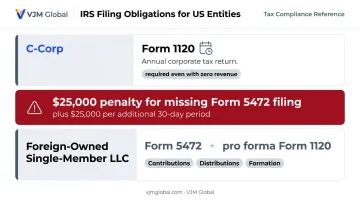
- C-Corps: Must file Form 1120 (US Corporation Income Tax Return) annually, whether or not the company has taxable income
- Foreign-owned single-member LLCs: Must file Form 5472 (Information Return of a 25% Foreign-Owned US Corporation) along with a pro forma Form 1120 when reportable transactions occur — and "reportable transactions" includes contributions, distributions, and even the initial formation of the entity
The penalty for failing to file Form 5472: $25,000. An additional $25,000 applies for each 30-day period after 90 days from IRS notice. This is one of the most common and expensive surprises for first-time foreign founders.
State-Level Obligations
| Requirement | Delaware C-Corp | Wyoming LLC |
|---|---|---|
| Annual report deadline | March 1 | Anniversary month |
| Annual fee | $50 report + $175+ franchise tax | $60 license tax |
| Late penalty | $200 + 1.5% monthly interest | Administrative dissolution |
Non-compliance doesn't just mean fines — states can administratively dissolve your company without prior warning.
Working with Cross-Border Compliance Experts
Between Form 5472 penalties, state dissolution risks, and Indian tax reporting obligations, the compliance load across two jurisdictions adds up fast. VJM Global, with offices in New York and Noida, works with Indian founders on US federal filings, state annual reports, IRS documentation, and FEMA advisory — so nothing falls through the cracks on either side of the equation.
Conclusion
Starting a US business from India is entirely achievable, and the registration process itself is straightforward. Most of the real work happens in the decisions you make before filing: which structure, which state, how you'll fund the company, and whether you eventually plan to relocate.
Most compliance failures trace back to the same mistakes: moving money informally, missing Form 5472, or assuming an inactive company has no filing obligations. These aren't obscure rules — they're the issues that turn an otherwise clean setup into a costly problem.
Before you file, make sure you've thought through:
- Entity type — LLC vs. C-Corp based on your funding and tax goals
- State selection — Delaware and Wyoming for most; your operating state if you have local presence
- Banking and fund transfers — proper documentation from day one, not retroactively
- Annual compliance — state reports, federal filings, and IRS obligations even if revenue is zero
Getting this right from the start is what keeps a US entity an asset rather than a liability. If you're navigating the cross-border tax and compliance side — especially Form 5472, FEMA considerations, or structuring for eventual relocation — working with advisors experienced in both Indian and US regulations is worth the investment.
Frequently Asked Questions
Can foreigners start a business in the USA?
Yes. Foreign nationals, including Indian citizens, can own 100% of a US LLC or C-Corp with no residency or citizenship requirement. Delaware law allows anyone to incorporate regardless of where they live or hold citizenship.
Can Indian nationals register a US company without visiting the USA?
The entire formation process — filing, registered agent appointment, and EIN application — can be completed remotely from India. Opening a US business bank account may require a brief visit at traditional banks. Fintech options like Mercury and Relay, however, accept non-resident founders without in-person requirements.
Which business structure is better for Indian founders — LLC or C-Corp?
It depends on your goals. A Delaware C-Corp is the standard for startups seeking VC funding or accelerator participation. A Wyoming LLC works better for service businesses, consultants, or founders who want lower compliance costs and aren't planning to raise institutional capital.
Do Indian citizens need a visa to start and run a US business?
No visa is needed to form a US company or manage it from India. A valid US work visa is only required if the founder intends to physically work inside the US. The E-2 investor visa is also off the table for Indian nationals — India does not have an E-2 treaty with the US.
How do I transfer money from India to fund my US business?
Transfers must go through an Authorized Dealer bank under India's LRS (FEMA), using Form A2 and your PAN. The annual limit is USD 250,000 per financial year. Anything above this threshold or sent through informal channels carries serious legal and tax consequences in both countries.