Interest is being driven by several factors: many sectors permit full foreign ownership, English is the official language, and ECOWAS membership offers regional market access. The National Investment Board (NIB) also runs incentive programmes for qualifying investors.
The people looking into this range widely — importers and exporters, mining and agribusiness investors, diaspora entrepreneurs, and SMEs hunting for their next market. This guide walks UK residents and companies through the legal steps of registering and operating a business in Sierra Leone.
TL;DR
- Most sectors in Sierra Leone allow full foreign ownership, though some legally require a local partner
- Register through OARG (Office of the Administrator and Registrar General); confirm current timelines before planning
- Budget for registration, a Tax Identification Number (TIN), municipal licensing, and any sector-specific permits
- Mining, agriculture, fisheries, and tourism are priority growth sectors
- Local professional support reduces delays on licensing, banking, and compliance
What Is Involved in Starting a Business in Sierra Leone from the UK?
Starting a business in Sierra Leone from the UK means setting up a legally recognised business entity there while you remain based in, or manage operations from, the UK.
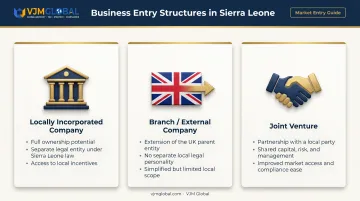
In practice, this usually takes one of three forms:
- Locally incorporated company — a private company registered in Sierra Leone under the Companies Act, wholly or partly foreign-owned
- Branch/external company — a UK company extending its operations into Sierra Leone rather than forming a new local entity
- Joint venture — partnering with a Sierra Leonean party, often structured through a locally incorporated company or a contractual arrangement
The best route depends on your ownership goals, liability exposure, and whether you will have someone on the ground or manage everything remotely.
Most UK founders start with a locally incorporated company. It offers the clearest path to full ownership in eligible sectors.
What to Know Before You Start a Business in Sierra Leone
Many UK founders underestimate how much in-country presence and follow-up is needed once the paperwork is filed. Treat the points below as practical constraints on time, people, and capital — not a verdict on whether the market fits your venture.
Plan for these realities early:
- Time and travel: Some tasks can be handled remotely with a local agent. Bank verification, site visits, and certain licensing steps usually need someone on the ground.
- Local support: Core registration is paper-based and done in-country. Without a local agent, lawyer, or registered office provider, moving documents through OARG is slow and unreliable.
- Timeline to revenue: Incorporation can move relatively quickly once documents are complete. Sector licensing, banking, and staffing typically take months, not weeks.
Other questions worth asking yourself early:
- Does the model need specialised sector knowledge (for example mining or agriculture), or is it general trading and import-export?
- Is this a short trading play, or a longer-term investment that needs larger capital and infrastructure?
- Can you fund travel, a local representative, and several months of setup costs before revenue starts?
Why Start a Business in Sierra Leone? (When It Makes Sense)
This section sets out when entering Sierra Leone is a sound decision for UK founders, and when the case is weaker.
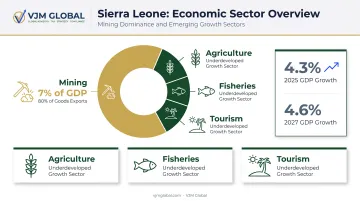
Growth is real, but concentrated. The World Bank projected 4.3% real GDP growth for Sierra Leone in 2025, rising to 4.6% by 2027, driven by agriculture, mining expansion, and resilient services.
The same report flags constraints around finance, land, electricity, skills, and macroeconomic stability. Treat growth as something to validate, not a guarantee.
Sector concentration favours specialists. Mining alone accounts for roughly 7% of GDP and 80% of goods exports, according to IMF data. Agriculture, fisheries, and tourism remain comparatively underdeveloped, which means less competition for founders who understand those industries.
Regional trade access, with conditions. ECOWAS membership can offer preferential treatment for qualifying Sierra Leone-origin goods, but this isn't automatic. Goods must satisfy origin rules and, in many cases, go through a national approval process before preferential tariffs apply.
Investment incentives exist, but confirm them in writing. The National Investment Board (NIB) publishes sector-based tax and customs concessions for priority sectors like agriculture, tourism, energy, and manufacturing. Terms vary and should be confirmed directly with NIB and the National Revenue Authority (NRA) before you build them into a financial model.
English as the working language removes a communication barrier many UK founders face elsewhere in West Africa. Contracts, regulatory correspondence, and day-to-day business are conducted in English.
Early Decisions That Matter When Starting a Business in Sierra Leone from the UK
Most early-stage problems come from underestimating regulatory and logistical complexity. A few decisions matter more than founders expect:
- True setup costs. Registration fees, licensing, and a registered office or local agent push the real bill well above the headline incorporation fee.
- Currency exposure. The leone has stabilised recently, but thinner external buffers leave pricing and profit repatriation exposed to shocks—model more than one exchange-rate scenario.
- Structure choice. A locally incorporated company, branch, or joint venture changes ownership rights and liability. Confirm the route with Sierra Leone counsel before you file.
- Sector licensing. Mining, fisheries, and tourism need extra permits that can add weeks or months beyond basic incorporation.
- Local advisor support. If you cannot be on the ground full-time, a reliable local advisor is essential. Weak local support is a common reason applications stall.
How to Start a Business in Sierra Leone from the UK – Step by Step
These seven stages walk a UK-based founder through structure choice, incorporation, tax, licensing, banking and ongoing compliance. Common mistakes include registering without a local agent, skipping sector licensing entirely, and underestimating what banks will require before opening an account.
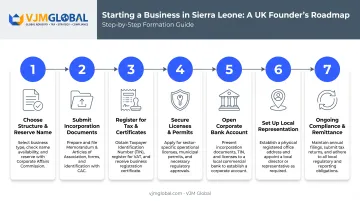
Step 1 – Choose Your Business Structure and Reserve a Name
Decide between a locally incorporated company, branch office, or joint venture based on your ownership goals and appetite for liability. Then conduct a name search and reservation with OARG.
Common miss: choosing a structure without understanding its tax and compliance implications down the line.
Step 2 – Prepare and Submit Incorporation Documents
Draft the Memorandum and Articles of Association, list director and shareholder details, and confirm a registered office address. Documents are submitted physically at OARG, usually via a local agent, since UK founders can't always be present.
Common miss: assuming this can be done entirely online. Submission is paper-based and requires in-country coordination.
Step 3 – Register for Tax and Obtain Statutory Certificates
Once incorporated, obtain your Certificate of Incorporation and Tax Identification Number (TIN) from the NRA. If you plan to hire locally, register with NASSIT for social security contributions.
Common miss: delaying TIN registration. It blocks both banking and further licensing, so treat it as urgent, not optional.
Step 4 – Secure Business Licenses and Sector-Specific Permits
Apply for a municipal business licence through Freetown City Council if operating in the capital, plus any sector permits your business needs. Mining, fisheries, and tourism ventures typically need sign-off from bodies like the Ministry of Mines or the Environmental Protection Agency.
Common miss: assuming incorporation alone authorises full operations. It doesn't.
Step 5 – Open a Local Corporate Bank Account
Gather your Certificate of Incorporation, board resolution, director ID, proof of address, and TIN. Sierra Leonean banks may require an initial deposit and in-person verification. Confirm exact requirements with your chosen bank early.
Common miss: leaving banking setup until operations are meant to start. Build this into your timeline from day one.
Step 6 – Set Up Local Representation and Operations
Decide whether you'll appoint a local director or agent, use a registered office service, or rotate UK staff through the country periodically. Factor Sierra Leone's developing infrastructure into your supply chain and staffing plans.
Common miss: trying to manage everything remotely without any trusted local presence.
Step 7 – Understand Ongoing Compliance and Remittance Rules
Track your statutory filing obligations, annual returns, and tax deadlines. Understand the current foreign exchange process for repatriating profits — NIB recognises repatriation as an investor right, but the documentary process runs through the Bank of Sierra Leone and your bank, and should be confirmed before you invest.
Common miss: focusing entirely on setup and neglecting compliance once trading actually begins.
How VJM Global Can Support Your Sierra Leone Market Entry
Cross-border entity formation needs market knowledge most UK founders do not hold in-house, especially in a regulatory environment as layered as Sierra Leone's.
VJM Global delivers entity formation, tax, and compliance services across markets that include Ghana, Kenya, Nigeria, and South Africa. That regional experience with how registrars, tax authorities, and sector regulators work across West and sub-Saharan Africa informs advice for UK businesses entering frontier markets such as Sierra Leone.
Having supported 250+ UK businesses with international expansion, VJM Global helps coordinate the practical steps:
- Liaising with local regulators on filings and approvals
- Preparing statutory documentation for incorporation and tax registration
- Managing ongoing compliance once the business is trading
For founders who cannot be on the ground full-time, that coordination keeps applications moving and day-to-day obligations covered after launch.
Conclusion
Starting a business in Sierra Leone from the UK is achievable when you prioritise preparation over speed. Get structure, licensing, and local representation right before you file; rushing the paperwork rarely pays off.
Let costs, timelines, and compliance obligations drive your decisions. Once you are trading, keep a reliable local presence and review those obligations on a set schedule rather than treating incorporation as a one-off task.
VJM Global supports UK businesses with entity formation, tax compliance, and ongoing governance across African and other international markets, so you can move from setup into operations with a clear compliance path.
Frequently Asked Questions
How much does it cost to register a company in Sierra Leone?
Costs include a name search fee, OARG registration fee, and TIN registration, plus any charges from a corporate service provider handling filings on your behalf. Current fee schedules should be confirmed directly with OARG, as published figures change.
How much money do you need to live in Sierra Leone?
Living costs vary significantly depending on whether you're based in Freetown or elsewhere, and your expected standard of accommodation. Get a current, dated cost estimate from a local advisor before budgeting for extended stays.
Which business is most profitable in Sierra Leone?
Mining remains the largest sector by export value, followed by agriculture, agro-processing, and fisheries, all comparatively underdeveloped relative to demand. Profitability ultimately depends on your sector expertise and access to capital.
Do British citizens need a visa for Sierra Leone?
Entry requirements can change, so check the current GOV.UK Sierra Leone travel advice page before booking travel. Don't rely on older guidance, as visa rules are updated periodically.
How long does it take to register a business in Sierra Leone?
Basic OARG incorporation can move relatively quickly once documents are complete, but this excludes tax registration, licensing, and sector permits. Confirm current processing times directly with OARG or a local agent before setting expectations.
Can a UK citizen fully own a company in Sierra Leone?
Most sectors permit 100% foreign ownership under Sierra Leone's investment framework, though some sectors legally require a local partner. Confirm your specific sector's ownership rules with NIB (National Investment Board) or Sierra Leone counsel before proceeding.