More UK-based founders are looking at Nigeria today than at any point in the past decade. The reasons are practical: a young, digitally engaged population, 100% foreign ownership permitted in most sectors, and strong diaspora ties that make market entry feel less foreign than it looks on paper.
Interest comes from three distinct groups: Nigerian diaspora professionals in the UK who understand the market instinctively, UK entrepreneurs chasing genuine growth outside saturated Western markets, and established UK companies wanting a formal Nigerian presence rather than ad-hoc exports.
This guide walks through registration, compliance, banking, and the practical realities of building a Nigerian company from a UK base—without skipping the parts that usually trip people up.
TL;DR
- 100% foreign ownership is permitted in most sectors, registered via the Corporate Affairs Commission (CAC)
- ₦100,000,000 has been the usual foreign-participation threshold; confirm the current figure in writing with CAC
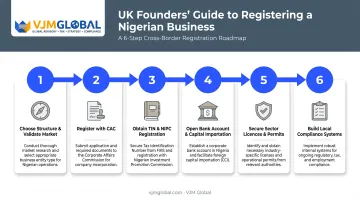
- Core steps: choose structure, register with CAC, get a TIN, register with NIPC, open a bank account, handle capital importation
- Local professional support cuts registration delays and compliance risk
- Ongoing compliance (tax filings, CAC returns, FX rules) matters as much as incorporation itself
What Does Starting a Business in Nigeria from the UK Involve?
In plain terms: setting up and legally operating a Nigerian-registered company while managing it, wholly or partly, from the UK.
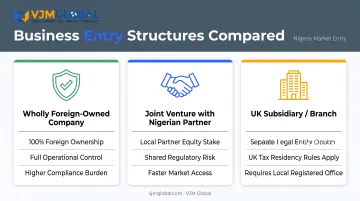
The work covers company incorporation, tax and regulatory registration, banking, and the ongoing compliance that keeps the business legal and bankable. Three common formats exist:
- Wholly foreign-owned private company — full control, no local shareholder requirement in most sectors
- Joint venture with a Nigerian partner — useful for regulated or relationship-driven sectors
- UK company subsidiary or branch presence — extends an existing UK entity into Nigeria
What to Know Before You Start a Business in Nigeria from the UK
Many UK-based founders underestimate two things: the regulatory layering, and the effort of managing filings remotely. Get those expectations right before you commit time and capital.
Remote Coordination Is the Real Challenge
CAC registration happens largely online through the iCRP portal, but NIPC registration, banking KYC, and sector licensing often need someone physically present in Nigeria. That means:
- Reliance on local solicitors, accountants, or formation agents for on-ground steps
- Timelines stretching beyond CAC's official targets once banking and licensing enter the picture
- Early decisions on Nigerian directors, a registered local address, or in-country staff
Letterbox Registration vs. a Trading-Ready Entity
A Certificate of Incorporation is not the same as a business that can bank, invoice, and repatriate profit. Plenty of foreign-owned Nigerian companies exist on paper only, stalled at the NIPC or banking stage. A properly compliant entity has:
- A registered TIN and active FIRS filing status
- Completed NIPC registration
- A functioning corporate bank account with capital importation documented
Why Start a Business in Nigeria from the UK? (When It Makes Sense)
This isn't a guaranteed win. It makes sense under specific conditions.
Nigeria's economy was valued at roughly $290.79 billion in 2025, with a population approaching 237.5 million—41% of whom are under 14. That's a demand runway most European markets can't match, particularly in payments, education, and entry-level consumer goods.
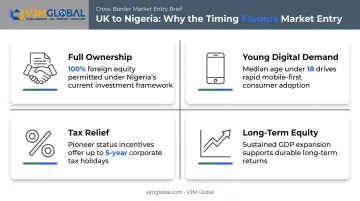
Conditions favouring entry:
- Full ownership: 100% foreign ownership is allowed in most sectors, with profit repatriation protected once a Certificate of Capital Importation is on file
- Young digital demand: A large under-14 population is driving fintech, e-commerce, and mobile-first services
- Tax relief: The 1987 UK–Nigeria Double Taxation Agreement remains active; EDTI adds a 5% tax credit on qualifying capital expenditure in eligible sectors
- Long-term equity: Build ownership in an early digital-growth market instead of only renting access through exports
None of this removes the compliance burden. It just means the upside can justify it.
Early Decisions That Matter When Registering in Nigeria from the UK
Most early-stage problems come from underestimating Nigeria's regulatory layers, not from a lack of effort. Founders who plan for this upfront move faster.
Areas commonly overlooked:
- True costs: Confirm the widely quoted ₦100,000,000 foreign-owned minimum capital in writing before fixing issued capital; its status is unsettled after recent CAC and Ministry of Interior changes. Budget separately for CAC fees and 0.75% stamp duty on share capital
- Structure: A private limited company suits most founders; joint ventures or branches fit some regulated sectors better
- Sector licences: Fintech needs CBN approval, food and drugs need NAFDAC, and telecoms need NCC clearance. Incorporation alone grants none of these
- FX and capital importation: Capital must enter through a CBN-authorised dealer and be documented with an electronic Certificate of Capital Importation (eCCI)
- Local filing support: Without someone on the ground managing filings, timelines slip badly
How to Start a Business in Nigeria from the UK – Step by Step
This breaks the process into stages a UK-based founder can realistically follow. The most common mistakes are easy to avoid if you plan for them up front:
- Skipping NIPC registration
- Underestimating share capital requirements
- Ignoring FX and repatriation rules until money is already stuck
Step 1 – Choose Your Business Structure and Validate the Nigerian Market
Decide between a private limited company, joint venture, or branch presence based on your sector and risk tolerance. Research demand, competition, and pricing specific to Nigeria, not assumptions carried over from the UK market.
Common miss: assuming a UK business model transfers directly. Pricing, payment behaviour, and distribution channels in Nigeria often need genuine local adaptation, not translation.
Step 2 – Register with the Corporate Affairs Commission (CAC)
Reserve a company name online through iCRP, then submit your Memorandum and Articles of Association (MEMART), director and shareholder details, and registered office address. CAC's published service targets are 4 working hours for name availability and 24 working hours for full registration, once documents are complete.
Foreign-owned companies have commonly worked to a ₦100,000,000 minimum issued share capital figure, though its current legal footing should be confirmed directly with CAC before you commit.
Common miss: inconsistent documentation between UK and Nigerian filings—director names, addresses, and company details need to match exactly across both jurisdictions.
Step 3 – Obtain Your TIN and Register with NIPC
Register for a Taxpayer Identification Number with the Federal Inland Revenue Service (FIRS). This is required for tax compliance and, critically, for opening a corporate bank account.
Foreign-owned businesses must then complete registration with the Nigerian Investment Promotion Commission (NIPC). Section 20 of the NIPC Act sets a 14-day statutory target once a complete application is submitted.
Common miss: treating CAC incorporation as sufficient on its own. Without NIPC registration, a foreign-owned entity can't legally operate or bank properly.
Step 4 – Open a Corporate Bank Account and Handle Capital Importation
Set up a naira or domiciliary account using your Certificate of Incorporation, TIN, and board resolution. Nominate a CBN-authorised dealer bank to receive foreign capital, and ensure it issues an electronic Certificate of Capital Importation (eCCI). This document protects your right to repatriate profits later.
Common miss: importing capital before the paperwork is agreed with the bank. Retrofitting documentation after the fact is far harder than getting it right on entry.
Step 5 – Secure Sector Licences, Permits, and Expatriate Quota (If Needed)
Identify sector-specific approvals relevant to your business:
| Sector | Regulator |
|---|---|
| Food, drugs, cosmetics | NAFDAC |
| Banking, fintech, payments | CBN |
| Telecoms and communications | NCC |
If UK staff will relocate to Nigeria, apply for a Business Permit and Expatriate Quota through the Federal Ministry of Interior—separate from each employee's individual immigration process.
Common miss: discovering licensing requirements only once launch is imminent, causing avoidable delays.
Step 6 – Build Local Operations and Compliance Systems
Decide between local hires and remote UK-based management, and align your bookkeeping with Nigerian tax filing deadlines from day one—company income tax, 7.5% VAT, and withholding tax all run on their own schedules.
This is where the work genuinely never stops. CAC annual returns, FIRS filings, payroll compliance (PAYE, pension contributions, NHF, NSITF), and beneficial-ownership reporting all continue for the life of the company.
A firm like VJM Global supports UK founders through this stage, handling entity formation, TIN and NIPC registration support, and back-office compliance across Nigeria and other African markets. That help is useful when you'd rather manage the business than chase paperwork.
Common miss: treating incorporation as the finish line. It's the start of an ongoing compliance relationship, not a one-off task.
Conclusion
Starting a business in Nigeria from the UK is achievable. Full foreign ownership is permitted in most sectors, and the regulatory pathway, while layered, is well-documented once you know where to look.
Success depends less on speed and more on getting the fundamentals right. That means the correct structure, a clear picture of capital requirements, and banking documentation that holds up when you need to repatriate profit. Founders who rush registration but skip NIPC, or import capital without proper documentation, end up paying for it later in delays and disputes.
Treat compliance as an ongoing discipline rather than a box-ticking exercise. Do that, and Nigeria’s growth story is one you can take part in from London, Manchester, or anywhere else in the UK.
VJM Global supports UK founders with Nigerian entity formation, tax, and ongoing compliance so structure, filings, and banking records stay in order from day one.
Frequently Asked Questions
What business can I start with ₦500,000 naira in Nigeria?
₦500,000 suits small-scale ventures like retail, food services, or e-commerce. It sits well below the ₦100,000,000 threshold commonly applied to foreign-owned entities, so this budget works for local, wholly Nigerian-owned businesses only.
How much will it cost me to register my business in Nigeria?
Costs include CAC filing fees, 0.75% stamp duty on your share capital, and, for foreign-owned entities, the ₦100,000,000 minimum capital threshold. Get a live CAC fee quote before fixing your issued capital, as fee schedules update periodically.
What sells very fast in Nigeria?
Fintech, consumer retail, food and agritech, and e-commerce all show strong demand signals, with fintech platforms like Moniepoint raising over $200 million in 2025 to expand. Still, validate local demand before committing: country-wide trends don't guarantee city-level or sector-level fit.
Can a UK citizen fully own a company in Nigeria?
Yes. The NIPC Act permits 100% foreign ownership in most sectors. A short negative list exists, covering activities like arms production and narcotics, but these are exceptions rather than the norm.
Do I need to be physically present in Nigeria to register a company?
CAC registration can largely be completed remotely through the iCRP online portal. Banking, some sector licences, and NIPC-related steps may still require in-person action or a trusted local representative.
How long does it take to register and start operating a business in Nigeria?
CAC incorporation can take as little as 24 working hours once documents are complete, and NIPC registration has a 14-day statutory target. In practice, banking setup and capital importation add further weeks before you're fully trading-ready.