But the process raises real questions. Do you need US residency? What happens with tax treaties? Can you even open a bank account from London? This guide walks through each step, addressing the confusion that trips up most UK founders before they file a single form.
TL;DR
- UK citizens can own and direct a Virginia LLC or corporation without a US visa or residency
- LLC vs. corporation choice shapes your tax treatment, liability, and investor readiness
- Virginia SCC registration is fast and cheap. Banking and IRS reporting are the real hurdles
- EIN applications, registered agents, and US-UK treaty rules catch most founders off guard
- Cross-border help with US and UK compliance (for example, VJM Global) keeps formation and reporting on track
Can a UK Citizen Start a Business in Virginia?
Yes. Virginia imposes no citizenship or residency requirement on LLC members, managers, or corporate directors. Virginia Code section 13.1-1024 confirms LLC managers don't need to be state residents or even members. Similarly, section 13.1-674 states a director "need not be a resident of the Commonwealth" unless the company's own bylaws say otherwise.
Core requirements to register:
- A unique business name, verified through the Virginia SCC's name availability search
- A Virginia registered agent with a physical (not PO box) address
- Formation documents filed through the SCC's Clerk's Information System
One critical distinction: owning and directing a Virginia business remotely is a tax and business matter. Living or working in the US is an immigration matter requiring a visa. These are entirely separate.
You can run a Virginia LLC from Manchester and never set foot in Virginia — much the same way an American can direct a UK company without ever visiting London.
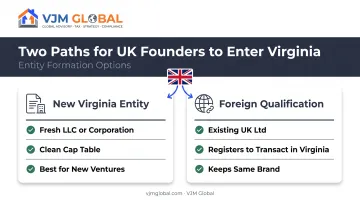
UK founders have two entry paths:
- Form a brand-new Virginia LLC or corporation as a fresh entity
- Register an existing UK Ltd as a foreign entity authorized to transact business in Virginia
Most founders launching a new US-facing venture choose the first path. The second suits companies already trading under a UK Ltd that want to formally operate in Virginia under the same brand.
What to Know Before You Start a Virginia Business from the UK
Choosing Your Structure
An LLC offers pass-through taxation and simpler compliance, making it ideal for consultants, solo founders, and small e-commerce operations.
A corporation suits founders planning to raise US venture capital. Most American investors expect a Delaware- or Virginia-style C-Corp structure.
Tax Treaty Reality Check
The 2001 UK-USA Double Taxation Convention helps prevent double taxation, but it doesn't eliminate US filing obligations. Article 1(8) of the treaty deals specifically with "fiscally transparent entities" like LLCs, where US and UK classifications can differ.
Practically, this means:
- Foreign-owned single-member LLCs must file Form 5472 with a pro forma Form 1120
- The treaty covers US federal taxes only, not Virginia state tax
- UK tax credits under Article 24 apply against UK tax computed on the same income, subject to UK law
Banking Friction
Most non-resident founders can't simply walk into a US bank branch. Research providers that explicitly support remote onboarding for foreign-owned entities before you file anything. This step is often the single biggest bottleneck in the entire process.
Step-by-Step: How to Start a Business in Virginia from the UK
The most common early mistake? Assuming UK and US business terms are interchangeable. A Virginia LLC is not the same as a UK Ltd — they carry different tax defaults, liability rules, and compliance calendars. Here's the practical breakdown.
Step 1 – Choose Your Business Structure and Name
Decide between an LLC and corporation based on growth plans and whether you'll need US investors. Then check name availability through the Virginia SCC's Clerk's Information System (CIS) before drafting any paperwork.
Step 2 – Appoint a Registered Agent
Virginia requires a registered agent with a physical Virginia address to receive legal and state correspondence. Most non-resident UK founders use a commercial registered agent service rather than trying to serve this role personally. It's simply impractical from overseas.
Step 3 – File Formation Documents with the Virginia SCC
File your Articles of Organization (LLC) or Articles of Incorporation (corporation) online via CIS.
| Entity Type | Filing Fee |
|---|---|
| LLC (Form LLC1011) | $100 |
| Stock Corporation (Form SCC619) | $75 minimum (up to 25,000 shares); up to $2,525 for higher share counts |
Step 4 – Obtain an EIN from the IRS
This step surprises most UK founders. Without a Social Security Number, you can't use the instant online EIN application. Complete Form SS-4 first (enter "foreign" on line 7b), then submit by one of these routes:
- Phone: IRS international line 267-941-1099 (Monday-Friday, 6 a.m.-11 p.m. Eastern)
- Fax: 304-707-9471 from outside the US; typical EIN return in 4 business days
- Mail: EIN International Operation, Cincinnati; allow about 4 weeks
You need this EIN before you can open a bank account, file taxes, or hire staff.
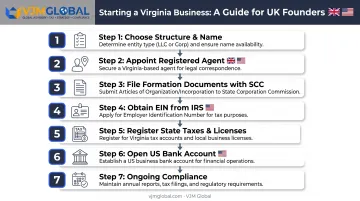
Step 5 – Register for Virginia State Taxes and Licenses
Register with Virginia Tax if you'll collect sales tax or withhold employee income tax. Also check whether the specific city or county where you operate requires a local business license. Virginia's BPOL tax is administered locally, not at the state level.
Step 6 – Open a US Business Bank Account
This is often where non-resident applications stall. Expect longer processing times, and possibly an in-person visit requirement, unless you use a fintech provider built for remote onboarding. Firms like VJM Global can help UK founders assemble the right documentation package before applying, reducing back-and-forth delays.
Step 7 – Understand Ongoing US and UK Compliance
- Virginia: Pay the annual registration fee and keep a registered agent in place
- Federal US: Foreign-owned LLCs often need Form 5472 (and related IRS filings) each year
- UK: Report worldwide income on HMRC self-assessment and track your US-UK tax treaty position
What It Costs: Fees and Ongoing Compliance for UK Founders
Plan for three layers of cost: Virginia SCC filing, annual state compliance, and UK–US cross-border overhead.
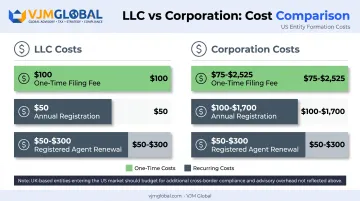
One-time Virginia SCC filing fees:
- LLC: $100
- Stock corporation: $75 minimum, up to $2,525 for higher authorized share counts
Ongoing annual costs:
- LLC annual registration: $50, due by the last day of your formation anniversary month
- Stock corporation annual registration: $100 to $1,700, based on authorized shares
- Commercial registered agent renewal: typically $50-$300 per year
UK-specific costs to budget for:
- Currency conversion fees on cross-border transfers between US and UK accounts
- Dual-country accounting or bookkeeping support to keep both HMRC and IRS filings accurate
- US tax preparer fees for Form 5472, pro forma 1120, and any Virginia-specific returns (get an explicit quote that covers all three)
With two tax systems in play, most UK founders outsource dual compliance rather than juggle HMRC and IRS rules alone. VJM Global works across both jurisdictions and has supported 250+ UK businesses and 500+ American owners, which helps reduce the filing errors that trigger IRS penalties.
Common Mistakes UK Founders Make When Setting Up in Virginia
UK founders often carry Companies House assumptions into Virginia filings. These three mistakes cause the most costly delays and penalties:
- Treating a Virginia LLC and a UK Ltd as interchangeable: wrong entity choice and missed tax elections
- Underestimating non-resident banking timelines: long delays before funds can move if no fintech fallback is ready
- Missing US information-reporting obligations: foreign ownership triggers Form 5472; the penalty starts at $25,000
Frequently Asked Questions
How much does it cost to start a business in Virginia?
Virginia SCC filing fees are $100 for an LLC; corporation fees start at $75 depending on authorized shares. Budget another $50–$300 for a commercial registered agent in year one.
How much does it cost to run an LLC in Virginia?
Ongoing costs center on the $50 SCC annual registration fee plus your registered agent. If you outsource the agent, renewal typically adds $50–$300 per year on top of the state fee.
What is the annual registration fee for a Virginia LLC?
The fee is $50 per year, due by the last day of the month your LLC was originally formed. A $25 late penalty applies if you miss the deadline.
Can I form an LLC in Virginia for free?
No — the $100 state filing fee is mandatory and non-negotiable. However, formation guidance itself can be low-cost or bundled free with certain registered agent services.
How do I register a foreign business in Virginia?
An existing UK company foreign-qualifies with the SCC—Form LLC1052 for LLCs, or SCC759/921 for corporations—rather than forming a brand-new domestic Virginia entity. UK-owned domestic formation is a separate path if you are not registering an existing foreign company.
Can a UK citizen start a business in Virginia?
Yes. Virginia imposes no citizenship or residency requirement for ownership or management. Owning a Virginia business remotely is separate from living or working in the US, which requires an appropriate visa.