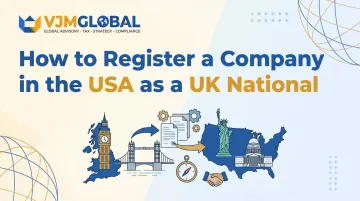
However, while the basic steps appear straightforward, outcomes vary significantly depending on business structure chosen, state of registration, tax treaty implications, and how post-registration compliance is handled. Mistakes at any stage can be costly — particularly around Form 5472 obligations, which carry a $25,000 penalty for non-compliance even when your company has zero revenue.
This guide covers the exact steps to register a US company as a UK national, the key decisions that affect cost and compliance, UK-specific considerations including E-2 visa eligibility and the UK-US tax treaty, and common errors to avoid.
Key Takeaways
- UK nationals can form a US LLC or C-Corporation without a US address, SSN, or physical presence
- Choose an LLC for simplicity and tax flexibility, or a C-Corp if you plan to raise venture capital or list publicly
- Delaware, Wyoming, and Florida offer low fees, privacy protections, and business-friendly laws
- Appoint a registered agent (US physical address required) and obtain an EIN from the IRS via phone or fax
- Stay compliant with annual reports, franchise taxes, and Form 5472 filings — missed deadlines carry heavy IRS penalties
Why UK Nationals Are Registering Companies in the USA
The USA's GDP and position as the world's largest consumer market make it one of the most attractive destinations for UK entrepreneurs. Post-Brexit, with EU-based market access routes no longer automatic for UK businesses, American market entry has become an increasingly deliberate strategic choice.
Market Access and Credibility Benefits
A US-registered entity opens doors that a UK-only structure often cannot. Key advantages include:
- Access to US payment processors like Stripe and PayPal
- Easier contract execution with American clients
- Eligibility to attract US-based investors
The US records approximately $16 trillion in annual personal consumption expenditures — the largest consumer market in the world.
Structural Advantages for UK Nationals
UK nationals enjoy specific advantages over many other foreign nationals when registering in the USA. The UK is a qualifying treaty country for the E-2 Treaty Investor Visa (treaty date: July 3, 1815), allowing active management of a US business with renewable two-year stays. Protections under the UK-US Double Taxation Convention (in force since March 31, 2003) also prevent UK nationals from being taxed twice on the same income when properly claimed.
LLC vs C-Corp: Choosing the Right Business Structure as a UK National
UK nationals (and foreign nationals generally) can choose between two structures: the LLC (Limited Liability Company) and the C-Corporation. S-Corporations are restricted to US citizens and permanent residents and are not an option for UK nationals.
LLC Advantages
The LLC offers:
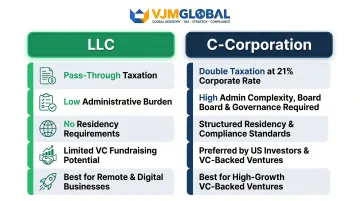
- Pass-through taxation: Profits flow directly to owners' personal tax returns — no entity-level US tax, no double taxation
- Lower admin burden: Fewer compliance requirements than corporations, no mandatory board or formal meetings
- No residency requirements: Members can be located anywhere in the world
- Remote-friendly structure: Well-suited for UK sole founders or small teams operating digitally
Critical tax nuance: As a foreign owner of a US LLC, the IRS treats your entity as a disregarded entity but still requires you to file Form 5472 and a pro-forma Form 1120 as an informational return, even if the LLC itself owes no US tax. These filings cannot be submitted electronically and must be sent by fax or mail.
C-Corporation Advantages
The C-Corp offers:
- Multiple share classes: Issue preferred and common shares to accommodate different investor types
- VC-ready structure: The preferred format for US venture capital and institutional fundraising
- Public listing pathway: Required structure for businesses planning to list on US exchanges
- Predictable tax rate: Flat 21% federal corporate tax on profits
Downside: Double taxation applies — corporate tax on profits, then personal tax on dividends. Governance requirements are also heavier, including a formal board of directors, documented meetings, and more extensive annual filings.
UK-US Tax Treaty Impact
The UK-US tax treaty significantly reduces the default 30% US withholding tax on dividends for UK residents. Here's how the rates break down:
- 30% — Standard US statutory withholding rate (no treaty claim)
- 15% — Treaty rate for portfolio dividends (less than 10% ownership)
- 5% — Treaty rate for controlling-stake dividends (10%+ ownership)
These reduced rates make C-Corp structures far more workable for UK founders than the headline 30% figure suggests — but the treaty benefit is not automatic. It must be claimed by filing Form W-8BEN with the paying entity.
Comparison Table
| Feature | LLC | C-Corporation |
|---|---|---|
| Liability Protection | Full limited liability | Full limited liability |
| Taxation | Pass-through (but Form 5472 required) | Double taxation (21% corporate + dividend withholding) |
| Admin Complexity | Low | High (board, meetings, formal governance) |
| Fundraising Ability | Limited for VC | Preferred by US investors |
| Suitability for UK Nationals | Most common choice for remote/digital businesses | Best for scale-focused, VC-backed ventures |
The right structure depends on your growth plans, tax residency position, and whether you intend to raise external capital. VJM Global has worked with 250+ UK businesses on exactly this decision — running scenario comparisons across both structures before a single form is filed.
How to Register a Company in the USA as a UK National: Step-by-Step
While procedures vary slightly by state, the core registration process follows a consistent sequence. UK nationals can complete the majority of these steps remotely without travelling to the USA.
Step 1: Select Your State of Registration
UK nationals do not need to register in the state where they will conduct business, especially for online or remote businesses. Top choices include:
Delaware
- Most business-friendly corporate law
- No income or sales tax if not operating locally
- Filing fee: $90
- Annual franchise tax: $300 (due June 1)
- Late penalty: $200 plus 1.5% monthly interest
Wyoming
- Lowest cost structure
- Strong privacy protections
- Filing fee: $100-$104 (online)
- Annual report: $60 minimum
- Strong asset protection laws
Florida
- Straightforward process
- Large consumer market access
- Filing fee: $125 ($100 + $25 registered agent)
- Annual report: $138.75 (due May 1)
- Late penalty: $400 (jumps to $538.75 total if received after May 1)
Foreign Qualification Warning: Choosing a state purely for low fees can create obligations if you later establish physical presence in another state. Foreign qualification in a second state triggers additional filing fees (national average approximately $186), a second registered agent requirement, and dual-state compliance costs.
Step 2: Reserve Your Business Name and Appoint a Registered Agent
Name Reservation
Your chosen business name must be unique within the state. Check availability through each state's Secretary of State database. Legal entity names must include designators like "LLC" or "Inc."
Once your name is confirmed, appointing a registered agent is the next immediate requirement before filing formation documents.
Registered Agent Requirement
Every US company must have a registered agent with a physical US address (not a PO Box). They must be available during business hours to receive legal and government documents. As UK nationals lack a US address, hiring a commercial registered agent service is the standard approach, typically costing $50-$200 per year.
Step 3: File Your Formation Documents
For an LLC: File Articles of Organization with the state's Secretary of State For a C-Corp: File Articles of Incorporation
These documents contain:
- Entity name
- Registered agent address
- Management structure
- Authorised shares (for C-Corp)
Most states allow online filing with processing times ranging from same-day (expedited) to 1-4 weeks for standard submissions. UK nationals can file directly or through a formation service.
Step 4: Obtain an Employer Identification Number (EIN)
An EIN (the US equivalent of a UTR or company tax reference) is required to open a US bank account, hire employees, and file taxes. It is free to obtain from the IRS via Form SS-4.
Critical UK-Specific Detail: UK nationals without a US Social Security Number cannot use the IRS online EIN application. Instead, you must apply by:
| Method | Contact | Processing Time |
|---|---|---|
| Phone (Recommended) | +1 267-941-1099 (not toll-free) | Same-day during call |
| Fax | +1 304-707-9471 | Approximately 4 business days |
| IRS, Ogden, UT | Approximately 4 weeks |

Phone line hours: Monday-Friday, 6:00 a.m. to 11:00 p.m. Eastern Time
The IRS limits EIN issuance to one per responsible party per day, regardless of application method. Initiate this process immediately after formation documents are filed to avoid delays in opening your US bank account.
Step 5: Open a US Business Bank Account and Meet Ongoing Compliance
Banking Options for UK Nationals
Opening a US bank account as a UK national has traditionally been challenging, as most traditional banks require an in-person visit. Your main options are:
- Mercury: Explicitly accepts applications from company founders living abroad — no US citizenship or residency required, provided the entity is US-registered with an EIN. Note that Mercury requires a genuine US physical operating address; registered agent addresses are not accepted as the principal business address.
- Wise Business: Offers remote account opening for foreign-owned US entities with valid formation documents.
- HSBC and other international banks: May allow remote account setup through their UK branches if you hold an existing relationship with the bank.
Ongoing Compliance Obligations
UK nationals must maintain compliance in two key areas after formation.
Annual reports are due each year with deadlines and fees that vary by state:
- Wyoming: Due anniversary month, $60 minimum
- Delaware: Due June 1, $300 flat fee
- Florida: Due May 1, $138.75 (or $538.75 if late)
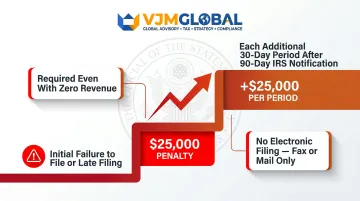
Form 5472 paired with a pro-forma Form 1120 is a federally required information return for foreign-owned single-member LLCs. The penalties for missing it are severe:
- $25,000 for failure to file, late filing, or incomplete filing
- An additional $25,000 for each 30-day period after 90 days from IRS notification
- Must be filed by fax or mail — no electronic filing available
- Required even when the entity has zero revenue or activity
VJM Global, which has supported 250+ UK businesses with accounting and compliance, offers ongoing bookkeeping and US tax compliance support including Form 5472 preparation, ensuring these critical filings are never missed.
Key Considerations Specific to UK Nationals
Generic guides cover the registration steps. What they miss are the cross-border factors — tax treaty mechanics, visa constraints, and state selection trade-offs — that determine whether your US structure actually works for a UK-based owner.
UK-US Tax Treaty
The UK and US have a comprehensive Double Taxation Convention (DTC) that prevents UK nationals from being taxed twice on the same income. However, treaty benefits are not automatic — they must be claimed correctly on relevant US tax filings.
Key Treaty Provisions:
Article 7 (Business Profits): Profits of a UK enterprise are taxable only in the UK unless attributable to a US permanent establishment. A UK national operating a US LLC without US physical presence may not owe US federal income tax on business profits — though Form 5472 filing obligations remain.
Article 10 (Dividends): Reduced withholding rates for UK residents receiving C-Corp dividends:
- Portfolio dividends (<10% ownership): 15% vs. statutory 30%
- Direct investment (10%+ voting stock): 5%
- Qualified pension funds (80%+ ownership, subject to LOB): 0%
Article 23 (Limitation on Benefits): Anti-treaty-shopping provision requiring UK nationals to satisfy specific tests to claim treaty benefits.
To claim reduced withholding rates, UK residents must provide Form W-8BEN (individuals) or W-8BEN-E (entities). Consulting a US-UK cross-border tax adviser is essential to properly claim these benefits.
Visa Requirements: Can UK Nationals Work in Their US Company?
UK nationals can own and manage a US company from the UK without any visa. However, to physically work inside the US for their company, a valid work visa is required.
E-2 Treaty Investor Visa:
- UK nationals are eligible (UK is a qualifying treaty country)
- Allows active management of a US business with substantial capital investment
- Initial stay: Up to 2 years, with unlimited extensions in 2-year increments
- No fixed minimum investment amount (must be "substantial" relative to business cost)
- Does not provide a direct path to permanent residency
EB-5 Immigrant Investor Visa:
- Minimum investment: $800,000 (Targeted Employment Area/Infrastructure) or $1,050,000 (standard)
- Job creation requirement: 10 full-time US workers
- Does provide a path to green card (conditional, then permanent)
- Amounts subject to automatic inflation adjustment every five years starting January 1, 2027
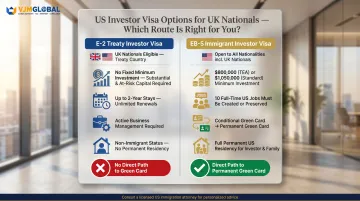
The E-2's lack of a path to permanent residency creates a practical constraint: you must either maintain the investment enterprise indefinitely or transition to another immigration category. This means your company structure and any immigration planning need to be aligned early — the wrong entity type can complicate a later visa application or status change.
State Selection and UK Business Patterns
Most UK nationals registering remotely default to Delaware or Wyoming. However, if your business plans to hire US employees or operate from a specific US state, registering in that state avoids foreign qualification complications and dual-state compliance costs.
If you register in Delaware but later open an office in California, you'll need to foreign qualify in California, triggering additional filing fees, a second registered agent, and ongoing annual obligations in both states.
Common Mistakes UK Nationals Make When Registering a US Company
Skipping or Delaying the EIN Application
Many UK nationals register their company first and then discover they cannot open a US bank account without an EIN. The phone-based EIN process for non-SSN holders requires calling during US Eastern business hours — meaning calls between roughly 2 PM and 8 PM UK time. Start this process immediately after formation documents are filed, not as an afterthought.
Ignoring Form 5472 and Annual Reporting Obligations
This is the most expensive and most common compliance error for foreign-owned US entities. UK nationals who treat their US LLC as "set and forget" risk IRS penalties starting at $25,000 per missed filing — even with zero activity or revenue that year. The obligation kicks in from the moment you make your first capital contribution.
Choosing the Wrong Structure Without Considering UK Tax Implications
A C-Corp faces US corporate tax at 21%, and any dividends paid back to UK shareholders attract withholding tax — even if the UK-US tax treaty reduces it to 5–15%, that layered tax drag can significantly erode returns compared to an LLC. Model both structures with a qualified cross-border adviser before filing anything.
Key questions to work through with your adviser:
- How will the entity be classified for UK tax purposes?
- Does the LLC structure create a UK tax transparency issue?
- What's the effective combined tax rate under each scenario?
Selecting a State for Low Fees Without Operational Planning
Choosing Wyoming for its $60 annual fee looks attractive on paper. But if you hire staff, lease office space, or hold regular meetings in another state, you'll trigger foreign qualification requirements in that state — often costing more than you saved. Match your formation state to where the business will actually operate before you file.
Frequently Asked Questions
How much money is required to start a business in the USA?
State filing fees range from approximately $50–$500 depending on the state and structure chosen, plus ongoing costs for a registered agent (~$50–$200/year) and franchise taxes where applicable. There is no minimum capital requirement to form an LLC or C-Corp as a foreign national.
How do I register a company (LLC) in the USA as a foreigner?
Choose a state, appoint a registered agent, and file Articles of Organization with that state. Next, obtain an EIN from the IRS via phone or fax — UK nationals without an SSN cannot use the online tool. Finally, open a US business bank account to begin trading.
What business structures are available for companies in the USA?
The main options are LLC, C-Corporation, and Partnership. S-Corporations are not available to non-residents, so UK nationals choose between an LLC (simpler, pass-through taxation) and a C-Corp (better suited for outside investment and scaling).
Can I stay in the USA if I start a business?
Owning a US company does not grant the right to live or work in the USA. UK nationals who wish to be physically present to manage their business need an appropriate visa — such as the E-2 Treaty Investor visa.
Do UK nationals need a visa to manage their US company?
Remote management requires no visa. However, operating on the ground within the US requires a valid work visa. The E-2 Treaty Investor visa is the most common route, typically requiring a substantial investment in an active US business — the threshold is generally considered to be $100,000 or more, though no fixed minimum is set by law.
Can I open a US business bank account from the UK without visiting the USA?
Traditional US banks typically require an in-person visit, but digital banking platforms such as Mercury and Wise Business offer remote account opening for foreign-owned US entities with valid formation documents and an EIN.