What surprises many UK entrepreneurs is how accessible the process actually is. You can register a US business without relocating, without a visa, and without a US Social Security Number. The structure is different from what you're used to in the UK, but it's not more complicated — it's just unfamiliar.
This guide walks you through every material decision: which entity to form, which state to register in, how to get an EIN, what your visa options are if you want to work on the ground, and what ongoing compliance looks like once you're up and running.
Key Takeaways
- UK citizens can register a US LLC or C-Corp without a visa or US residency; physically working there requires a separate work visa
- Delaware suits most non-resident founders; Wyoming works for solo or online-first businesses with no US fundraising plans
- Your EIN (Employer Identification Number) is free, mandatory, and unlocks US banking, hiring, and tax filing
- The E-2 Treaty Investor Visa is the primary route for UK founders who want to live and operate in the US
- US tax obligations span federal, state, and local levels; the UK-US double tax treaty reduces but does not eliminate your exposure
Why UK Entrepreneurs Are Expanding to the USA
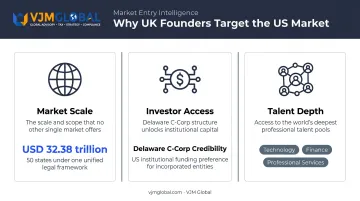
The commercial case is straightforward. The US economy is projected at approximately USD 32.38 trillion in 2026, and UK businesses already have deep commercial roots there — UK outward FDI stock in the US stood at £529.9 billion at end-2024, representing 28.5% of total UK outward FDI stock.
Three factors drive UK founders toward the US specifically:
- Market scale — the US consumer market is unmatched in size and purchasing power, with direct access to customers across 50 states under one legal framework
- Investor access — US venture capital and private equity investors strongly prefer funding US-registered entities; a Delaware C-Corp carries significantly more credibility with US capital than a UK Ltd company
- Talent depth — the US labour market offers industry-specific talent pools that are difficult to replicate elsewhere, particularly in tech, finance, and professional services
Post-Brexit, UK entrepreneurs are in the same position as any other non-EEA national when it comes to US market entry. The visa and regulatory considerations that once applied to third-country nationals now apply to UK founders too. That's the starting point for planning, not a reason to hesitate.
What UK Founders Should Know Before Getting Started
The US business environment isn't harder than the UK's, but it is structured differently in two areas that consistently catch UK founders off guard.
Two structural differences require early attention:
- Tax obligations are layered and location-specific. The UK's nationally uniform VAT has no direct US equivalent. Instead, sales tax rates vary by state, and federal, state, and local taxes can all apply at once. Knowing where your business has tax obligations — called "nexus" — requires deliberate planning from day one.
- Employment law varies by state, not nationally. Minimum wage, termination rights, benefits mandates, and payroll tax rules differ across states. Hiring in California involves a fundamentally different compliance exercise than hiring in Texas.
Remote Registration vs. Physical Operation
This distinction matters more than most UK founders realise:
- Registering remotely — A UK founder can form a US LLC or C-Corp entirely from the UK, without visiting the US or holding a visa. Delaware's Division of Corporations supports electronic filing, and there is no requirement for members to be US residents.
- Operating physically — Attending meetings occasionally under ESTA is permitted for UK citizens. But managing day-to-day operations, employing staff, or directing a US business on the ground requires an appropriate work visa.
Realistic Timelines
| Step | Typical Timeframe |
|---|---|
| Entity formation (LLC/C-Corp) | 1–5 business days |
| EIN (fax application) | ~4 business days |
| EIN (mail application) | ~4 weeks |
| US business bank account | Days (fintech) to weeks (traditional banks) |
| E-2 visa processing | Several months |
Start early. EIN delays create bottlenecks for banking and hiring.
Choosing the Right Business Structure and US State
Non-US residents can form a Limited Liability Company (LLC) or a C-Corporation (C-Corp). S-Corporations are not available to non-resident alien shareholders — the IRS explicitly prohibits this — so that option is off the table for UK founders.
For context: an LLC functions similarly to a UK Ltd company in terms of liability protection. A C-Corp is structurally closer to a UK PLC.
LLC vs. C-Corp — Which Is Right for UK Founders?
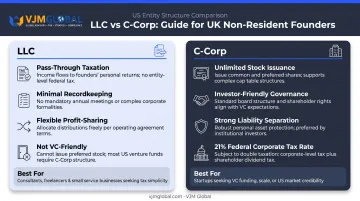
LLC advantages:
- Pass-through taxation: profits flow directly to the owner's personal tax return, avoiding a corporate-level tax
- Minimal recordkeeping requirements compared to a corporation
- Flexible profit-sharing arrangements between members
One significant drawback: US venture capital investors typically expect a C-Corp structure. If you're targeting US institutional funding, an LLC creates friction.
C-Corp advantages:
- Unlimited stock issuance and a share class structure that US investors recognise
- Investor-friendly governance framework
- Strong liability separation between founders and the business
The main drawback is double taxation: profits taxed at the corporate level (currently 21% federal rate), then again when distributed as dividends. Proper tax planning can mitigate this, but get specialist cross-border advice before committing to a structure.
Once you've settled on a structure, the next decision is equally strategic: which state to register in.
Which US State Should You Register In?
Delaware is the default choice for most non-resident founders:
- Home to more than 66% of the Fortune 500 and over 2,000,000 registered business entities
- Court of Chancery: a dedicated business court with over 225 years of corporate case law
- Corporations incorporated in Delaware but not operating there are not subject to Delaware corporate income tax (though franchise tax still applies)
- Member names are not required on the LLC certificate of formation, limiting public disclosure
- Annual LLC tax: USD 300, due 1 June each year
Wyoming suits solo founders and online businesses with no immediate US fundraising plans:
- Annual licence tax is the greater of USD 60 or USD 0.0002 per dollar of relevant Wyoming assets, substantially lower than Delaware
- Annual reports due on the first day of the anniversary month of formation
- Less investor recognition than Delaware, but adequate for e-commerce, consulting, or service businesses
Other states to consider:
- Nevada, Florida, and Texas are worth exploring if you have a specific regional presence or industry anchor there
- If you register in one state but operate in another, you'll need to register as a foreign LLC in that second state, effectively doubling your compliance obligations
How to Start a Business in the USA from the UK — Step by Step
Step 1: Choose and Verify Your Business Name
Before anything else, confirm your chosen name is available:
- Search the Secretary of State's business name database for your chosen state
- Search the USPTO trademark database for any conflicts
- The name must include a legal designator (e.g., "LLC" or "Inc.")
- Check .com domain availability at the same time — it's an afterthought that becomes a problem later
Step 2: Appoint a Registered Agent and File Formation Documents
A registered agent with a physical address in your chosen state is mandatory. As a UK resident, you cannot serve as your own agent, so a commercial registered agent service is required.
File either:
- Articles of Organization (for an LLC) — includes LLC name, registered agent details, business address, and member/manager information
- Articles of Incorporation (for a C-Corp) — includes corporate name, authorized shares, and registered agent details
Delaware supports electronic filing, so this step can be completed entirely online.
Step 3: Obtain an EIN from the IRS
The Employer Identification Number is the US equivalent of a company tax reference. Without it, you cannot open a US business bank account, hire employees, or file taxes.
Key facts:
- Applying for an EIN is free through the IRS
- Online applications are not available to international applicants whose principal place of business is outside the US
- International applicants can apply by calling the IRS at 267-941-1099, or by fax/mail using Form SS-4
- Fax applications are generally processed within 4 business days (if a return fax number is provided); mail takes approximately 4 weeks
- If you lack a US Social Security Number, you can enter "foreign" or "N/A" where applicable on Form SS-4
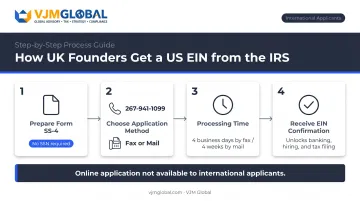
Plan for the EIN timeline — it creates the biggest bottleneck in the formation process.
Step 4: Open a US Business Bank Account
Traditional US banks typically require an in-person visit, which is impractical for UK-based founders. Three fintech platforms stand out for UK-based founders:
- Mercury — accepts US companies with founders worldwide; US citizenship or residency not required
- Relay — accepts US-registered businesses owned by non-US citizens or non-US residents, subject to operating presence requirements
- Wise Business — non-US citizens can open a US account with a registered US business and US operating address (note: Wise is an MSB, not a bank)
Typical documents required: LLC formation certificate, EIN confirmation, two forms of ID, and a US business address.
Sales tax is a separate obligation to plan for. If you're selling goods or services in the US, you may need to register in any state where you have nexus. Pennsylvania requires registration once gross sales exceed USD 100,000; New York applies a presumption of nexus above USD 500,000 and more than 100 transactions. Foreign ownership does not remove this obligation.
Step 5: Establish Operational Presence and Prepare to Hire
You can build a functional US footprint without relocating:
- Obtain a US virtual address or coworking space address
- Set up a US phone number
- Create a US-targeted website reflecting the US entity
- Update professional profiles to show the US business
Hiring US-based employees introduces significant differences from UK norms:
- At-will employment applies — no notice periods as a default
- Many states mandate healthcare benefit contributions
- State-level payroll tax registrations are required separately
- Salary benchmarks vary sharply by location
An Employer of Record (EOR) is a lower-risk option for early US hires before your entity is fully operationally established.
Visa and Immigration Options for UK Citizens
Registering a US company does not give you the right to work in the US. ESTA — available to UK citizens — permits short business visits such as attending meetings or conferences, but not ongoing work, management, or employment.
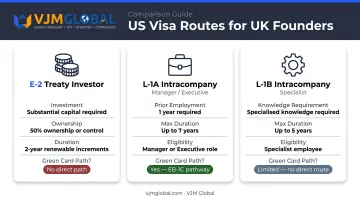
E-2 Treaty Investor Visa
The primary route for UK entrepreneurs who want to live and work in the US. Key requirements:
- The UK is a listed E-2 treaty country, so UK citizens are eligible
- You must make a "substantial" investment of capital — the USCIS uses a qualitative standard, not a fixed dollar threshold; funds must be irrevocably committed and at risk
- You must own at least 50% of the enterprise or have operational control
- The business must be more than marginal — it cannot exist solely to support the owner
- E-2 status is granted in increments of up to 2 years, renewable indefinitely as long as eligibility continues
- The E-2 does not directly lead to a Green Card (unlike the L-1A or EB-5 routes below)
L-1 Visa (Intracompany Transferee)
For UK founders expanding an existing UK business into the US:
- L-1A — executives and managers; L-1B — employees with specialised knowledge
- Requires at least 1 continuous year of employment with the UK company in the 3 years prior to admission
- Initial stay: 3 years (1 year for new US offices), extendable to a maximum of 7 years (L-1A) or 5 years (L-1B)
- The L-1A can lead to permanent residency via the EB-1C route for certain multinational executives
Other Routes to Note
Two additional pathways are worth knowing about, depending on your investment level and profile:
- EB-5 Immigrant Investor Visa — minimum USD 800,000 investment in a qualifying targeted employment area, requires creation of 10 full-time US jobs, and leads directly to permanent residency
- O-1A Extraordinary Ability Visa — for founders with nationally or internationally recognised expertise, supported by evidence such as awards, publications, or significant industry recognition
- TN Visa — available to Canadian and Mexican nationals under USMCA, but not available to UK citizens post-Brexit; worth knowing so you don't pursue a dead end
Every visa route is fact-specific — your investment size, business structure, and personal history all shape which option actually works. Speak with a licensed US immigration attorney before committing to any path.
US Tax, Compliance, and Ongoing Obligations
Understanding the US Tax Layers
UK founders need to account for multiple tax obligations simultaneously:
| Tax Type | Who It Applies To |
|---|---|
| Federal corporate tax (21%) | C-Corps on taxable income |
| State income tax | Varies by state; some states have none |
| Local taxes | Varies by municipality |
| Sales tax | Any seller with nexus in that state |
For LLC owners, the pass-through structure means income is reported on personal returns rather than at the entity level. But non-resident aliens face specific IRS rules:
- Effectively Connected Income (ECI) — income connected to a US trade or business is taxed at graduated rates after allowable deductions
- FDAP income — fixed, determinable, annual, or periodical income not connected to a US trade or business is generally taxed at 30% on the gross amount, unless reduced by treaty
Foreign-owned US LLCs (single-member disregarded entities) must also file Form 5472 attached to a pro forma Form 1120. This catches many UK founders by surprise — get specialist advice before assuming an LLC equals no US tax obligation.
The UK-US Double Tax Treaty
The US-UK treaty for the avoidance of double taxation helps prevent the same income being taxed in both countries. It does not eliminate all obligations on either side, and treaty positions require case-by-case analysis. Professional cross-border tax advice is essential before taking any treaty position — and it sets the groundwork for staying compliant on both sides of the Atlantic.
Ongoing Compliance Obligations
Most guides focus on registration and stop there. The ongoing obligations are where UK founders most often fall short:
- Delaware LLCs — USD 300 annual tax due 1 June each year; failure to maintain compliance can result in loss of good standing
- Delaware C-Corps — annual report and franchise tax due 1 March; minimum tax USD 175 under the Authorized Shares method
- Wyoming entities — annual report due on the anniversary month; licence tax from USD 60 per year
- All entities — maintain a registered agent, keep corporate records current, and file required US tax returns even if the business is run entirely from the UK
- Administrative dissolution is a real risk in both Delaware and Wyoming if annual filings lapse
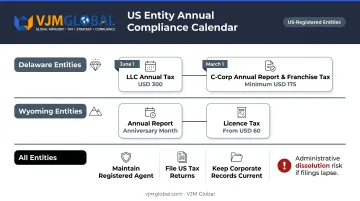
The US legal and regulatory framework is transparent and well-documented. What trips up UK founders is not understanding the rules — it's maintaining the filing cadence once the business is running. Setting up the right compliance infrastructure before you need it is far easier than correcting lapses under time pressure.
Frequently Asked Questions
Can a UK citizen start a business in the USA?
Yes. UK citizens can register a US LLC or C-Corp without a US visa, US residency, or a US Social Security Number. Physically operating in the US — managing staff, meeting clients regularly, directing day-to-day operations — requires an appropriate work visa such as the E-2 or L-1.
Do I need a US visa to register a business in America from the UK?
No visa is needed to register a US company remotely. A visa is required only if you want to live and work in the US as a business owner or manager. Short business visits under ESTA are permitted for UK citizens but do not authorise ongoing work or management activities.
Which US state should a UK entrepreneur register their business in?
Delaware is the most widely used state for non-resident founders — its Court of Chancery, investor familiarity, and favourable corporate law make it the default. Wyoming is a lower-cost alternative suited to solo founders and online-first businesses that have no near-term plans to raise US institutional funding.
Do I need a US bank account to run a US business from the UK?
A US business bank account is strongly recommended and practically necessary for most operational purposes. Fintech platforms like Mercury and Relay now make remote account opening possible for foreign founders. An EIN must be in place before any US business account can be opened.
How are UK business owners taxed on a US company?
US LLCs are typically pass-through entities, with income reported on personal returns. Non-resident owners face IRS withholding rules on ECI and FDAP income, and foreign-owned LLCs carry Form 5472 filing obligations — with penalties up to $25,000 for late submission. The UK-US double tax treaty can reduce double taxation exposure, though the interaction between US and UK obligations requires qualified cross-border tax advice.
Can I run a US LLC remotely from the UK?
Yes — many UK founders run US LLCs entirely from the UK, particularly for digital, e-commerce, or service-based businesses. The requirements are a registered agent in the US, annual reports filed on time, and US and UK tax obligations met.