Introduction
Washington, DC's economy hit $149.5 billion in real gross state product in Q3 2024, driven by federal contracting, tech, consulting, and cybersecurity firms clustering around the capital. Yet the District's own Chamber of Commerce reports business establishment growth slowed to 1.6% in 2024, down sharply from 6.1% the year before.
Entrepreneurs still flock here: local residents, federal contractors chasing agency proximity, remote founders, and international investors. DC offers a highly educated workforce and direct access to government contracts. Still, many struggle with a regulatory path that differs sharply from Virginia or Maryland—from entity choice through DLCP registration, licensing, and tax setup.
This guide walks through the exact steps: choosing your structure, registering with DLCP, getting licensed, and staying compliant with DC's tax and reporting rules.
TL;DR
- Choose a structure, register with DLCP, obtain a Basic Business License, get an EIN, and file biennial reports
- Typical costs: LLC filing $99, Basic Business License $99 for 2 years (effective August 2025)
- Online filings typically process within 5 business days
- DC's layered local rules make professional guidance useful for first-time founders
What Does It Mean to Start a Business in Washington, DC?
Starting a business in DC means legally forming an entity (an LLC, corporation, partnership, or sole proprietorship) through the Department of Licensing and Consumer Protection (DLCP), then getting the licenses you need to operate.
That step is compliance and registration. It does not prove your business idea will work in the market.
Common entity types available in DC:
- Sole proprietorship (no DLCP registration required)
- Limited Liability Company (LLC)
- Corporation (C-corp or S-corp election)
- Partnership (general, limited, or LLP)
DC handles entity registration through DLCP and taxes through the Office of Tax and Revenue (OTR). Virginia and Maryland use their own state corporation commissions and revenue departments, so the filings are not interchangeable across the region.
What to Know Before You Register a Business in DC
Most first-time DC founders underestimate how many layers stack on top of each other. Formation is just the start. Licensing and occupancy approval follow.
Key things to understand before you file anything:
- DC requires both business registration with DLCP and a separate Basic Business License to legally operate
- A registered agent with a physical DC address is mandatory for LLCs and corporations (no PO boxes)
- You need either a Certificate of Occupancy (commercial space) or a Home Occupation Permit (home-based work)
- Compliance doesn't end at formation: biennial reports and DC tax registration are ongoing obligations
- High-propensity business applications averaged 361 per month in 2024 (DC Chamber 2025), so build in time for shared processing load
Why Washington DC Is a Strong Place to Start a Business
DC has real advantages. It also has higher rents and more regulatory steps than many U.S. jurisdictions. Treat this as a set of favorable conditions, not a guarantee.
What works in DC's favor:
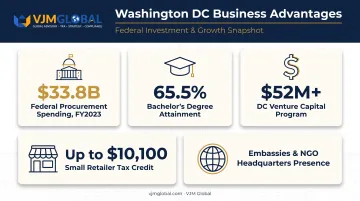
- Federal procurement spending reached $33.8 billion in FY2023, a large market for contractors and consultants
- About 65.5% of DC residents aged 25+ hold a bachelor's degree or higher (U.S. Census Bureau), well above the national average
- Programs such as the DC Venture Capital Program ($52M+) and the Small Retailer Property Tax Relief Credit (up to $10,100) support qualifying businesses
- Embassies, NGOs, and multilateral organizations create diverse B2B and institutional customers
- Virtual offices and coworking spaces reduce the need for long commercial leases at launch
How to Start a Business in Washington, DC – Step by Step
Skip a step and you risk fines or a business license you cannot use. The process breaks into six sequential stages.
Common mistakes to avoid:
- Choosing sole proprietorship for liability-heavy work without understanding personal asset exposure
- Skipping the registered agent requirement
- Launching operations before the Basic Business License is approved
Step 1 – Choose Your Business Structure
Your structure determines liability exposure, tax treatment, and how attractive you look to investors.
| Structure | Liability Protection | Taxation | Investor-Ready |
|---|---|---|---|
| Sole Proprietorship | None (personal assets exposed) | Pass-through | No |
| LLC | Yes | Pass-through (or elect corporate) | Moderate |
| Corporation | Yes | Corporate tax + dividends | Yes |
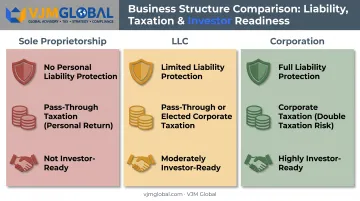
DC's default treatment: sole proprietors don't need to register with DLCP at all. Every other structure (LLC, corporation, partnership) does.
The most common misstep: freelancers or consultants in liability-heavy work (government contracting, health-adjacent services) pick a sole proprietorship because it is simple. They still put personal savings and home equity on the line if something goes wrong.
Step 2 – Name Your Business and Reserve It
Run a search through CorpOnline/Access DC to confirm your business name isn't taken. DC also restricts certain words outright — you can't use "bank," "FBI," or names implying a government agency affiliation without special approval.
If you're not ready to file formation documents immediately, reserve your name:
- File Form GN-3 with DLCP
- Pay the $50 reservation fee
- Your reservation holds for 120 days
- Transfer the reservation to another party if needed
Operating under a name other than your own legal name (as a sole proprietor) or your registered entity name? You'll need to register a trade name (DBA) separately.
Step 3 – Appoint a Registered Agent and File Formation Documents
Every LLC or corporation registering with DLCP must maintain a registered agent with a physical DC street address. A PO box does not meet the requirement.
Filing costs and documents:
- LLC: file Articles of Organization with DLCP — $99
- Corporation: file Articles of Incorporation, starting at $99 for authorized capital up to $100,000 (higher capital tiers cost more)
- Standard online filings process within 5 business days
Founders expanding into the US without a local presence (for example, an international entrepreneur launching a DC subsidiary) often struggle to coordinate a registered agent, file the right formation paperwork, and track deadlines from another time zone.
An entity formation and compliance partner such as VJM Global can handle registered agent coordination and DLCP filings so you are not managing DC-specific paperwork remotely.
Step 4 – Get an EIN and Register for DC Taxes
Two separate registrations happen here — one federal, one local.
Federal EIN:
- Apply via IRS Form SS-4
- Free
- Instant online issuance if you have a US legal residence or principal business location
DC tax registration:
- File Form FR-500 with the DC Office of Tax and Revenue
- This sets up your corporate franchise tax, sales tax, and employer withholding tax accounts
- Complete through MyTax.DC.gov
The sequence matters: register with DLCP first if your structure requires it, then complete FR-500, then return to DLCP for your business license in the next step.
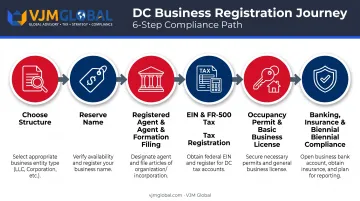
Step 5 – Obtain Your Occupancy Permit and Basic Business License
Where you operate from determines which permit you need.
- Certificate of Occupancy: required for commercial space; confirms the building's use complies with zoning and safety codes
- Home Occupation Permit: required if you run the business from a residential address; secure it before applying for your business license
Once occupancy is settled, apply for your Basic Business License (BBL) through DLCP. As of August 1, 2025, BBL pricing is:
- $49 for 6 months
- $99 for 2 years
- $198 for 4 years
Earlier estimates of $200–$500 for a two-year license are outdated.
Industry-specific activities (food service, childcare, cosmetology) may require additional endorsements on your BBL.
Step 6 – Set Up Banking, Insurance, and Ongoing Compliance
With your license in hand, a few final pieces finish the setup that keeps you compliant.
Banking: Open a business account. Banks typically want your formation documents, EIN confirmation, and BBL on file before opening one.
Insurance: Workers' compensation coverage is required for all private employers in the District; DC's official guidance cites no small-employer exception. Liability coverage is not mandated but is worth carrying.
Biennial Report: This is the recurring obligation founders forget.
- First report due April 1 the year after registration
- Subsequent reports due every two years, same deadline
- Filing fee: $300
- Late fee after April 1: $100
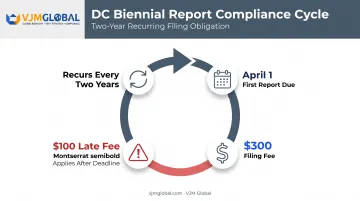
Miss this and your entity can fall out of good standing with DLCP, which creates downstream problems for contracts, banking, and licensing renewals.
Conclusion
Starting a business in DC involves more moving pieces than most jurisdictions: formation, a separate business license, occupancy approval, and recurring biennial filings. Handled in the right sequence, none of it is overwhelming.
The initial paperwork is rarely what trips founders up. Ongoing compliance is: biennial reports, tax filings, and license renewals all carry real deadlines and real penalties.
Founders unfamiliar with DC's specific regulatory stack, particularly those setting up from outside the US, often find it worth working with experienced entity formation and compliance specialists like VJM Global to reduce setup errors and avoid delays.
Frequently Asked Questions
How do I start and register a small business in Washington, DC?
Choose a business structure, file the appropriate formation documents with the Department of Licensing and Consumer Protection (DLCP), then obtain an EIN from the IRS and a Basic Business License before you begin operating.
Do I need to register my business in Washington, DC?
Sole proprietors generally don't need to register with DLCP unless operating under a trade name. LLCs, corporations, and partnerships must register regardless of trade name use.
Do I need a business license in Washington, DC?
Yes. Most businesses need a Basic Business License from DLCP, and certain industries — food service, childcare, personal care — require additional endorsements on top of it.
How much does a basic business license cost in Washington, DC?
As of August 2025, pricing is $49 for six months, $99 for two years, or $198 for four years, depending on the term you select.
How much does it cost to form an LLC in Washington, DC?
Filing Articles of Organization costs $99. Budget additional funds for name reservation, occupancy permits, and your Basic Business License on top of that.
Is Washington, DC a good place to start a business?
DC offers federal contracting access, an educated workforce, and local funding programs. Weigh that against higher licensing complexity and commercial rents compared to neighboring states.