That first filing sounds simple, but requirements shift depending on whether you're forming an LLC, a corporation, a nonprofit, or running a sole proprietorship. Skip a step, and you could face a rejected filing or a compliance headache months down the road.
This guide walks through the exact registration steps, the documents you'll need, what it costs, and the mistakes that trip up most new filers.
Key Takeaways
- All D.C. LLCs, corporations, partnerships, and foreign entities doing business in D.C. must register with DLCP through CorpOnline
- A registered agent with a physical D.C. street address is mandatory for every filing entity
- File a Biennial Report every two years by April 1 to keep your entity in good standing
- Sole proprietors using their own legal name skip entity registration but must file a trade name if operating under a DBA
Do You Need to Register Your Business in Washington D.C.?
Not every business owner needs to file formation paperwork with DLCP. It depends on your structure and how you plan to operate.
Sole proprietors and general partnerships operating under their own legal name aren't required to register as a filing entity with DLCP. You'll still need a Basic Business License and tax registration with the Office of Tax and Revenue (OTR), but there's no corporate formation form to file.
Everyone else needs to register, including:
- LLCs, corporations, and nonprofits
- Limited partnerships and limited liability partnerships
- Any business (including a sole proprietorship) operating under a fictitious or trade name — this requires Form TN-1
Businesses formed outside D.C. but conducting regular activity within the District must file a Foreign Registration Statement (Form FN-1).
There's an exception for isolated or single transactions that fall outside a course of similar dealings, which D.C. law doesn't count as "doing business". If you're closing recurring deals, signing leases, or hiring employees in D.C., that exception won't apply to you.
How to Register a Business in Washington D.C.: Step-by-Step
Step 1: Choose Your Business Structure
Your entity type determines your liability protection, tax treatment, and which formation form you'll file:
- Sole proprietorship: no liability separation, no formation filing required
- LLC: pass-through taxation by default, personal liability protection, filed via Form DLC-1
- Corporation: separate tax entity (unless S-corp election), filed via Form DBU-1
- Nonprofit: tax-exempt structure for charitable/social missions, filed via Form DNP-1
This decision affects everything downstream, from your internal governance documents (operating agreement versus bylaws) to your filing fees.
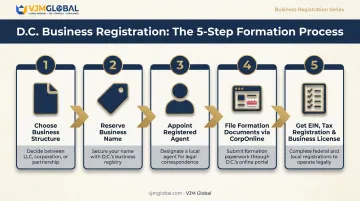
Step 2: Choose and Reserve Your Business Name
D.C. naming rules under DC Code § 29-103.01 require:
- A name distinguishable from any active, reserved, or registered entity in D.C.
- The correct entity suffix (LLC, Inc., Corp., or an approved abbreviation)
- Prior Mayor approval before using restricted words like "bank," "insurance," or "credit union"
Not ready to file yet? You can lock in your name with a Name Reservation (Form GN-3) for a $50 fee, which holds it for 120 days. Planning to operate under a different name than your legal one? File a Trade Name Registration (Form TN-1) for $55, valid for two years with renewal due every April 1.
Step 3: Appoint a Registered Agent
Every filing entity in D.C. must continuously maintain a registered agent with a physical D.C. street address, no P.O. boxes allowed, under DC Code § 29-104.02. This agent receives legal notices and official correspondence on your behalf.
You have three options:
- Serve as your own agent: free, but your address becomes public record
- Appoint someone within your company: same privacy trade-off applies
- Hire a commercial registered agent: costs more, but keeps your personal address off the public CorpOnline record
Going more than 60 days without a valid agent is grounds for administrative dissolution, so this isn't a step to treat casually.
Step 4: File Formation Documents Through CorpOnline
Once your structure, name, and agent are set, you'll file your formation document through CorpOnline, D.C.'s online filing portal. Mail and in-person filing are also available, though online tends to be fastest.
| Filing | Base Fee |
|---|---|
| Domestic LLC (Articles of Organization) | $99 |
| Domestic corporation (up to $100,000 authorized capital) | $99 |
| Domestic corporation ($100,000–$500,000) | $550 |
| Domestic nonprofit | $80 |
| Foreign LLC or business corporation | $220 |
| Foreign nonprofit | $80 |
Standard online processing runs within 5 business days. Need it faster? DLCP offers expedited service for an extra $50 (3-day) or $100 (fastest available).
Step 5: Get an EIN, Register for Taxes, and Apply for a Business License
With your entity formed, three things remain before you can legally operate:
- Get a free federal EIN directly from the IRS, but only after your D.C. entity is officially formed
- File Form FR-500 (Combined Business Tax Registration) with OTR through MyTax.DC.gov
- Apply for a Basic Business License — the General Business License covers retail, consulting, and most services not regulated by a separate board, running $49 for 6 months, $99 for 2 years, or $198 for 4 years
Certain professions (engineering, healthcare, legal services) require a specialized professional license instead of the general one. Check with DLCP's licensing division before assuming General Business applies to you.
What You Need Before Registering Your D.C. Business
Gathering the right information upfront prevents rejected filings and avoids unnecessary back-and-forth with D.C.'s Department of Licensing and Consumer Protection (DLCP).
Business Information & Ownership Details
Have these ready before you start your filing:
- Legal business name and principal office address
- Entity type (LLC, corporation, nonprofit, etc.)
- Names and addresses of members, managers, or directors/officers
- Purpose statement (required for some entity types)
Registered Agent Requirements
Your registered agent must have a valid D.C. physical street address; P.O. boxes don't qualify. Failure to maintain one for more than 60 days can trigger revocation of your entity's good standing, so update your agent's information the moment it changes.
Documentation for Foreign Entities
If your entity was formed outside D.C., you'll need a Certificate of Good Standing from your home jurisdiction, dated within 90 days of your FN-1 filing. Without it, your foreign registration will be rejected outright.
Key Factors That Affect Your D.C. Business Registration
A handful of decisions made during setup drive your total cost, timeline, and ongoing compliance burden.
Business Structure Type
Why it matters: Your structure determines liability protection, tax treatment (pass-through versus corporate), and which formation form applies.
Impact: Filing fees and required internal documents (operating agreement versus bylaws) differ between an LLC and a corporation.
Registered Agent Choice
Why it matters: Whether your personal address becomes part of the public CorpOnline record depends entirely on who you name as agent.
Impact: Commercial registered agent services add an annual cost, but they protect privacy and ensure legal notices don't get missed.
Foreign Qualification Needs
Why it matters: Businesses formed in another state but operating regularly in D.C. must file Form FN-1 alongside their home-state registration.
Impact: This adds a second layer of biennial reporting and fees, doubling your compliance calendar.
Filing Method and Processing Speed
Why it matters: Mail, online, and in-person filings all move at different speeds.
Impact: Online filing through CorpOnline is generally fastest, with expedited options available for $50 (3-day) or $100 (fastest service) if you're on a deadline.
Common Mistakes to Avoid & Staying Compliant After Registration
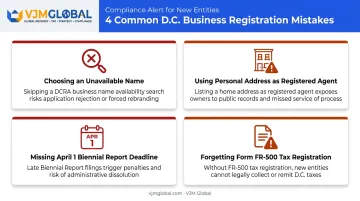
Most rejected filings and compliance lapses trace back to a handful of avoidable errors:
- Choosing an unavailable name: Skipping the name-availability check leads to outright filing rejection.
- Listing a personal address as registered agent: This unintentionally exposes it on the public CorpOnline record.
- Missing the April 1 Biennial Report deadline: Triggers a late fee and can eventually lead to administrative dissolution.
- Forgetting Form FR-500: Your entity is formed with DLCP but has no tax registration with OTR, creating problems the moment you start earning revenue.
Founders managing operations across two countries face an extra layer of complexity. NRIs and Indian entrepreneurs setting up a U.S. presence often find it hardest to keep bookkeeping, tax filings, and compliance aligned on both sides. Firms like VJM Global offer outsourced accounting, tax compliance, and back-office support built for exactly this kind of dual-jurisdiction setup, freeing founders from managing it all in-house.
Frequently Asked Questions
How do I register a company in DC?
Choose your business structure, name and reserve it if needed, appoint a D.C. registered agent, and file the relevant formation form through CorpOnline. Follow up with an EIN and FR-500 tax registration.
What is a DC LLC?
A D.C. LLC is a Limited Liability Company formed by filing Articles of Organization (Form DLC-1) with DLCP. It offers liability protection with pass-through taxation by default.
What is a registered agent in DC?
A registered agent is an individual or entity with a physical D.C. street address responsible for receiving legal notices and state correspondence on your business's behalf.
How can I check if a business is registered in DC?
You can search by entity name through DLCP's public CorpOnline portal, which shows filing status, registered agent details, and report history.
How much does it cost to register a business in Washington D.C.?
For an LLC or corporation with up to $100,000 in authorized capital, expect roughly $448 to $597 total, covering formation, the first Biennial Report, and a Basic Business License. Costs rise with higher authorized capital.
Can a non-U.S. resident or NRI register a business in Washington D.C.?
Yes. There's no residency or citizenship requirement to form a D.C. entity, though you'll still need a registered agent with a D.C. address. Advisory firms like VJM Global help NRIs and foreign founders manage the cross-border setup and compliance requirements.