The process of conversion of private company into a public company in India can open new doors to public investment, market expansion, and enhanced credibility in the Indian market.
Particularly for U.S. businesses looking to expand and capitalize on the Indian market, converting a private limited company into a public company is a significant step towards scaling operations, raising capital, and gaining visibility.
In this guide, we'll walk you through the essentials of converting your private company into a public company in India, focusing on U.S. companies and their unique challenges.
A private limited company is a business entity in which ownership is restricted to a certain number of members, and shares cannot be traded publicly. U.S. businesses planning to enter India may initially choose this structure because it offers privacy, fewer regulations, and easier management.
In contrast, a public limited company offers more opportunities for raising capital and gaining market visibility, which might be suitable for your expanding business needs.
A public limited company allows for the sale of shares to the general public and is typically listed on Indian stock exchanges like the BSE and NSE. Public companies are subject to stringent disclosure requirements under SEBI and MCA guidelines, boosting trust and transparency. This structure gives U.S. businesses greater access to capital markets and public investors in India.
Also Read: How to Register a Trademark in India: Step-By-Step Guide
Understanding the distinctions between a private limited company and a public limited company is crucial for making the right business structure decision as you expand into India.
Understanding the key distinctions between a public limited company and a private limited company is vital for U.S. businesses considering a conversion. Below is a detailed table to help differentiate the two:
If you’re considering expansion, converting your private company into a public company in India brings multiple advantages, including access to capital and increased credibility.

Converting a private limited company into a public company offers significant advantages for U.S. entrepreneurs and business owners seeking to expand their operations in India.
A public limited company can raise substantial funds through public subscriptions, IPO, and secondary offerings, providing financial resources for growth and innovation.
Being listed on stock exchanges like the BSE or NSE boosts the company's market visibility and recognition, attracting more investors and customers.
Publicly traded shares offer liquidity, enabling shareholders, including U.S. parent companies, to buy and sell shares freely on the open market.
Public limited companies are subject to strict regulatory oversight by SEBI and the Ministry of Corporate Affairs (MCA), improving transparency and credibility with investors and partners.
Public companies are more attractive targets for mergers and acquisitions, as their financials and operations are more accessible to potential investors.
If your U.S. business looks to convert into a public limited company in India, VJM Global ensures smooth FEMA compliance, transfer pricing strategies, and taxation advisory to optimize your expansion. Our expertise guides you through every step, from financial restructuring to SEBI compliance, ensuring a seamless transition.
Before proceeding, there are certain prerequisites you need to fulfill for the conversion to a public company.
Before converting a private limited company into a public company, there are several essential requirements that U.S. businesses must fulfill:
The company must have been profitable for the last three years, as demonstrated in the audited financial statements, to meet the eligibility criteria for a public company conversion.
The Memorandum of Association (MOA) and Articles of Association (AOA) must be amended to reflect the public company status and its expanded activities.
A public limited company must meet the minimum capital threshold set by Indian regulations. This may include raising initial funds from existing shareholders or public investors.
The Board of Directors must pass a resolution to convert the private limited company into a public company and approve changes to the corporate structure.
The shareholders must pass a special resolution during an Extraordinary General Meeting (EGM) to approve the conversion.
Suggested Read: Company Registration Cost in India Explained
The conversion process requires submitting essential documents to ensure smooth processing.
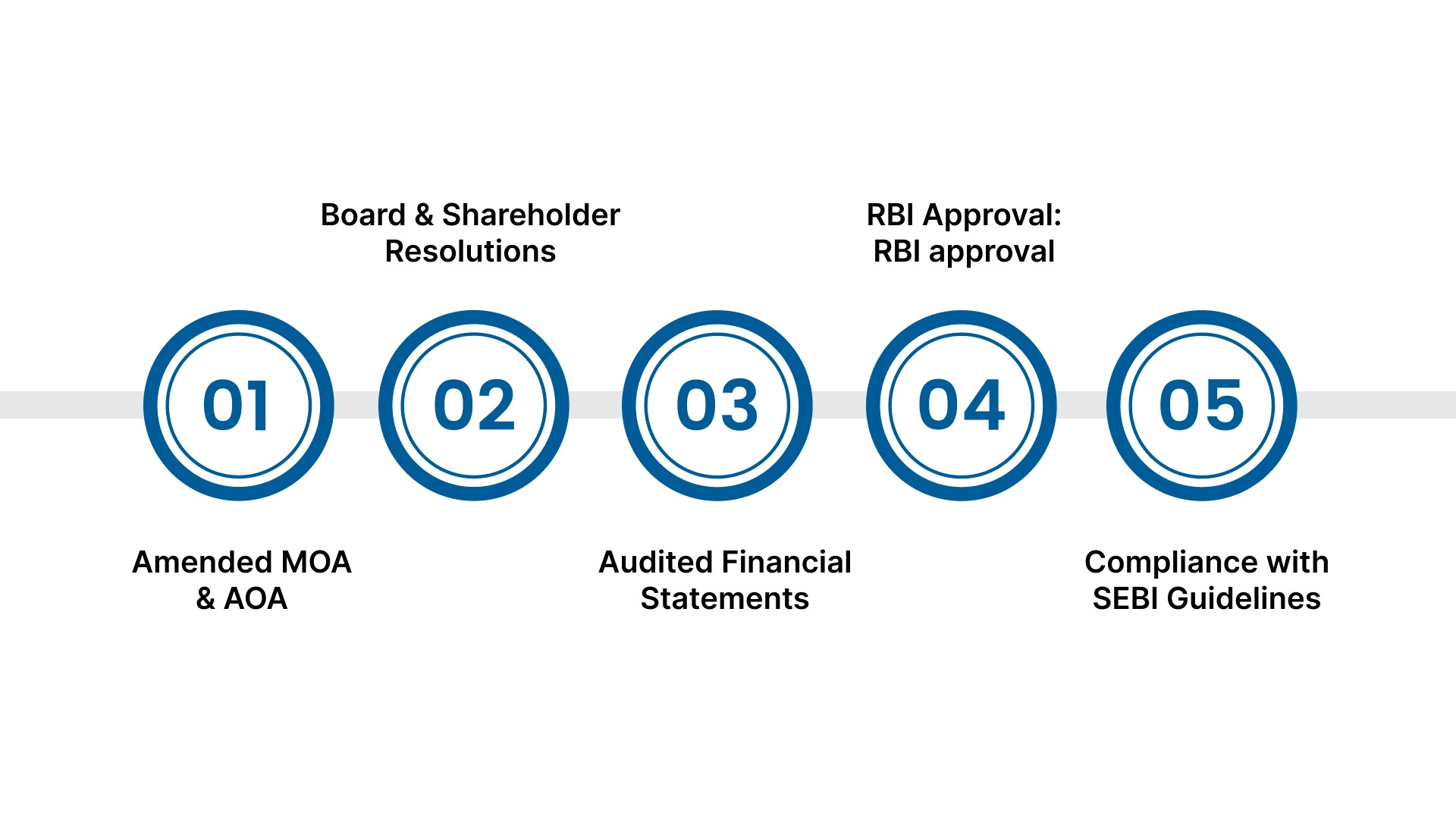
The following documents are required by U.S. companies seeking to convert their private limited company into a public company in India:
To facilitate the conversion, the following forms must be filed with the Registrar of Companies (RoC) with necessary attachments.
To successfully convert your US-based private limited company into a public company in India, you'll need to file specific forms with the Registrar of Companies (RoC).
This form must be filed with the Registrar of Companies (RoC) within 30 days of passing the special resolutions. It includes the board resolution and the amended MOA and AOA.
This form is required to apply for the conversion and must be filed within 15 days of the EGM resolutions. Attachments include the minutes of the meeting, the new AOA, and MOA, and a list of members.
A newspaper advertisement announcing the change in status must be published in a leading daily and filed with Form INC-25A.
As a US business owner, converting your private limited company into a public company in India can be tricky, but VJM Global simplifies the process. We assist with cross-border transaction advisory and statutory audits to ensure you meet all legal requirements while maximizing your company’s growth potential.
Also Read: Benefits of LLP Registration in India
While converting your company, compliance with SEBI regulations and Indian tax laws is crucial to ensure that your public company meets all statutory requirements.
U.S. businesses must fulfill a number of Indian compliance requirements during the conversion process:
Next, let's look at the steps to ensure proper registration and compliance of the conversion process.

Converting a private limited company into a public limited company in India is a critical process for U.S. businesses looking to expand. The following steps provide clarity on how to deal with the legal and regulatory conditions when making this transition.
Step 1: Conduct a Board Meeting
U.S. companies must hold a board meeting to approve resolutions for conducting an EGM, adopting a new MOA and AOA, and restructuring the board.
Step 2: Issue Notice for EGM and Convene the Meeting
U.S. entrepreneurs must issue an EGM notice at least 21 days prior to the meeting to pass resolutions for name change and to revise the MOA and AOA.
Step 3: File Forms with the RoC
File E-Form MGT-14 and E-Form INC-27 with the Registrar of Companies (RoC), including the new MOA, AOA, and certified resolutions from the EGM.
Step 4: Publish the Conversion Notice
U.S. companies must publish an advertisement in a local newspaper using Form INC-25A to announce the company’s conversion to a public limited company.
Step 5: Obtain Certificate of Incorporation
Once the RoC approves the documents, the U.S. company will receive a Certificate of Incorporation as a public limited company and update its legal documents.
Also Read: Understanding the Three Financial Statements and Their Connections
After converting a private limited company into a public limited company, U.S. entrepreneurs must follow specific post-conversion procedures to ensure the transition is fully compliant with Indian regulations.
VJM Global provides expert assistance throughout the conversion process, ensuring that your U.S. company meets Indian regulatory standards and successfully transitions to a public limited company.
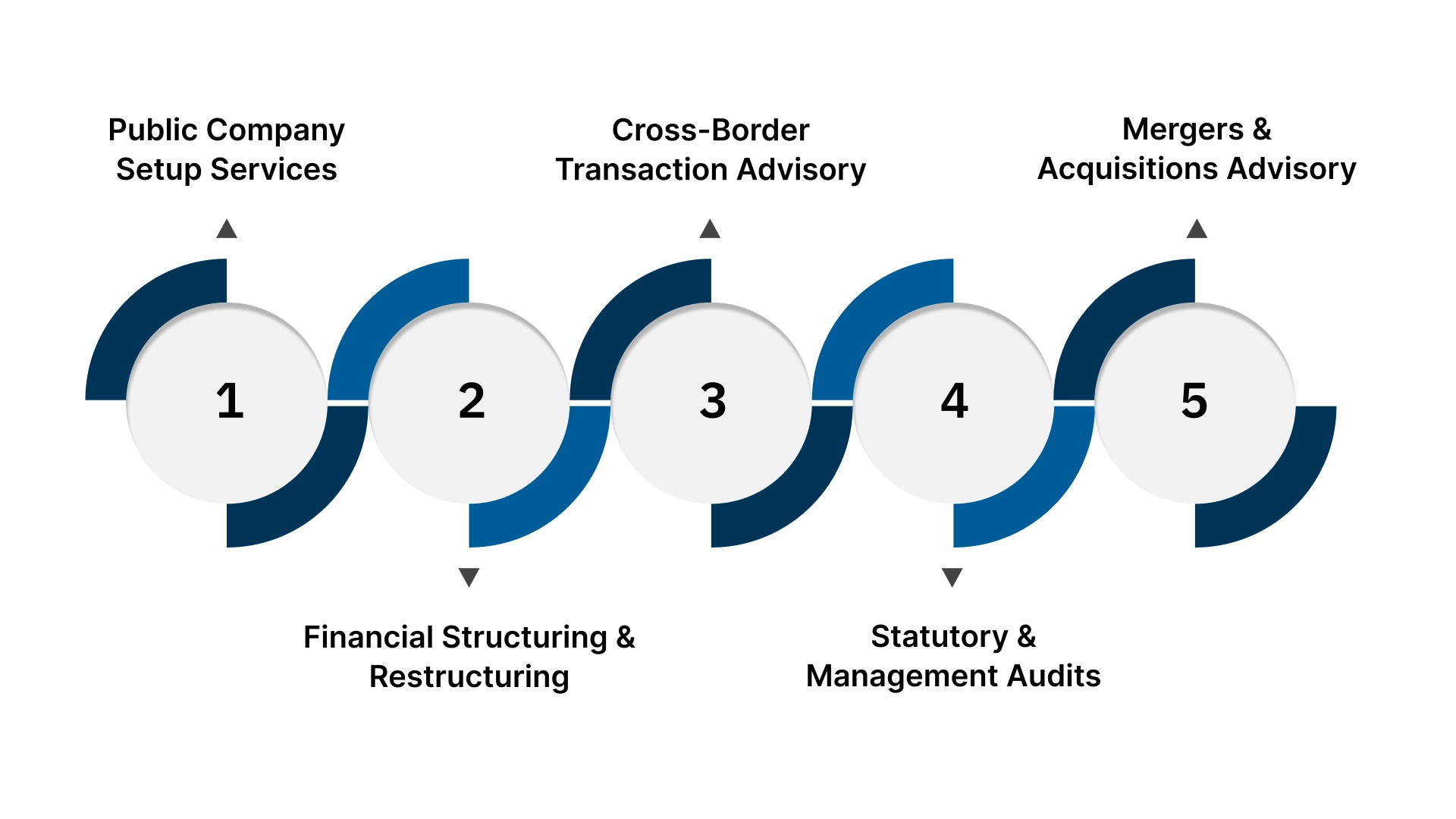
VJM Global offers a comprehensive range of services to guide you through the complexities of converting your private limited company into a public limited company in India. This will make sure that your business meets all the regulatory requirements and is well-positioned for long-term success.
1. Public Limited Company Setup Services
If you’re looking to convert your private limited company into a public limited company in India, VJM Global provides expert public limited company setup services. We assist with the necessary legal filings and amendments of the MOA and AOA, and help you comply with the SEBI regulations for a seamless transition.
2. Financial Structuring & Restructuring
As part of the conversion process, financial restructuring may be required to meet the capitalization and liquidity requirements for a public company. VJM Global’s restructuring services provide financial strategies, including business process re-engineering and due diligence audits, to optimize operations and ensure profitability.
3. Cross-Border Transaction Advisory
For U.S. companies expanding in India, VJM Global offers FEMA advisory, transfer pricing guidance, and DTAA compliance to help your company adhere to foreign investment rules, ensuring that your public company setup aligns with both U.S. and Indian laws.
4. Statutory and Management Audits
For U.S. companies converting to a public limited company, ensuring statutory compliance is essential. VJM Global provides statutory audits, internal audits, and management audits to ensure that your financial reporting meets Indian and international standards, particularly under the Companies Act, 2013.
5. Mergers & Acquisitions Advisory
Changing your private company to a public company may require strategic mergers or acquisitions to meet regulatory requirements and market expectations. VJM Global’s M&A advisory services guide you through merger planning, valuation, and post-conversion integration, maximizing your business growth potential in India.
From financial restructuring to statutory compliance, we offer end-to-end solutions tailored to meet the unique needs of U.S. businesses seeking to convert their private limited company into a public company in India.
Converting a private limited company into a public company in India is an essential step for U.S. companies looking to expand their presence, raise capital, and increase market visibility.
The process requires thorough planning and adherence to Indian corporate laws. With the right guidance and expertise, U.S. entrepreneurs can overcome these regulatory hurdles efficiently, ensuring a smooth transition and maximizing growth potential in the Indian market.
At VJM Global, we offer specialized support to help you through every step of the conversion process, ensuring that your U.S. business can develop as a public limited company in India. We offer expert support in corporate restructuring, M&A advisory, ROC compliance, corporate law advisory, company audits, and accounting and taxation compliance.
Contact VJM Global and ensure your business is ready for public offerings with confidence and clarity.
To convert to a public company in India, U.S. businesses must meet profitability and capitalization requirements, ensure board approval, and comply with Indian corporate laws.
The Registrar of Companies (RoC) verifies the company’s documents, ensures compliance with Indian regulations, and issues the certificate of incorporation post-conversion.
No, after conversion, a U.S. company must meet SEBI regulations and prepare for an IPO, which includes satisfying minimum financial requirements and public disclosure norms.
After conversion, U.S. companies must adhere to SEBI regulations, tax reporting requirements, statutory audits, and annual filings with the Registrar of Companies (RoC).
Post-conversion, U.S. companies must allow public shareholders greater control, comply with board structure changes, and follow governance guidelines under Indian corporate law.