The underlying obligation hasn't gone anywhere, though. C corporations still need to estimate and pay federal income tax in instalments four times a year. Miss a deadline or underpay, and the IRS calculates penalties instalment by instalment, not just against the year-end balance.
This guide uses the IRS's current Form 1120, Form 1120-S, and Form 2220 instructions to explain the process as it stands today. We'll distinguish Form 1120-W from the forms that actually matter now, walk through the calculation workflow, and flag where Australian finance teams managing a US entity should bring in cross-border advice. Treat this as general guidance, not advice for your specific position.
Key Takeaways
- Form 1120-W is historical: its final version covered the 2022 tax year, so verify any downloaded copy.
- Estimated-tax obligations still apply to eligible C corporations and certain S corporation entity-level taxes.
- Current calculations use Publication 542, Form 1120 instructions, and Form 2220, not the retired worksheet.
- Payments must go through an approved electronic channel; keep confirmation records for every instalment.
- Australian parent companies should sync US subsidiary projections with group reporting and cross-border tax advice.
Who Should Use the Current Corporate Estimated-Tax Process and What You Need
A C corporation generally must make estimated-tax instalments once it expects its total tax for the year, after applicable credits, to reach US$500 or more. That's a tax-liability test, not a revenue or turnover test. A small subsidiary with modest profit can still trip the threshold once credits are factored in.
S corporations work differently. Income typically passes through to shareholders, so there's no entity-level estimated tax in most cases. The exception is a combined US$500 threshold covering three specific taxes:
- Built-in gains tax
- Excess net passive income tax
- Investment credit recapture tax
If that combined total hits US$500, the S corporation generally pays four equal instalments. LIFO recapture tax runs on a separate schedule entirely, tied to return due dates across several years rather than quarterly payments within one.
Several situations change the calculation:
- First-year corporations with no prior return to lean on
- Short tax years
- Fiscal-year corporations whose deadlines don't follow the calendar
- Businesses with irregular income
An Australian parent with a US subsidiary doesn't get special treatment here. The subsidiary, as a US-formed entity, follows the same federal rules as any domestic corporation.
Required Information and Inputs
Before calculating anything, gather:
- Current-year projections for gross income, expenses, depreciation, losses, credits, withholding, and other taxes
- The prior-year federal return and tax liability, to assess a potential safe-harbour comparison
- The corporation's tax year, EIN, payment account, and a named finance contact for payment authorisation
- A flag for anything needing specialist review (foreign tax credits, international tax provisions, or large-corporation rules) so it goes to a qualified adviser rather than a generic calculation
How to Calculate and Pay Corporate Estimated Tax: A Current Step-by-Step Workflow
With Form 1120-W off the table, the modern process runs through five stages: project the liability, determine the required annual payment, allocate installments, submit payments, and reconcile against the annual return.

Build the Tax Projection
Start with year-to-date bookkeeping and extend it into a defensible full-year forecast covering revenue, ordinary expenses, depreciation, losses, credits, and other taxable items. The current flat federal corporate rate is 21% of taxable income, confirmed in the current Form 1120 instructions.
Only layer in additional provisions, such as corporate minimum-tax or base-erosion rules, where they genuinely apply. Most mid-sized subsidiaries won't be subject to them, so don't assume otherwise by default.
Determine the Required Annual Payment
The required annual payment is generally the smaller of 100% of current-year tax or 100% of qualifying prior-year tax, where the prior-year return covered a full 12 months and showed a positive liability. Large corporations face a limitation here (more below).
Document the assumptions behind the number: tax-year basis, credits applied, losses used, and any revisions made mid-year. This paper trail matters if the IRS later questions an installment.
Allocate and Schedule Installments
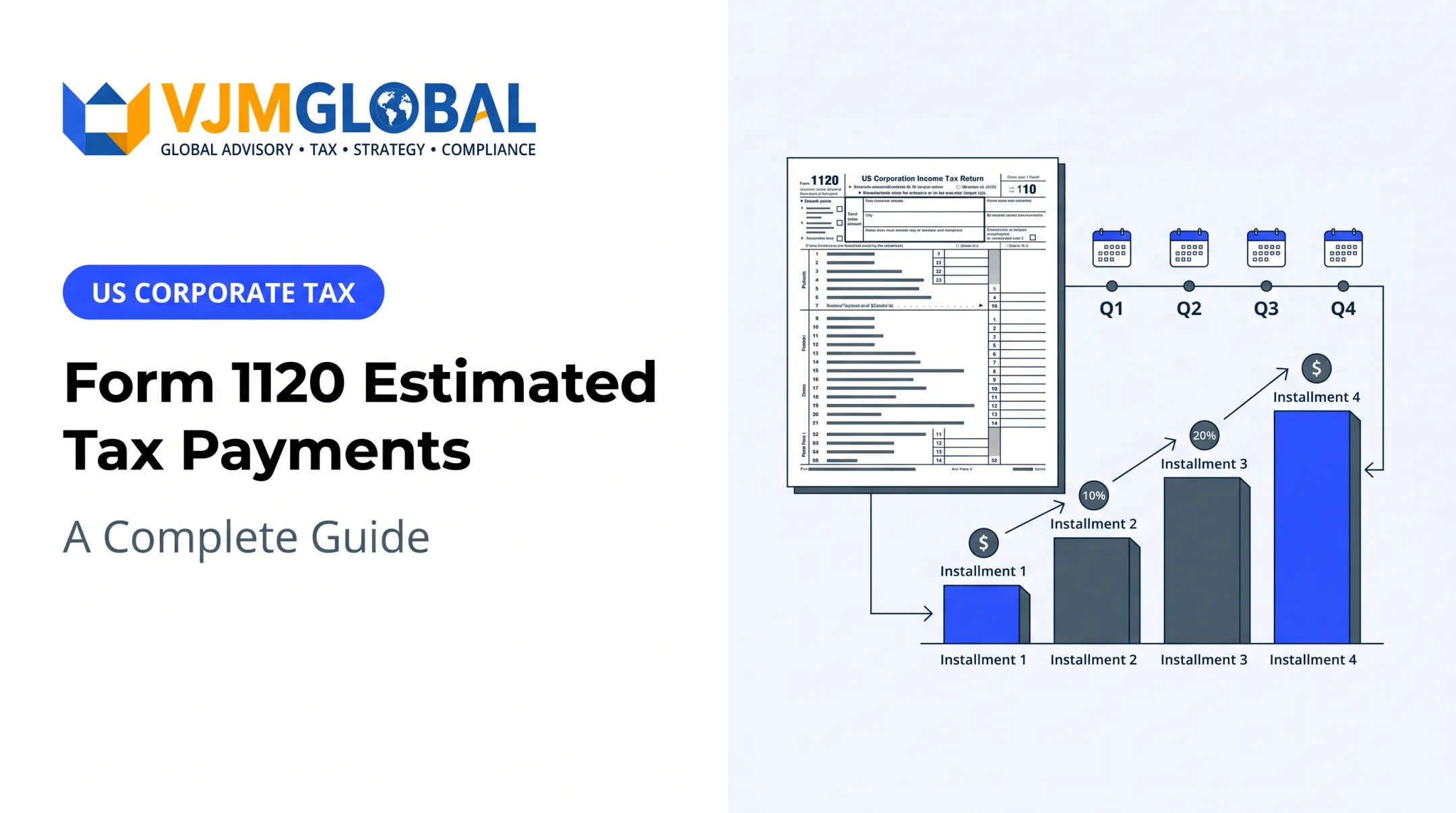
The regular method splits the required annual payment into four equal 25% installments:
| Installment | Standard due date (calendar year) |
|---|---|
| First | 15th day of 4th month |
| Second | 15th day of 6th month |
| Third | 15th day of 9th month |
| Fourth | 15th day of 12th month |
Fiscal-year corporations calculate these dates from their own tax-year start, not from the calendar-year dates above. Weekends and legal holidays also push a due date to the next business day. Always check it against the current IRS calendar rather than assuming last year's dates still apply.
Submit the Payment and Retain Evidence
Electronic payment is required. Options include EFTPS, the IRS business tax account, a trusted third party making the deposit on the corporation's behalf, or a same-day bank wire. New EFTPS enrollments can take up to five business days to process, so don't leave registration until the week of a deadline.
Cutoff timing depends on the amount: payments of US$1 million or less generally qualify for same-day processing if submitted before 3 p.m. Eastern time, while larger payments need to go in by 8 p.m. Eastern time the day before.
Keep confirmation numbers, bank records, the underlying projections, approval sign-offs, and any adviser correspondence together. You'll want all of it if the IRS questions a payment later.
Reconcile at Year End
Estimated payments are credited against the annual Form 1120 liability. They don't replace filing the return itself. Form 2220 handles underpayment calculations and must be attached in specific circumstances, including when the annualized or seasonal methods were used.
Before closing the year, check:
- Total estimated payments made across all installments
- The final projected liability versus the filed return
- Any balance due or overpayment
- Whether Form 2220 needs to be attached
Safe Harbours, Instalment Methods, and Special Situations
A safe harbour protects a corporation from underpayment penalties when it pays the required amount on time. The statutory percentages and exceptions get updated periodically, so verify them for the current tax year rather than reusing last year's figures.
Regular, Annualised, and Adjusted Seasonal Methods
The regular method uses four equal 25% instalments and suits businesses with steady income throughout the year. Two alternatives exist for less predictable patterns:
- Annualised income method — uses actual income for defined portions of the year, annualised, and can lower or eliminate instalments when income is uneven
- Adjusted seasonal method — requires a genuine recurring seasonal pattern, with a base-period percentage of 70% or more for any six consecutive months, measured against the same period in the prior three years, per the Form 2220 instructions
How the methods play out in practice:
- A steady logistics-support business sticks with the regular method
- A fast-growing software subsidiary ramping revenue through the year benefits from annualising
- A produce exporter with a genuine harvest-season spike may qualify for the adjusted seasonal method, provided the records back up that 70% test
First-Year and Short-Year Corporations
A first-year corporation has no prior-year return to compare against, so it leans entirely on current-year projections. A short tax year can also change how many instalments are due and when. Check the current IRS instructions for the exact mechanics rather than assuming a standard four-instalment year.
Large Corporations and Major Business Changes
A large corporation (broadly, one with taxable income of US$1 million or more in any one of the preceding three tax years) can only use the prior-year safe harbour for its first instalment. Any shortfall from that gets folded into the second instalment, with the third and fourth based on current-year tax.
Recalculate the projection whenever one of these happens:
- A major asset sale or acquisition
- New financing or a significant ownership change
- A sharp revenue swing, up or down
- Large deductions or newly identified credits
Underpayment and Penalty Exposure
Underpayment is generally reviewed instalment by instalment, not just against the year-end balance. The penalty is calculated on the underpaid amount and the number of days it stayed unpaid, using the applicable quarterly rate. Paying the full balance with Form 1120 doesn't erase a shortfall from an earlier instalment. If that has happened, a tax professional can review whether any statutory exception or relief applies.

Where the Process Fits in Corporate Tax Compliance
Estimated tax work sits inside a bigger cycle:
- Bookkeeping and forecasting feed quarterly payment preparation
- Quarterly work feeds the annual Form 1120 filing
- The return is reconciled against payments already made
- Form 2220 is reviewed if a shortfall shows up
Federal estimated tax is also just one obligation among several. US corporate returns are filed on Form 1120, Form 1120-S, or Form 1065, depending on structure, and often sit alongside:
- State-level obligations, such as California franchise tax or New York corporate requirements
- Federal and state payroll withholding, reported through Forms W-4, W-2, 941, and 1099-NEC
- State-by-state sales tax registration
For an Australian parent, the US subsidiary's forecasts can feed directly into group cash-flow planning and consolidated reporting. Paying US federal estimated tax does not settle anything on the Australian side. Australian corporate tax compliance runs on its own separate timeline and rules.

Share the underlying records across four groups:
- The subsidiary's finance team
- The external tax adviser
- The parent company's reporting team
- Whoever is authorised to approve payments
Best Practices for Using the Process Effectively
A one-time annual estimate goes stale fast. Treat the projection as a living document instead:
- Run a rolling quarterly forecast tied to current bookkeeping, not the figure calculated back in month four
- Set internal review dates ahead of every IRS deadline, allowing time for approvals and any foreign-exchange considerations
- Recalculate after material changes: new financing, an acquisition, a swing in revenue, or a change in ownership
- Use two-person verification on EIN, tax period, payment type, amount, due date, and confirmation number before and after submission
- Keep a compliance folder with the prior-year return, calculation files, source reports, payment confirmations, and adviser notes together
- Check current IRS publications each year (Publication 542, the Form 1120 and 2220 instructions, and EFTPS guidance) rather than reusing last year's process
For businesses that want a second set of eyes, VJM Global supports Australian companies with US subsidiaries on this work: preparing projections, reviewing safe-harbour positioning, coordinating payment records, and reconciling the eventual US filings.
Get advice specific to your corporation's actual US and Australian tax position before relying on any general guide, including this one.
Conclusion
Form 1120-W belongs in the history books now: useful background, not a current form to file or lean on. What hasn't changed is the obligation itself: project the liability accurately, pick the right instalment method, pay electronically on time, and keep records that would survive an IRS enquiry.
If you're an Australian company with a US entity, don't wait for the next instalment deadline to figure out where you stand. Review your safe-harbour position, your projection assumptions, and your cross-border reporting obligations with a qualified tax professional before the date arrives, not after.
Frequently Asked Questions
Is Form 1120-W still required?
No. The IRS retired the form and its instructions after the 2022 tax year. It was never filed with the IRS anyway ; it was a worksheet for the corporation's own records, now superseded by current publications and Form 2220 guidance.
What replaced Form 1120-W?
No single worksheet took its place. Corporations now combine Publication 542, the current Form 1120 instructions, Form 2220 and its instructions, and their own internal tax projections.
Who must make corporate estimated tax payments?
C corporations generally must pay when their expected annual tax after credits reaches US$500. S corporations mostly pass income through to shareholders, except for specific entity-level taxes like built-in gains tax.
When are corporate estimated tax payments due?
Standard due dates fall on the 15th day of the 4th, 6th, 9th, and 12th months of the tax year. Fiscal-year corporations calculate from their own tax-year start, and weekend or holiday shifts should be checked against the current IRS calendar.
How are corporate estimated taxes paid?
Payments must be made electronically, commonly through EFTPS or another IRS-approved channel. Confirm the payment type, tax period, EIN, and amount carefully before submitting.
What happens if a corporation underpays estimated tax?
An instalment-based underpayment penalty may apply, generally calculated through Form 2220. Paying the full balance when filing Form 1120 doesn't automatically remove a penalty from an earlier instalment shortfall.