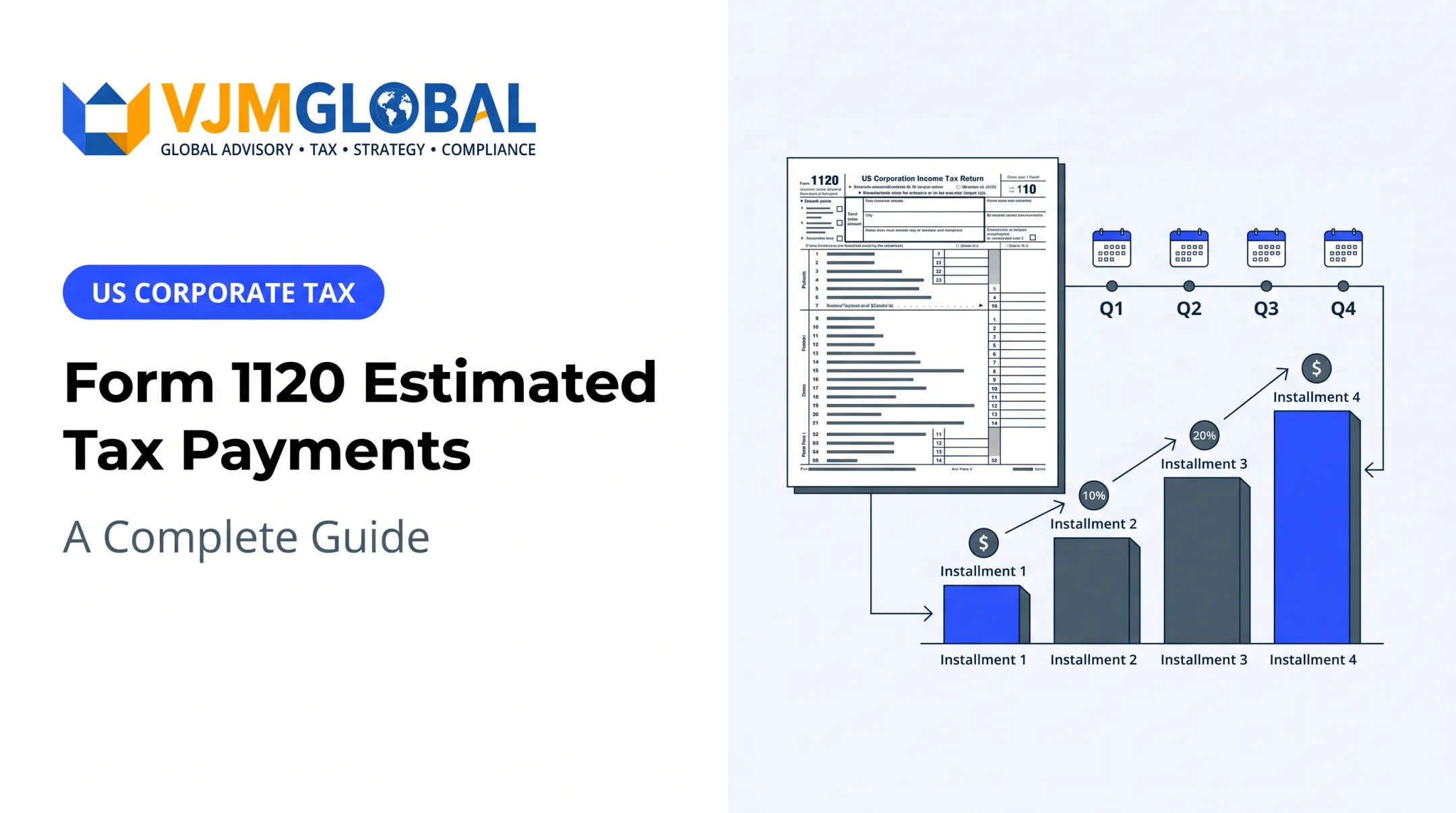
The quarterly estimated-tax obligation behind the worksheet, however, is very much alive. C corporations, first-year companies, and international businesses with US corporate tax obligations (including Australian parent companies running a US subsidiary) still need to calculate and pay installments four times a year.
This guide covers who owes estimated tax, when payments are due, how to calculate them using current IRS methods, safe-harbor rules, EFTPS payments, underpayment penalties, and how Form 1120-W relates to Forms 1120, 1120-S, and 2220.
Key Takeaways
- Form 1120-W was a worksheet for internal records, not a document submitted to the IRS
- Quarterly estimated-tax payments are still required even though the worksheet is retired
- Use Publication 542 and the Form 2220 instructions instead of outdated worksheet guidance
- Choose between current-year liability, prior-year safe harbor, annualized income, or adjusted seasonal methods
- Always verify current deadlines, electronic-payment rules, and penalty rates before paying
What Is Form 1120-W and Is It Still Used?
Form 1120-W, "Estimated Tax for Corporations," was never meant to be filed. It was a worksheet corporations used to project their annual tax liability and figure each quarterly installment, then kept for their own records.
2022 was the final tax-year edition. Publication 542 confirms that the worksheet and its instructions are now historical documents.
If you find a website describing Form 1120-W as something you'd complete and submit this year, that page is outdated. Always check the tax year printed on any IRS PDF before relying on it.
What Replaced the Worksheet
Nothing replaced Form 1120-W as a single document. Instead, corporations now pull calculation guidance from several current sources:
- Publication 542 for general corporate estimated-tax rules
- Form 1120 instructions for return-level tax and payment rules
- Form 2220 and its instructions for installment math and underpayment penalties
- Internal tax projections built from current-year bookkeeping data
How Form 1120-W Differs From the Forms You Actually File
| Form | Purpose | Filed with IRS? |
|---|---|---|
| 1120-W | Historical worksheet for estimating tax | No, retained internally |
| 1120 | Annual income tax return for a C corporation | Yes |
| 1120-S | Annual return for an S corporation | Yes |
| 2220 | Calculates underpayment penalty on estimated tax | Attached when required |
Form 2220 is not a renamed version of the old worksheet. It solves a different problem: figuring out whether you underpaid an installment and what that costs.
Who Must Pay Corporate Estimated Tax and When Are Payments Due?
A C corporation generally must make estimated payments if its expected tax liability, after credits, is $500 or more for the year. This threshold comes from the current Form 1120 instructions and Publication 542, not from the retired worksheet.
S corporations don't typically pay entity-level estimated tax because income passes through to shareholders. There's an exception: if an S corporation owes built-in gains tax, excess net passive income tax, or investment credit recapture tax totaling $500 or more, it must make its own installments.
Standard Due Dates for Calendar-Year Corporations
| Installment | Due date (calendar-year corporation) |
|---|---|
| 1st | 15th day of the 4th month |
| 2nd | 15th day of the 6th month |
| 3rd | 15th day of the 9th month |
| 4th | 15th day of the 12th month |
Fiscal-year corporations count these months from their own tax-year start, not from January. If a due date lands on a weekend or legal holiday, the payment moves to the next business day. Always confirm the exact calendar dates for the current tax year before scheduling anything.
A few situations deserve extra attention:
- First-year corporations often underestimate their first installment because there's no prior-year return to compare against
- Short tax years compress the installment schedule and change the applicable months
- Businesses with irregular income need to revisit projections mid-year rather than assume the first estimate still holds
- Any major change in expected liability, such as a large asset sale, should trigger a recalculation before the next due date
How to Calculate Estimated Tax and Apply the Safe-Harbor Rules
Start by projecting gross income, then estimate deductible expenses and adjustments to arrive at taxable income. Apply the current corporate tax rate, subtract eligible credits, and add any additional taxes that apply, such as the alternative minimum tax or base erosion provisions.
For items like net operating losses, research credits, and foreign tax credits, consult current IRS guidance rather than assuming prior-year rules still apply. Tax law changes year to year, and an outdated assumption here cascades through every installment.
The Required Annual Payment
Under current IRS rules, a corporation generally pays the lesser of 100% of current-year tax or 100% of the prior year's tax shown on a full 12-month return. This is the core safe-harbor comparison.

Two conditions can eliminate the prior-year option:
- The preceding tax year wasn't a full 12 months (common for brand-new corporations)
- The corporation didn't file a return showing a positive tax liability for that year
Large corporations face a further limit. A corporation (other than an S corporation) with taxable income of $1 million or more in any of the three preceding years can only use the prior-year safe harbor for its first installment. Any shortfall from that reduction has to be made up in the next installment.
Three Installment Methods Compared
| Method | How it works | Best suited for |
|---|---|---|
| Regular method | Generally splits the required annual payment into four equal installments | Steady, predictable income |
| Annualized income method | Calculates tax based on income actually earned in specified periods during the year | Businesses with uneven quarterly earnings |
| Adjusted seasonal method | Uses a historical seasonal income pattern, generally requiring 70% or more income concentration in a recurring six-month stretch | Businesses with genuine, repeating seasonality |
If your revenue, deductions, credits, or ownership structure changes mid-year, revise your projection and keep a record of what changed and why. That paper trail matters if the IRS later questions an installment.
How to Pay Estimated Corporate Tax and Maintain Records
Corporations generally must pay estimated tax electronically. EFTPS (the Electronic Federal Tax Payment System) is the primary channel, though banks and authorized third parties can also initiate transfers on a corporation's behalf.
A Practical EFTPS Workflow
- Enroll early: processing can take several business days, and first-time users receive a mailed PIN
- Select the correct payment type for corporate estimated tax
- Enter the tax period and amount carefully; mismatches cause misapplied payments
- Schedule the payment ahead of the deadline, since same-day scheduling cutoffs apply
- Confirm the transaction before logging off
- Retain the acknowledgment number for your records
Verify current enrollment lead times and scheduling cutoffs directly on EFTPS before your first deadline. For urgent situations, you can also use IRS Direct Pay for businesses or arrange a same-day wire through your bank.
Records Worth Keeping
- Income and cash-flow projections used for each installment
- Calculation worksheets and the rationale behind any revision
- Prior-year tax return
- Payment confirmations and bank records
- Supporting documentation for tax credits claimed
- Correspondence with your tax advisor
The IRS credits estimated payments toward your annual Form 1120 liability; they do not replace filing the return itself. Before you submit any payment, double-check the EIN, tax period, payment amount, payment type, bank account, due date, and confirmation number.
What Happens If Estimated Tax Is Underpaid?
The IRS doesn't just compare your total tax paid against your total tax owed at year-end. It calculates underpayment installment by installment, applying the rate in effect during each period the underpayment existed.
Interest rates on underpayments change quarterly. As one example, the IRS's Q4 2026 announcement set the ordinary corporate underpayment rate at 7% for October through December 2026. That means a shortfall sitting unpaid across two quarters could be charged two different rates.

Common reasons corporations end up underpaid:
- Overly optimistic or stale income forecasts
- EFTPS payments misclassified under the wrong tax period
- Late payments that miss the scheduling cutoff
- Unplanned transactions, such as an asset sale, that spike taxable income
- Overlooked additional taxes like AMT or base erosion charges
- Failing to revise projections after a material business change
Paying your full balance when you file Form 1120 does not erase an installment-based penalty that already accrued earlier in the year. The penalty clock runs from each missed due date, not from year-end.
Relief exists in limited circumstances. A corporation that properly used the annualized income or adjusted seasonal method may reduce what it owes, and qualifying statutory exceptions can apply.
Businesses with a clean compliance history may also qualify for the IRS First-Time Penalty Abatement program. Reconcile estimated payments against the final Form 1120 promptly, and respond to any IRS notice without delay.
How Professional Tax Support Can Help
Coordinating bookkeeping data, tax projections, safe-harbor analysis, EFTPS scheduling, and year-end reconciliation is a lot to manage internally, especially for a growing company or one operating across borders.
VJM Global works with US businesses and multinational companies on exactly this kind of coordination. That includes corporate tax advisory covering direct tax, withholding tax, and international taxation, plus accurate preparation of Forms 1120, 1120-S, and 1065.

For Australian companies running a US subsidiary or C corporation, that often means reconciling two sets of accounting standards while keeping US estimated-tax deadlines on track.
This isn't a substitute for the IRS, and no advisor can promise a penalty will never apply. What a dedicated tax team can do is:
- Build defensible quarterly projections tied to your actual bookkeeping
- Run the safe-harbor comparison correctly for your specific facts
- Set up and manage EFTPS payment schedules
- Reconcile estimated payments against your final Form 1120
If your business is newly formed, cross-border, seasonal, growing quickly, or managing multiple entities, it's worth getting a second set of eyes on your estimated-tax approach before the next installment is due.
Frequently Asked Questions
How do I file my corporate tax return?
C corporations generally file Form 1120 for their annual federal income tax return. Filing method, schedules, and state obligations vary by corporation, so check current IRS instructions or work with a qualified tax professional.
What is the due date for a Form 1120?
The due date depends on your corporation's tax year, generally the 15th day of the fourth month after year-end for calendar-year filers. This is separate from the quarterly estimated-tax deadlines, so verify both on the current IRS calendar.
What is the safe harbor for underpaying estimated tax?
Generally, a corporation avoids underpayment penalties by paying the lesser of 100% of current-year tax or 100% of the prior year's tax from a full 12-month return. Large corporations and those without a qualifying prior-year return face different rules under IRC Section 6655.
What is form 1120 in US tax?
Form 1120 is the annual federal income tax return generally filed by C corporations to report income, deductions, and tax liability. It's distinct from the now-retired Form 1120-W, which was only ever a calculation worksheet.
What is an 1120S tax return?
Form 1120-S is generally filed by an eligible S corporation to report income, deductions, and credits, with results typically passed through to shareholders. Certain entity-level taxes and separate shareholder filings may still apply.