This creates genuine confusion, especially for Australian businesses expanding into the US and foreign-owned US subsidiaries trying to separate American estimated-tax rules from Australian PAYG instalments or company tax procedures back home. The two systems share a similar concept but run on completely different forms, thresholds, and payment platforms.
This guide walks through whether estimated payments apply to your corporation, how to calculate the projected tax, which instalment method fits your income pattern, how to actually pay the IRS, and how everything reconciles with your annual Form 1120. Because IRS rules shift by tax year, always confirm current figures against IRS.gov before filing.
Key Takeaways
- Form 1120-W is historical; verify current rules through IRS Publication 542 and the Form 1120 instructions instead
- Corporations generally owe estimated tax once projected liability reaches the IRS-set threshold, subject to entity type and prior-year figures
- Calculating instalments requires projected income, deductions, credits, and a chosen calculation method
- Electronic payments, consistent bookkeeping, and regular forecast updates limit underpayment penalty exposure
What Was Form 1120-W and Is It Still Used?
Form 1120-W was never a tax return. It was a worksheet corporations used internally to project their annual tax liability and divide it into quarterly instalments. The figures stayed with the corporation's records; nothing from Form 1120-W was ever submitted to the IRS.
The IRS confirms that the 1120-W historical page marked the 2022 version as the form's final revision. Older editions remain online for reference only, not for active use.
What Replaced It
Corporations now rely on a different set of documents to do the same job:
- Publication 542 for general corporate tax background
- Form 1120 instructions for the current threshold, tax rate, and payment rules
- Form 2220 for calculating or reporting an underpayment penalty
Form 1120 itself stays separate from all of this. It's the annual return reporting actual results for the year, not a vehicle for instalment payments.
Which Entities This Applies To
These estimated-tax rules generally apply to:
- C corporations
- LLCs that elect corporate taxation
S corporations work differently. Income typically passes through to shareholders rather than facing entity-level tax, though certain built-in gains or other entity-level taxes can still apply. Check current IRS guidance for your structure before assuming an exemption.
A common question from Australian parent companies is whether a US subsidiary's foreign ownership changes anything. Generally, no. A corporation organised under US law is treated as domestic for federal tax purposes, regardless of where its shareholders or parent company sit.
An Australian-owned Delaware C-corp follows the same estimated-tax rules as a corporation wholly owned by US residents.
How to Estimate Corporate Tax Using the Form 1120-W Logic
Even without the form itself, the calculation logic hasn't changed. It's a straightforward workflow once you break it into stages.
The projection workflow:
- Project gross receipts and other income for the full tax year
- Estimate deductible expenses, including payroll, depreciation, and operating costs
- Subtract deductions from projected income to find taxable income
- Apply the current corporate tax rate
- Subtract eligible credits (foreign tax credit, research credit, general business credits)
- Add any applicable additional taxes
- Compare the result against your safe-harbour option

What Data Feeds the Projection
Reliable estimates depend on current records, not guesswork. Pull from:
- Year-to-date profit-and-loss statements
- Depreciation schedules
- Payroll and operating expense trends
- Prior-year Form 1120 figures
- Any expected asset sales or one-off income events
With those figures assembled, apply the statutory rate. Under the current Form 1120 instructions, corporate tax is calculated at a flat 21% of taxable income.
A corporation generally must make estimated instalments when it expects total tax, after credits, to reach $500 or more for the year. These figures move occasionally, so confirm them before filing rather than trusting last year's number.
The Safe-Harbour Comparison
Corporations typically compare two numbers: projected current-year tax and the prior year's total tax liability. The required annual payment is based on whichever figure is smaller, giving corporations a safe harbour against underpayment penalties.
This comparison breaks down in specific situations:
- No prior-year tax liability existed
- The preceding tax year ran shorter than 12 months
- Large-corporation status (generally $1 million or more taxable income in any of the prior three years) limits prior-year safe-harbour use to the first instalment only
Illustrative example only (fictional figures, not advice): A corporation projects $800,000 taxable income and applies the 21% rate for $168,000 projected tax. After a $20,000 research credit, annual tax is $148,000.
If last year's tax was $130,000, that smaller figure sets the safe-harbour instalment target, assuming no large-corporation restriction applies.
When and How Do Corporations Pay Estimated Tax?
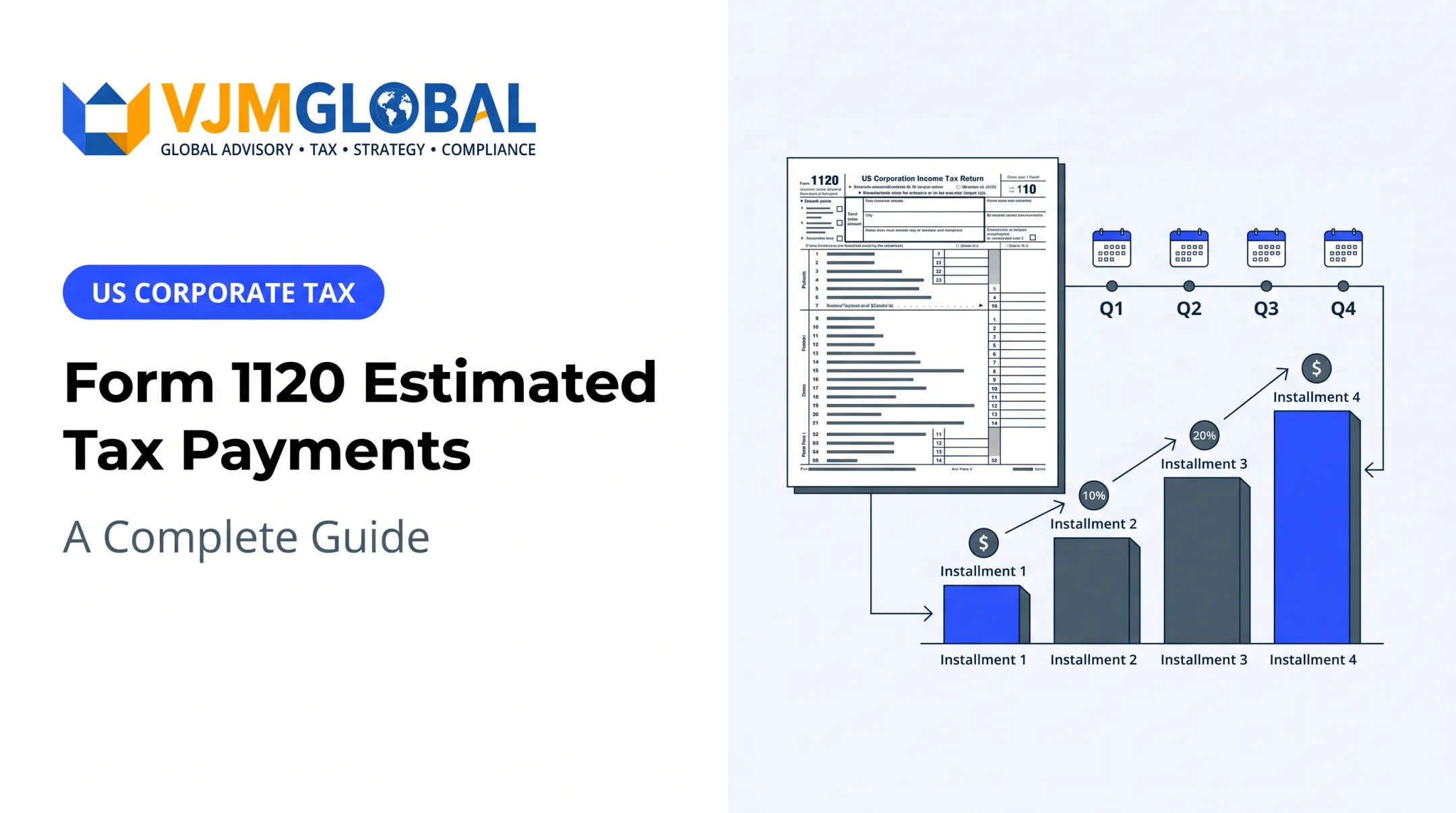
Calendar-year corporations pay on a fixed four-instalment cycle: the 15th day of the 4th, 6th, 9th, and 12th months of the tax year. Fiscal-year corporations apply the same logic using their own year-start date.

For a standard calendar-year corporation, that typically lines up around April, June, September, and December. Exact dates shift when they fall on a weekend or federal holiday, so confirm the specific calendar for your filing year through the IRS before setting internal reminders.
One frequently missed point: filing an extension on Form 1120 pushes back the return deadline, not the payment deadline. Tax owed is still due by the original due date regardless of any extension filed.
Making the Actual Payment
Corporate estimated-tax payments must go through electronic funds transfer, typically the Electronic Federal Tax Payment System (EFTPS). A few practical details matter here:
- Enrol early: IRS validation and PIN mailing take 5–7 business days
- Payments must be scheduled by 8:00 p.m. Eastern Time the day before the due date
- Save every payment confirmation; it's your proof of timely payment if a dispute ever arises
A simple internal workflow helps:
- Calculate the instalment
- Get internal sign-off
- Schedule the EFTPS payment ahead of the cutoff
- File the confirmation
- Reconcile it against your tax records at year-end
First-year corporations face a wrinkle here. With no prior-year liability to lean on, they must build estimates from current-year projections alone. The same applies to any corporation with sharply changing income; don't assume a prior-year safe harbour will be available just because it worked last cycle.
How Instalment Methods, Underpayments, and Recordkeeping Fit Together
Not every corporation earns income evenly across the year. The IRS offers three calculation approaches, and picking the right one can meaningfully change your cash-flow timing.
| Method | Best suited for |
|---|---|
| Regular instalment | Steady, predictable income throughout the year |
| Annualised income | Income concentrated in certain quarters |
| Adjusted seasonal | Businesses with a recurring seasonal pattern (using a 70% base-period test) |
Form 2220 and its Schedule A govern the annualised and seasonal calculations. Once Schedule A is used for any instalment, it applies to all remaining instalments for that year.
Updating Your Forecast Mid-Year
Revenue swings, new credits, ownership changes, or tax-law updates mean your original estimate can go stale fast. A catch-up payment on a later instalment can correct the ongoing shortfall, but it won't erase penalty exposure already accrued on an earlier underpaid instalment.
What Happens If You Underpay
The Form 2220 instructions calculate underpayment penalties instalment by instalment. The clock runs from each due date until the earlier of the payment date or the fourth month after year-end.

Reasonable-cause relief generally doesn't apply to this penalty. Specific statutory exceptions still exist, including no penalty when total tax is under $500.
Keeping Defensible Records
Build a simple checklist so the estimated-tax process stays defensible:
- Calculation worksheets for each instalment
- Supporting financial statements
- Prior-year Form 1120
- Credit documentation (research credit, foreign tax credit, etc.)
- EFTPS payment confirmations
- Any revised forecasts made mid-year
- Year-end reconciliation against the filed Form 1120
Common Mistakes Worth Avoiding
- Treating Form 1120-W as something you still need to file
- Applying individual estimated-tax rules to a corporate return
- Basing payments purely on available cash rather than projected tax
- Ignoring fiscal-year due dates and defaulting to calendar-year assumptions
- Mixing up federal obligations with separate state or local estimated-tax requirements
How VJM Global Can Support Corporate Tax Compliance
Running accurate estimated-tax projections depends on clean, current bookkeeping, something many foreign-owned corporations struggle to maintain while juggling operations across time zones. VJM Global works with multinational companies and foreign-owned businesses on bookkeeping, accounting outsourcing, and financial reporting that feeds directly into reliable tax estimates.
Our team helps with the groundwork that supports estimated-tax decisions:
- Maintaining timely, accurate financial records throughout the year
- Organising supporting documentation for credits and deductions
- Tracking filing and payment deadlines alongside your broader compliance calendar
- Assisting with Form 1120 preparation and related federal filings
- Coordinating closely with your qualified US tax adviser on filing-specific decisions
With over 30 years in tax, audit, and advisory work and a team of 100+ accounting professionals, VJM Global has supported businesses across the US, UK, and Australia with cross-border compliance. We don't replace your US tax counsel on filing positions, but we do make sure the numbers feeding those decisions are accurate and on time.
If your business needs steadier bookkeeping or coordinated support around US corporate tax compliance, contact VJM Global to discuss how we can help.
Frequently Asked Questions
How do you make estimated tax payments for a Form 1120 corporate tax return?
Calculate projected tax using current-year income and deductions, then pay through the IRS electronic payment system (typically EFTPS). The annual Form 1120 return is filed separately. Always verify current EFTPS enrolment timelines and due dates directly on IRS.gov.
How do you estimate corporate tax?
Project gross income, subtract deductible expenses to find taxable income, apply the current corporate tax rate, then subtract eligible credits and add any extra taxes owed. Compare that figure against your prior-year safe-harbour amount to confirm your required instalment.
How do you report dividends paid on Form 1120?
Dividends paid to shareholders aren't deductible business expenses; they're generally reported as distributions on Schedule M-2, separate from dividend income the corporation receives, which goes on Schedule C. Confirm the exact current line references in the IRS Form 1120 instructions.
Is Form 1120-W still required?
No. It's historical and was never the annual corporate return to begin with. Use current Publication 542 and the Form 1120 and Form 2220 instructions for active guidance instead.
What happens if a corporation underpays estimated tax?
An underpayment can trigger an instalment-based penalty, generally calculated on Form 2220, even if the full balance gets settled with the annual return. If this happens, review the shortfall promptly with a qualified tax professional to understand your exposure and options.