Introduction
Texas has become one of the most compelling destinations for entrepreneurs in the US — and the numbers back it up. According to the Texas Governor's Office, 314 headquarters relocations were announced between 2015 and 2024, representing more than 7,360 jobs — and that momentum hasn't slowed.
The appeal comes down to a few hard advantages:
- No personal or corporate state income tax
- A $2.9 trillion economy representing 9.4% of US GDP
- A No. 4 ranking from CNBC in its 2026 Top States for Business study, with the top spot for workforce quality
But choosing Texas is only half the decision. Austin's office rents run nearly double those of San Antonio. Houston's tech ecosystem looks nothing like Dallas's corporate finance environment. Fort Worth is growing faster than almost any comparable US city.
Each metro has its own industry clusters, cost structure, and incentive programs. Picking the wrong one can cost you early.
This guide breaks down the five best Texas cities for starting a business, with verified data on office costs, key industries, available incentives, and what makes each city distinctly worth considering.
TL;DR
- Texas has no personal or corporate state income tax — a franchise tax applies to entities above the $2.65M revenue threshold
- Austin leads for tech and innovation startups; Houston offers affordability and major corporate investment signals
- Dallas is the state's financial and corporate hub; San Antonio and Fort Worth suit cost-conscious founders
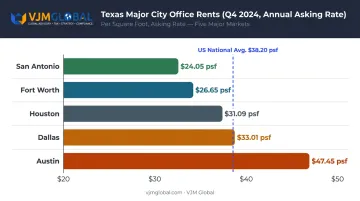
- Office costs range from $24.05 per sq ft in San Antonio to $47.45 per sq ft in Austin (Q4 2024 data)
- Match your city to your industry, budget, and growth stage — not just its reputation
Why Texas Is One of the Best States to Start a Business
Texas's statewide advantages are well-documented, but a few are worth spelling out clearly for founders weighing their options.
No Income Tax — And Low Early-Stage Exposure
Texas imposes no personal income tax and no corporate income tax. Most entities doing business in Texas face a franchise tax — rates are 0.375% for retail and wholesale businesses and 0.75% for others, with a no-tax-due threshold of $2.65M for 2026. For early-stage businesses, this often means minimal tax exposure in the first few years.
A Deep, Growing Talent Pool
Texas is home to the University of Texas at Austin, Texas A&M, Rice University, and Texas Christian University — institutions that feed skilled graduates into industries ranging from aerospace and energy to healthcare and technology. With 31.7 million residents and population growth of 8.8% since 2020, both the labor pool and the consumer base are expanding simultaneously.
Strong Business Climate Rankings
CNBC ranked Texas No. 1 nationally for workforce in 2026 and No. 5 for cost of doing business — a combination few coastal markets can offer at comparable cost.
Where things get more nuanced is at the city level. Each Texas metro has a distinct industry concentration, cost profile, and set of incentive structures. The sections below break down what that means in practice.
Best Cities to Start a Business in Texas
Cities were evaluated across five factors:
- Startup density and ecosystem maturity
- Commercial space affordability
- Workforce education levels
- Industry alignment
- Active business incentive programs
Austin
Austin is Texas's most recognized startup environment, and the data backs it up. Forbes Advisor ranked Austin No. 2 among large US metros for starting a small business in 2026, and 59.6% of residents age 25+ hold a bachelor's degree or higher, one of the highest rates among similarly sized US cities.
The city's innovation culture has attracted dense concentrations of SaaS companies, creative agencies, consulting firms, and healthcare tech ventures. For founders in these sectors, Austin's professional network and accelerator ecosystem are genuine advantages.
The main tradeoff is cost. At $47.45 per square foot annually (Q4 2024, all classes, full-service asking rent), Austin has the highest office rents of any major Texas city. That's a real consideration for early-stage businesses watching their burn rate.
| Category | Details |
|---|---|
| Key Industries | Technology, SaaS, Creative Industries, Consulting, Healthcare Tech |
| Business Incentives | Business Expansion Program; Place-Based Enhancement Program; Family Business Loan Program (low-interest); Chapter 380 agreements; GTOP grants for qualifying nonprofits (up to $40,000) |
| Notable Stats | 59.6% of residents hold a bachelor's degree or higher; office rent $47.45 psf (Q4 2024); Forbes Advisor No. 2 large metro for small business (2026) |
Best for: Tech founders, SaaS companies, creative agencies, consultants who need access to educated talent and don't mind paying a premium for it.
Houston
Houston is the fourth most populous US city at 2.39 million residents, and its economy spans energy, aerospace, healthcare, and advanced manufacturing at a scale that few US metros can match.
The city's biggest draw for cost-conscious founders: office space at $31.09 per square foot annually (Q4 2024, gross asking rent) — well below the US weighted average of $38.20. For businesses that need physical space, that gap adds up fast.
Corporate investment signals are also strong. Apple announced a 250,000 sq ft Houston facility to produce Apple Intelligence servers, with shipments beginning in October 2025 — a clear indicator that major players see Houston as a viable manufacturing and technology hub.
| Category | Details |
|---|---|
| Key Industries | Energy, Aerospace, Healthcare, Advanced Manufacturing, Technology |
| Business Incentives | Hire Houston First (local procurement preferences); Chapter 380 loans and performance-based grants; Texas Enterprise Zone program (state sales-and-use-tax refunds for qualified projects) |
| Notable Stats | 4th largest US city by population (2.39M); office rent $31.09 psf vs. US average $38.20 (Q4 2024); Apple's 250,000 sq ft server manufacturing facility operational since late 2025 |
Best for: Energy sector startups, aerospace suppliers, healthcare businesses, and manufacturers who want a large market at below-average office costs.
Dallas
Dallas functions as Texas's financial and corporate anchor. The DFW metro hosts 21 Fortune 500 companies — spanning finance, telecommunications, healthcare, and retail — which creates a substantial enterprise client base for B2B service providers.
Dallas's per-capita income of $45,811 (2024 dollars) reflects a high-income consumer base, and office rents of $33.01 per square foot annually (Q4 2024) are moderate relative to Austin while still placing Dallas in a competitive position nationally.
The city's incentive structure is negotiation-based rather than automatic: Dallas Economic Development offers abatements, grants, and loans tied to job creation and tax base growth. Renewable energy businesses and workforce training initiatives are specifically named evaluation factors.
| Category | Details |
|---|---|
| Key Industries | Finance, Technology, Telecommunications, Retail, Healthcare |
| Business Incentives | Negotiated tax abatements; performance-based grants and loans; workforce apprenticeship programs; renewable energy and EV infrastructure incentives through Dallas Economic Development |
| Notable Stats | Per-capita income $45,811 (2024); office rent $33.01 psf (Q4 2024); 21 Fortune 500 companies in DFW metro |
Best for: Financial services, corporate B2B providers, technology firms targeting enterprise clients, and retail businesses serving a high-income consumer base.
San Antonio
San Antonio is Texas's second-largest city by population, with 1,548,422 residents and 8.0% population growth since 2020. For entrepreneurs prioritizing cost control, it offers the most affordable major-market office space in Texas at $24.05 per square foot annually (Q4 2024) — roughly half Austin's rate.
The city's economic base is diversified across military and defense, healthcare, tourism, and financial services. A strong military presence creates reliable government contracting opportunities, and the healthcare sector has expanded significantly alongside population growth.
San Antonio's support programs are also notably accessible — most are structured for small businesses from the start, rather than requiring the size or leverage needed to negotiate incentives in larger markets like Dallas.
| Category | Details |
|---|---|
| Key Industries | Military & Defense, Healthcare, Tourism, Finance, Retail |
| Business Incentives | SBIR/STTR and Second Stage Company grants; Vendor Development Academy; SBEDA contracting preferences; fee waivers; PACE; Chapter 312 abatements; Chapter 380 grants; Ready to Work employer pledge |
| Notable Stats | Population 1.55M, up 8.0% since 2020; lowest major-market office rent in Texas at $24.05 psf (Q4 2024) |
Best for: Defense contractors, healthcare providers, hospitality businesses, and any founder where minimizing overhead in the early stages is a priority.
Fort Worth
Fort Worth is one of the fastest-growing major US cities, with 11.9% population growth since April 2020 — outpacing Dallas over the same period. That growth translates directly into expanding consumer demand and a deepening labor market.
Office rents here sit at $26.65 per square foot annually (Q4 2024), well below Dallas's $33.01, making Fort Worth attractive for businesses that want DFW market access without paying Dallas prices.
Dallas-Fort Worth International Airport gives logistics, aviation, and distribution companies direct access to one of the world's busiest cargo hubs, effectively in Fort Worth's backyard. Texas Christian University (TCU), with over 11,000 undergraduates and 1,800 graduate students, contributes to the local talent pipeline and supports an estimated 7,525 jobs within Fort Worth.
| Category | Details |
|---|---|
| Key Industries | Logistics & Transportation, Aviation, Manufacturing, Healthcare, Energy |
| Business Incentives | Tax abatements (up to 10 years on incremental ad-valorem taxes); Small Business Development Program (consultations, business plan support, SBE certification, procurement assistance); Fort Worth Business Plan Competition |
| Notable Stats | 11.9% population growth since April 2020; office rent $26.65 psf vs. Dallas $33.01 (Q4 2024); TCU supports 7,525 local jobs |
Best for: Logistics companies, aviation suppliers, manufacturers, and entrepreneurs who want DFW market access at significantly lower overhead than Dallas.
How to Choose the Right Texas City for Your Business
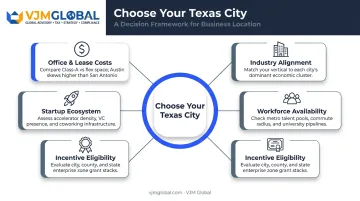
The most common mistake founders make is choosing a city based on reputation rather than fit. Here's what a smarter evaluation actually covers:
Office & Lease Costs:
- Compare office rents against your space requirements — a $23 psf difference between Austin and San Antonio adds up fast at any real footprint
- Factor in local commercial lease terms, not just advertised rents
Industry alignment:
- Energy companies belong in Houston's supply chain, not Austin's tech ecosystem
- B2B financial service providers will find more enterprise clients in Dallas than in Fort Worth
Workforce availability:
- Austin's 59.6% bachelor's degree rate is hard to beat for tech hiring
- Houston's scale (2.39M residents) offers breadth across industries
- Both cities also draw from strong university pipelines — UT Austin and Rice University feed consistent talent into the local market
Incentive program eligibility:
- Most city programs are performance-based and negotiated — read the actual eligibility criteria before assuming you qualify
- San Antonio's small business programs are among the most accessible; Dallas's incentives favor larger job-creating projects
Startup Ecosystem & Support:
- Co-working availability, active accelerator programs, and engaged chambers of commerce matter more in year one than people assume
- Proximity to your target customers and supply chain should factor into city selection alongside cost
Conclusion
Texas gives entrepreneurs a structurally advantageous starting point: no personal or corporate income tax, a $2.9 trillion economy, and a talent pool fed by universities like UT Austin, Texas A&M, and Rice. But the right city within Texas depends entirely on what your business actually needs.
Austin is worth its premium for tech and creative founders who need educated talent and startup infrastructure. Houston offers scale and affordability for energy, aerospace, and manufacturing. Dallas serves B2B and corporate-focused businesses best. San Antonio and Fort Worth reward founders who prioritize low overhead and fast-growing consumer markets.
Go beyond the rankings. Pull the actual office cost data, check your industry's local density, and read the incentive program fine print before committing.
Starting a business in Texas involves financial and compliance decisions that compound quickly — especially for founders with international operations or cross-border structures. VJM Global has supported 500+ American business owners through business setup, international tax planning, and cross-border compliance, including FEMA advisory and India-entry structuring for US-based companies expanding globally. Reach out to make sure your business is structured correctly from day one.
Frequently Asked Questions
What makes Texas a good state for starting a business?
Texas has no personal or corporate state income tax, a franchise tax that only kicks in above $2.65M in revenue, and a $2.9T economy ranking second nationally by GDP. CNBC ranked Texas No. 4 overall and No. 1 for workforce quality in its 2026 Top States for Business study.
Which city in Texas is best for tech startups?
Austin leads for tech startups. Forbes Advisor ranked it No. 2 among large US metros for small business in 2026, 59.6% of residents hold a bachelor's degree or higher, and its SaaS ecosystem is the densest in the state.
Is Austin or Dallas better for starting a business?
Austin suits tech, SaaS, and creative startups best. Dallas has the advantage for financial services, corporate B2B providers, and businesses targeting enterprise clients — with lower office rents ($33.01 vs. $47.45 psf) and 21 Fortune 500 companies nearby.
What are the typical office space costs for a new business in Texas?
Q4 2024 annual asking rents ranged from $24.05 psf in San Antonio and $26.65 psf in Fort Worth, up to $33.01 in Dallas, $31.09 in Houston, and $47.45 psf in Austin. The national weighted average was $38.20 psf — Houston, Fort Worth, and San Antonio all sit below it.
Do I need to register my business separately in Texas if I'm already registered in another state?
Yes. Out-of-state entities transacting business in Texas must register as a foreign entity with the Texas Secretary of State and appoint a registered agent with a physical Texas street address. The filing entity cannot serve as its own agent.
Which Texas city has the most affordable office space for startups?
San Antonio has the lowest verified office rents among major Texas cities at $24.05 psf annually (Q4 2024), followed closely by Fort Worth at $26.65 psf. Both are well below the national average and nearly half the cost of Austin.