
Introduction
The rules governing where to incorporate, where to hold profits, and where to employ staff are shifting faster in 2026 than at any point in the past decade. Getting the jurisdiction decision wrong now carries real consequences — not just inefficiencies.
The OECD Pillar Two 15% global minimum tax is rewriting the playbook for large multinationals. New free trade agreements are opening doors in some markets while closing them in others. And digital-first incorporation now means a founder in Sydney can register an EU company before lunch.
The stakes of choosing the wrong jurisdiction are real: higher effective tax burdens, banking KYC nightmares, restricted market access, and compliance costs that eat into margins before you've made your first sale. The right jurisdiction delivers something more concrete: lower effective tax rates, cleaner banking, and market access that compounds as you scale.
This article covers what actually matters when evaluating a jurisdiction in 2026, then walks through six countries that consistently stand out — including one high-growth market that remains underestimated by Western investors.
TL;DR — Key Takeaways
- Six standout jurisdictions for 2026: Singapore, UAE, UK, Ireland, India, and Estonia — each with distinct strengths depending on your business model
- Registration speed, foreign ownership rules, banking access, double tax treaty networks, and ongoing compliance costs matter as much as headline tax rates
- Pillar Two raises the stakes for large multinationals (EUR 750M+ revenue) — substance requirements and effective rates now outweigh headline figures
- India is an emerging priority — USD 81.04 billion in FDI inflows in FY2024-25, up 14% year-on-year, signals genuine momentum
- Structure errors made at incorporation are expensive to unwind — professional guidance is non-negotiable
What to Look for When Choosing a Country to Set Up a Business
The right jurisdiction must align with your business model, target market, and growth trajectory — not simply offer the lowest headline tax rate.
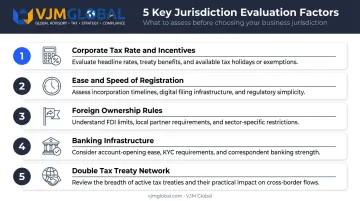
The Five Factors That Actually Matter
- Corporate tax rate and incentives — Effective rate after exemptions, not just the statutory number
- Ease and speed of registration — Days or hours matter when you're moving fast
- Foreign ownership rules — 100% ownership versus mandatory local partnership changes your risk profile entirely
- Banking infrastructure — KYC difficulty varies enormously between jurisdictions; some low-tax regimes are nearly unusable in practice
- Double tax treaty (DTT) network — Determines withholding tax exposure on cross-border payments
What Entrepreneurs Get Wrong
The most common mistake is optimizing for one variable (usually the tax rate) while ignoring the full picture. Choosing a jurisdiction with minimal substance requirements and a grey-list reputation often results in banking rejections, counterparty distrust, and restructuring costs that dwarf the original tax savings.
The tax landscape itself is also shifting. The OECD Pillar Two rules now impose a 15% minimum effective tax rate on multinational groups with consolidated revenues above EUR 750 million. If your business operates at that scale, headline-rate arbitrage alone is no longer a viable strategy.
The six countries below were evaluated across every dimension covered here — tax structure, ownership rules, banking access, and treaty networks.
Best Countries to Set Up a Business in 2026
These six jurisdictions consistently stand out for their combination of tax efficiency, regulatory clarity, market access, and practical ease of incorporation for foreign entrepreneurs.
Singapore
Singapore ranked 1st globally in the Economist Intelligence Unit's 2024 Business Environment Rankings. Its appeal is structural: stable government, strong financial infrastructure, and a position connecting Southeast Asian, Chinese, and global markets.
Key structural facts for foreign founders:
- Ownership: 100% foreign ownership permitted
- Director requirement: At least one locally resident director required — most founders use a Corporate Service Provider
- Tax treaties: Agreements with around 100 jurisdictions, among the broadest networks globally
Why it stands out in 2026:
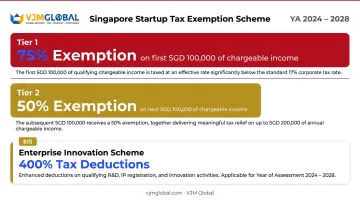
Singapore's flat 17% corporate tax rate is competitive, but the startup exemptions are where it gets genuinely attractive. For qualifying new companies in their first three consecutive years of assessment:
- 75% exemption on the first SGD 100,000 of chargeable income
- 50% exemption on the next SGD 100,000
The Enterprise Innovation Scheme (running YA 2024–2028) provides enhanced 400% tax deductions or allowances for qualifying R&D, IP registration, and approved innovation projects — putting Singapore among the most R&D-friendly regimes in Asia.
| Factor | Details |
|---|---|
| Registration Time | Usually approved soon after payment; complex applications up to 15 working days |
| Corporate Tax Rate | 17% flat (significant startup exemptions for first 3 years) |
| Best Suited For | Regional HQs, fintech, trading companies, Asia-Pacific market entry |
UAE
The UAE — particularly its free zones such as DMCC, DIFC, and Dubai South — remains the top destination for entrepreneurs seeking a near-zero tax environment. The UAE operates more than 40 free zones, all offering 100% foreign ownership, with no personal income tax for individuals.
The tax structure in plain terms:
- Free zone companies receiving qualifying income: 0% corporate tax (subject to substance, transfer pricing compliance, audited financials, and the de minimis rule)
- Mainland businesses: 0% on taxable income up to AED 375,000; 9% above that threshold
DMCC alone registered 2,048 new companies in 2024, bringing its total past 25,000 — a useful indicator of continued momentum, though UAE-wide registration figures are broader still.
One caveat for 2026: The UAE introduced a Domestic Minimum Top-up Tax (Cabinet Decision No. 142 of 2024) effective for financial years beginning on or after 1 January 2025, covering UAE entities in multinational groups with EUR 750M+ revenue. For businesses below that threshold, the free zone 0% treatment remains intact.
| Factor | Details |
|---|---|
| Registration Time | Varies by free zone; DMCC estimates around 10 working days |
| Corporate Tax Rate | 0% (free zone qualifying income); 9% mainland |
| Best Suited For | Trading, e-commerce, consulting, fintech, logistics, holding companies |
United Kingdom
The UK offers one of the fastest company registration processes in the world — typically completed within 24 hours online via Companies House. Combined with a globally recognized common law system, strong IP protections, and unrestricted foreign ownership, it remains a top-tier option for businesses wanting credibility alongside speed.
Directors do not need to live in the UK. The company must maintain a registered UK office, but operational control can be exercised from anywhere.
The tax structure:
- 19% small-profits rate for annual profits of £50,000 or less
- 25% main rate for profits above £250,000
- Marginal relief applies between those thresholds
Beyond the rates, the UK's standing with international banks and institutional investors is a genuine competitive advantage — particularly for startups seeking Series A funding or companies building a base for global expansion.
| Factor | Details |
|---|---|
| Registration Time | Usually within 24 hours (online via Companies House) |
| Corporate Tax Rate | 19% (profits ≤ £50K); 25% (profits > £250K) |
| Best Suited For | Startups, consulting firms, technology companies, creative industries |
Ireland
Ireland's 12.5% corporate tax rate on active trading income is the lowest standard rate in the EU, which is why it has attracted over 1,800 multinational client companies employing more than 302,000 people, according to IDA Ireland's 2024 annual report.
For IP-driven businesses, the incentives go further:
- R&D tax credit: Now 30% for accounting periods commencing on or after 1 January 2024, increasing to 35% for periods ending 31 December 2026 or later
- Knowledge Development Box (KDB): An effective 10% rate on qualifying profits from qualifying IP assets developed through R&D (updated from the previously cited 6.25%)
Ireland is an English-speaking EU member state with full access to European markets and a large, skilled workforce — a strong combination for US and UK businesses seeking a European base.
Important note for large multinationals: Ireland's Pillar Two rules (Income Inclusion Rule and Domestic Top-up Tax) have applied since fiscal years beginning 31 December 2023, with UTPR following from 31 December 2024. The 15% effective minimum applies to groups with EUR 750M+ revenue.
| Factor | Details |
|---|---|
| Registration Time | 3–7 working days |
| Corporate Tax Rate | 12.5% (trading income); 25% (passive income) |
| Best Suited For | Tech companies, SaaS, pharma, IP holding structures, EU-focused operations |
India
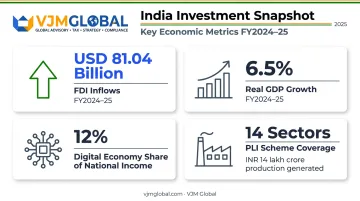
India is a different kind of opportunity from the others on this list. This is not a tax minimization play — it is a market access play, and the numbers reflect that scale:
- USD 81.04 billion in total FDI inflows in FY2024-25, up 14% year-on-year
- 6.5% real GDP growth in FY2024-25 (World Bank)
- Digital economy estimated at nearly 12% of national income, with projections tracking higher through 2025
- Production-Linked Incentive (PLI) scheme covering 14 sectors, with INR 1.61 lakh crore in approved investment and INR 14 lakh crore in production and sales generated
The tax structure reflects this growth-first posture:
The tax landscape:
- 22% base rate for qualifying domestic companies (Section 115BAA)
- 15% for eligible new domestic manufacturing companies (Section 115BAB — note that this requires setup and registration after 1 October 2019, with manufacturing commenced by 31 March 2024, so this concession is not available to businesses incorporating fresh in 2026)
For foreign investors, India permits 100% FDI through the automatic route in most sectors. Entry structures include wholly-owned subsidiaries, liaison offices, branch offices, joint ventures, and project offices — each carrying different tax, operational, and regulatory implications.
For businesses considering India entry, VJM Global provides end-to-end support covering entity selection, registration, FEMA compliance, transfer pricing, GST filing, and ongoing back-office operations. With 500+ American businesses and 250+ UK businesses served, and a 95% client retention rate built over 30+ years, the firm covers the full journey from entry strategy to ongoing compliance.
| Factor | Details |
|---|---|
| Registration Time | Typically 15–30 days (varies by entity type and approvals) |
| Corporate Tax Rate | 22% (domestic companies); 15% (new eligible manufacturing — conditions apply) |
| Best Suited For | Manufacturing, technology, services, retail, companies targeting Asia's largest consumer market |
Estonia
Estonia sits in a category of its own. Its e-Residency program allows entrepreneurs anywhere in the world to register and operate an EU-based company entirely online, without relocating. During the first half of 2024 alone, e-residents established 2,450 new Estonian companies; cumulatively, e-residents have founded or co-founded more than 31,800 companies.
The standout feature: Estonia taxes corporate profits only when they are distributed, not when earned. From 2025, dividends are taxed at company level at a rate equivalent to 22% of the gross distribution — but retained earnings face no immediate tax. For businesses reinvesting heavily into growth, this deferred tax structure is a meaningful structural advantage.
The e-Residency portal currently indicates company setup in 1–2 days online. Estonia joined the EU in 2004, giving registered companies full access to the Single Market.
Pillar Two note: Estonia's Ministry of Finance has stated that its EU directive derogation permits postponement of Pillar Two implementation until 2030 — a significant carve-out for businesses considering Estonian structures.
| Factor | Details |
|---|---|
| Registration Time | 1–2 days (online, for e-residents) |
| Corporate Tax Rate | 22% on distributed profits only (no tax on retained earnings) |
| Best Suited For | SaaS, digital services, solo founders, remote-first teams targeting EU markets |
How We Chose These Countries
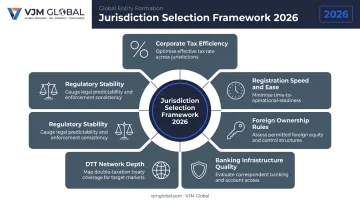
The selection framework behind this list weighted six factors:
- Corporate tax efficiency — effective rate after exemptions and incentives, not just headline figures
- Registration speed and ease — realistic timelines, not best-case scenarios
- Foreign ownership rules — 100% ownership as the baseline preference
- Banking infrastructure quality — account opening difficulty and KYC friction in practice
- DTT network depth — breadth of treaty coverage for withholding tax management
- Regulatory stability — predictable compliance environment with low political risk
Purely offshore jurisdictions with grey-list or blacklist status were excluded. The banking complications alone — where major correspondent banks decline to transact with entities in certain jurisdictions — make those structures unworkable in practice, regardless of what the tax rate looks like on paper.
These exclusions also reflect where entrepreneurs most often go wrong. The most persistent mistakes when choosing a jurisdiction:
- Focusing on headline tax rates while ignoring substance requirements
- Underestimating ongoing compliance costs (annual filings, audits, local accounting)
- Failing to verify banking access before incorporating
- Ignoring how their chosen jurisdiction is perceived by target customers and investors
Every country profiled below clears all six criteria — not just on paper, but in how they function for operating businesses day to day.
Conclusion
There is no single best country to set up a business in 2026. The right answer depends on your target market, business model, funding needs, and where your customers and talent are located.
2026 demands more sophisticated analysis than previous years. Pillar Two has made effective tax rate management more complex for large multinationals. Evolving FDI rules in markets like India are opening sectors that were once off-limits. And digital incorporation options mean that location-independent founders have more flexibility than ever, provided they choose the right structure from the start.
The six countries covered here — Singapore, UAE, UK, Ireland, India, and Estonia — each offer real advantages, but only when matched to the right business model.
For businesses considering India as a destination — whether as a wholly-owned subsidiary, liaison office, branch office, or joint venture — VJM Global provides end-to-end support: entry strategy, entity selection, registration, tax compliance, FEMA advisory, and ongoing back-office operations.
With 30+ years of experience and a team of 100+ chartered accountants and business setup specialists, VJM Global has served 500+ foreign businesses and acts as a single point of contact for companies navigating India's regulatory landscape.
Reach out to VJM Global at [email protected] or +91 9891576441 to book a consultation.
Frequently Asked Questions
Which country has the lowest tax rate for business?
The UAE offers 0% on qualifying free zone income — the lowest on this list. Ireland (12.5% trading rate) and Singapore (17% with startup exemptions) are the strongest options for substantive jurisdictions. For multinationals with EUR 750M+ revenue, the OECD Pillar Two 15% global minimum applies regardless of jurisdiction.
What is the best business to start to reduce taxes?
IP-driven businesses benefit most from IP box regimes — Ireland's Knowledge Development Box (10% effective rate) and the Netherlands' Innovation Box (9%) are the strongest options. Trading companies and holding structures can use UAE free zones or Singapore's territorial tax system to reduce their overall tax burden.
Can a foreigner set up a business in India?
Yes. Foreigners can establish businesses in India as wholly-owned subsidiaries, liaison offices, branch offices, or joint ventures — 100% FDI is permitted through the automatic route in most sectors. FEMA regulations and RBI guidelines govern the process; professional advisory is recommended to navigate sectoral caps and approval requirements.
How long does it take to register a company abroad?
Timelines vary significantly: Estonia offers 1–2 days for e-residents, the UK typically completes registration within 24 hours, Singapore approves most applications promptly after payment, and UAE free zones generally take around 10 working days. India's process takes 15–30 days depending on entity type and any regulatory approvals required.
What is the easiest country to set up a business in 2026?
The UK and Estonia are the simplest for pure administrative speed — both offer fast online registration with minimal physical presence. Singapore and the UAE rank highest when factoring in post-incorporation banking access, compliance support infrastructure, and market connectivity.
Do I need to be physically present to register a company in another country?
Most jurisdictions — including the UK, UAE free zones, Singapore, and Estonia — allow fully remote registration through licensed agents or digital portals. However, some banking setups and visa-linked residency requirements may require in-person verification. Confirm the full process with a local agent before proceeding.