Why Central Louisiana Is Becoming One of the South's Best Regions to Start a Business
Central Louisiana doesn't usually make national headlines — but that's changing fast.
In the past two years, the region has attracted major capital that signals real structural change. Applied Digital's $3.6 billion AI Factory Campus in Boyce, P&G's $96.7 million manufacturing expansion, and Ucore's $75 million rare earth metals facility don't fit the profile of a typical mid-size Louisiana metro.
For a region centered on Alexandria and Rapides Parish, that scale of investment is a meaningful economic reset.
When capital at that scale enters a region, it creates downstream demand — suppliers, service providers, staffing firms, IT consultants, and other businesses that didn't exist before the anchor investment arrived. That's the opening entrepreneurs should be watching.
This article identifies the top industries to consider when starting a business in Central Louisiana — grounded in what's actually happening in Rapides Parish and surrounding areas.
Key Takeaways:
- Healthcare, manufacturing support, and tech services offer the strongest near-term entry points
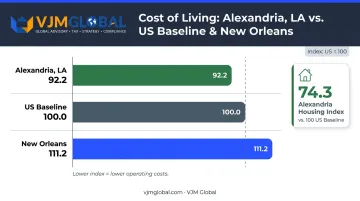
- Alexandria's composite cost-of-living index sits at 92.2 — well below the US baseline of 100 and significantly lower than New Orleans at 111.2
- Louisiana's Enterprise Zone Program and Industrial Tax Exemption can reduce startup costs for qualifying businesses
- Aligning your venture to a local industry cluster improves your odds of early traction
Why Central Louisiana Is a Smart Place to Start a Business
Strategic Location and Competitive Operating Costs
Central Louisiana sits at a natural crossroads for the Gulf South. Interstate 49 runs directly through Alexandria and Rapides Parish, and Louisiana Economic Development confirms the metro has rail, water, air, and ground transportation access — making it viable for businesses that depend on regional distribution or supply chain connectivity.
On cost, the picture is nuanced. CNBC's 2025 rankings place Louisiana No. 7 for cost of doing business among all states — ahead of Alabama (No. 19) and well ahead of most of the Midwest. The honest caveat: Louisiana ranks No. 46 overall, so "competitive operating costs" is the defensible claim, not "best business climate in the South."
For Central Louisiana specifically, Alexandria's C2ER Q3 2024 composite cost-of-living index sits at 92.2 (US baseline: 100), with housing indexing at just 74.3. For entrepreneurs, that gap is tangible: lower commercial rents, lower relocation costs, and a local hiring market that doesn't demand coastal salaries.
A Growing Workforce and Lower Startup Overhead
Two institutions shape Central Louisiana's labor pipeline in ways that don't get enough credit:
- LSU Alexandria reached 7,728 students in Spring 2026, up nearly 12% year over year, with nursing, healthcare, and professional degree pathways across 80+ programs
- Central Louisiana Technical Community College (CLTCC) runs the Cleco Advanced Manufacturing Center, offering certificates and two-year degrees in Industrial Manufacturing Technology and Welding
Fort Johnson (formerly Fort Polk) reported over 30,000 personnel in its most recent population counts. Many transition into the regional civilian workforce carrying technical, logistics, and leadership skills that are hard to find — and expensive to train — in larger metro markets.
The practical result: a startup here can access a credentialed, technically skilled workforce at operating costs that metros like New Orleans or Baton Rouge simply can't match.
Top Industries to Start a Business in Central Louisiana
Healthcare and Senior Care Services
Healthcare is Central Louisiana's anchor industry — and the numbers back that up.
Rapides Regional Medical Center operates 346 beds and more than 30 specialties, with at least 1,200 employees and a new $3 million interventional radiology suite opened in March 2026.
The Alexandria VA Medical Center system serves over 37,000 active patients across seven Louisiana locations, with a potential service population exceeding 100,000 veterans.
The demographic driver is just as significant: 19.6% of Rapides Parish residents are age 65 or older, according to Census QuickFacts. Nationally, BLS projects home health and personal care aide employment to grow 17% from 2024 to 2034 — roughly 765,800 openings per year. That trend maps directly onto Central Louisiana's aging population.
Lower-barrier entry points for healthcare entrepreneurs:
- Non-medical home care agencies (companion care, personal assistance)
- Medical transportation and non-emergency transport
- Adult day care centers
- Durable medical equipment supply and delivery
- Health and wellness coaching
- Medical staffing and placement
Both Rapides Regional and the VA system create sustained demand for contract clinical and administrative workers. That's a business model with relatively low capital requirements and an immediate local customer base already in place.
Manufacturing and Industrial Services
Manufacturing in Central Louisiana is in active expansion mode, backed by confirmed investment commitments.
Louisiana Economic Development has announced four major projects in the region within the past three years:
| Company | Investment | Scope |
|---|---|---|
| P&G Alexandria | $96.7M | Fabric care production expansion; ~50 jobs |
| Plastipak Pineville | $53.8M | Manufacturing expansion in Rapides Parish |
| Ucore Alexandria | $75M | Planned rare earth separation facility; 100 jobs |
| Applied Digital, Boyce | $3.6B | AI and cloud campus; 418 projected jobs |
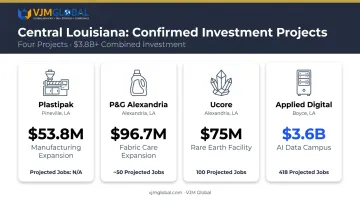
P&G's expansion is the lowest-risk signal — the plant has operated for nearly 55 years. Ucore and Applied Digital carry more execution uncertainty as greenfield projects, but even their construction phases create real demand.
Where the downstream business opportunities are:
- Industrial cleaning, maintenance, and janitorial services
- Logistics and freight coordination
- Staffing agencies specializing in technical and production roles
- Equipment repair and calibration
- Safety training and compliance consulting
- Supplier contracts for packaging, components, or consumables
CLTCC's technical programs produce a direct pipeline for manufacturing-adjacent businesses. Entrepreneurs who can absorb that trained workforce — or build services around the labor gap — have a real structural advantage over outside competitors entering the market.
Technology, AI, and Digital Services
Applied Digital's $3.6 billion AI Factory Campus in Boyce isn't just a data center — it makes Central Louisiana an emerging technology corridor with growing demand for surrounding services.
Large-scale AI infrastructure requires continuous IT support, network management, cybersecurity monitoring, electrical and cooling maintenance, and facility services. Louisiana's LED FastStart program is already working to develop local workforce capacity around the project. That creates early-mover opportunities for local service businesses before the campus reaches full operation.
Beyond the Applied Digital effect, the broader regional economy has a growing base of businesses modernizing their operations — and many lack in-house digital expertise.
Digital services businesses entrepreneurs can launch today:
- IT managed services (help desk, network monitoring, device management)
- Cybersecurity consulting for small and mid-size businesses
- Digital marketing agencies serving local retailers and healthcare providers
- Data analytics and reporting for regional manufacturers
- App development and software customization
BLS projects information security analyst employment to grow 29% from 2024 to 2034 — one of the fastest growth rates of any occupation. That national trend finds an accelerated local expression in a region that just committed to billions in technology infrastructure.
Agriculture and Agribusiness
The USDA's 2022 Census counted 754 farms, 191,242 farm acres, and $167.3 million in agricultural product sales in Rapides Parish alone — a scale that often surprises people unfamiliar with the region. Soybeans (32,738 acres), cotton, corn, and cattle are the primary commodities.
The opportunity for entrepreneurs isn't farm ownership — it's the services and value-added businesses that support an established agricultural base.
Agribusiness entry points worth considering:
- Precision agriculture consulting and GPS/drone services
- Farm equipment repair and mobile maintenance
- Crop input supply (seed, fertilizer, pest management)
- Food processing and value-added specialty products
- Farm-to-table supply relationships with restaurants and grocers
- Agricultural trucking and cold storage
Statewide, Louisiana's 25,006 farms generated $4.8 billion in agricultural product sales in 2022. That's the market context for businesses that serve farmers rather than compete with them.
Retail, Food Service, and Tourism
Alexandria functions as the primary retail and dining hub for a large rural catchment area across Central Louisiana. A 2021 city study described a $1.2 billion retail market with $519 million in annual sales imported from the surrounding region.
That figure means consumers are already traveling to Alexandria to spend — and the study identified groceries, dining, clothing, and sporting goods as underserved categories where local supply falls short.
Tourism adds another layer. Rapides Parish visitor spending reached $165.1 million in 2022, supporting roughly 1,840 local jobs.
Retail and tourism-adjacent opportunities:
- Specialty restaurants showcasing Cajun and Creole cuisine
- Hunting and fishing outfitters (Central Louisiana's outdoor culture is deeply established)
- Event venues for weddings, corporate gatherings, and community events
- Eco-tourism and guided outdoor experience operators
- Specialty retail targeting categories with documented spending leakage
The regional draw is already established. Entrepreneurs who match the right product or concept to documented spending gaps enter a market where the demand exists — it just hasn't been met locally yet.
Industries Poised for Growth in 2026 and Beyond
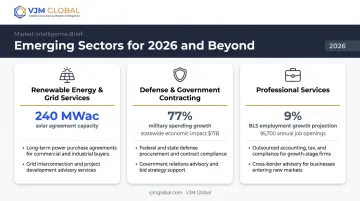
Three emerging sectors align well with Central Louisiana's near-term trajectory:
1. Renewable Energy and Grid Services Cleco and DESRI announced a 240 MWac solar agreement at the former Dolet Hills lignite site in 2022. Cleco also retired its 272 MW Teche Unit 3 coal plant in June 2024. Those transitions create demand for solar installation, grid maintenance, remediation services, and electrical contracting — though entrepreneurs should treat utility procurement cycles as multi-year timelines, not immediate opportunities.
2. Defense and Government Contracting Fort Johnson's Joint Readiness Training Center operates as one of the Army's primary combat training facilities. Military spending in Louisiana has grown 77% in recent years, generating $17 billion in statewide economic impact according to LED.
Businesses positioned for federal contracting have a clear early-mover advantage here. High-demand support areas include:
- Logistics and facilities management
- Professional services and technical training
- IT infrastructure and security support
- Workforce development and compliance consulting
3. Professional Services The wave of new businesses entering Central Louisiana creates immediate demand for accountants, HR consultants, legal advisors, and management analysts. BLS projects 9% growth in management analyst employment from 2024 to 2034, with 95,700 annual openings nationally.
Locally, the demand curve is steeper. Every new manufacturer, tech firm, and healthcare operator arriving in the region needs compliance support, staffing guidance, and advisory services from day one.
Before committing to any of these sectors, evaluate honestly: Does your existing skill set match the technical requirements? Do you have enough capital to sustain a 12-to-24 month runway before revenue stabilizes? Emerging sectors consistently reward early movers who arrive prepared and well-capitalized.
Steps to Launch Your Business in Central Louisiana
Louisiana has a clear registration path for new businesses — but skipping steps early creates compliance headaches later. Here's what to do in order.
Step 1: Choose your legal structure LLC, S-Corp, and sole proprietor structures carry different liability, tax, and operational implications. Most small businesses start as LLCs for the liability protection and pass-through taxation, but the right answer depends on your industry, funding plan, and long-term goals.
Step 2: Register with the Louisiana Secretary of State File through GeauxBIZ, Louisiana's official business registration portal. The current filing fee for LLC Articles of Organization is $100. Note that Commercial Division fees are scheduled to change on October 1, 2026 — verify current amounts at the time of filing.
Step 3: Obtain your local occupational license Rapides Parish and the City of Alexandria both require occupational licenses before opening. The application starts at a $50 minimum, with the final amount based on business classification and gross receipts.
Step 4: Secure industry-specific permits Healthcare businesses need state health department permits. Food businesses need food service permits. Contractors need state contractor licenses. Confirm your permit requirements with the relevant Louisiana state agency before investing in build-out or equipment.
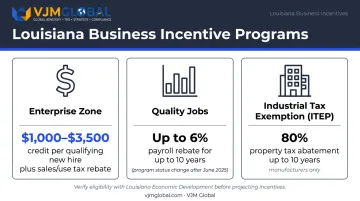
Step 5: Understand Louisiana's incentive programs early
| Program | Structure | Status |
|---|---|---|
| Enterprise Zone | $1,000–$3,500 credit per net new qualifying job; sales/use tax rebate | Confirm current eligibility with LED |
| Quality Jobs | Up to 6% payroll rebate for up to 10 years | No new advances after June 30, 2025 |
| Industrial Tax Exemption (ITEP) | 80% property tax abatement up to 10 years for manufacturers | Requires pre-approval before investment |
Don't assume eligibility. Verify in writing with Louisiana Economic Development before building incentives into your financial projections.
If your Central Louisiana business plans to operate internationally — including into markets like India — having the right accounting infrastructure from day one becomes even more critical. VJM Global supports US-based businesses with cross-border tax compliance, bookkeeping, and financial reporting, helping entrepreneurs avoid the compliance backlog that often hits in year two when international operations scale.
Frequently Asked Questions
What industry is best to start a business in?
The best industry depends on your existing skills, available capital, and local demand. In Central Louisiana, healthcare services, manufacturing support, and technology services stand out for their sustained demand and multiple accessible entry points at various capital levels.
What industry will boom in 2026?
AI infrastructure and technology services, senior care, and renewable energy are among the fastest-growing sectors nationally. Central Louisiana is directly positioned in all three, given the Applied Digital campus, a 19.6% senior population in Rapides Parish, and Cleco's ongoing energy transition.
Is Central Louisiana a good place to start a business?
Yes. A composite cost-of-living index of 92.2 (versus the US baseline of 100), Alexandria's role as a regional retail hub, Louisiana's state incentive programs, and a diversifying economy make Central Louisiana a strong choice for new ventures.
What are the tax incentives for businesses in Louisiana?
Louisiana offers the Enterprise Zone Program (tax credits per new hire), the Quality Jobs Program (payroll rebates), and the Industrial Tax Exemption for manufacturers (80% property tax abatement). Visit opportunitylouisiana.gov for current eligibility requirements.
What licenses do I need to start a business in Louisiana?
Most businesses need to register with the Louisiana Secretary of State, obtain a local occupational license from Rapides Parish or the City of Alexandria, and secure any industry-specific permits (such as health permits or contractor licenses).