Introduction
Europe offers US businesses something few other regions can match: 450 million consumers across the EU Single Market, a stable regulatory environment, and trade infrastructure built for transatlantic commerce. The opportunity is real — but so is the complexity of getting in.
The challenge is that Europe isn't a monolith. Corporate tax regimes, visa pathways, entity formation rules, and banking timelines vary sharply by country. Choosing the wrong jurisdiction can mean higher compliance costs, slower market entry, or tax exposure on both sides of the Atlantic.
This article identifies the five European countries that consistently offer the strongest combination of market access, tax efficiency, and entry accessibility for US businesses — with the specific tradeoffs you need to weigh before committing to any one of them.
Key Takeaways
- Ireland, the Netherlands, Estonia, Germany, and Poland are the top five European destinations for US business expansion
- The Netherlands' DAFT treaty gives American entrepreneurs a direct path to EU residency and business registration
- Estonia's e-Residency lets US founders register a company online in 1–2 days — no physical EU presence required
- Operating through a European entity doesn't eliminate US federal tax — worldwide income is still taxable at home
- Corporate tax rate is only one factor — VAT obligations, banking timelines, and local substance requirements matter equally
Why US Businesses Are Expanding to Europe
The EU Single Market is the primary draw. Once registered in one EU member state, a company can trade goods and services across all 27 member countries with minimal additional regulatory friction. The EU's combined GDP reached USD 21.2 trillion in 2025, making it one of the largest economic blocs in the world.
Beyond market size, three structural factors drive US interest:
- Talent access — multilingual, highly educated workforces across Western and Central Europe
- Regulatory stability — clear legal frameworks, enforceable contracts, and IP protection
- FDI position — US investors held EUR 2,243 billion in EU inward FDI stock at end-2024, representing 31% of all extra-EU investment — indicating deep, long-standing commercial ties
That FDI figure reflects accumulated investment, not a current growth trend. US-investor project announcements in Europe actually fell in 2024 — which means the case for expanding now rests on business-specific logic, not broad market momentum.
Not every European country offers the same entry conditions. The countries below stand out for their registration speed, tax structure, and track record with US-based operators.
Best European Countries for US Businesses
Countries were selected based on five criteria: corporate tax environment, ease of company formation for non-EU citizens, English-language accessibility, US-specific visa or treaty advantages, and overall business infrastructure.
Ireland
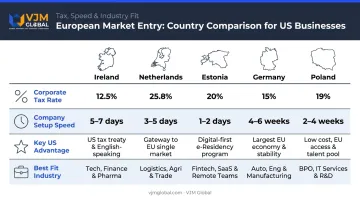
Ireland is the most common first entry point for US companies expanding into Europe. English-speaking, a full EU and Eurozone member, it hosts the European headquarters of Amazon, Google, Meta, and Salesforce. Its 12.5% corporate tax rate on trading income is among the lowest in the EU. Non-trading income (investment, rental) is taxed at 25%.
For larger multinationals with annual group revenue exceeding EUR 750 million, the OECD Pillar Two minimum effective rate of 15% applies — but most SMEs and mid-market US businesses fall well outside this threshold.
What makes it stand out for US businesses:
- The Start-Up Entrepreneur Programme (STEP) provides a legal pathway for non-EEA nationals, including Americans, to establish a business and secure Irish residency. Requirements include an innovative business proposal, good character, and at least EUR 50,000 in available funding. Successful applicants receive a two-year residence permission, renewable for three years.
- A comprehensive US-Ireland Double Taxation Treaty (1997, with 1999 amendments) prevents American business owners from being taxed twice on the same income.
| Factor | Detail |
|---|---|
| Corporate Tax Rate | 12.5% on trading income; 25% on non-trading income |
| Company Setup | CRO processes applications on a rolling queue; allow several weeks |
| Key US Advantage | US-Ireland Double Taxation Treaty + English-language environment |
Netherlands
The Netherlands is the fifth-largest EU economy and a primary logistics and trade hub. Amsterdam hosts hundreds of international companies, and English proficiency in the Dutch business community is exceptionally high.
What makes it stand out for US businesses:
The Dutch-American Friendship Treaty (DAFT) is one of the most significant — and underused — advantages available to American entrepreneurs in Europe. This bilateral agreement gives US nationals the right to live, work, and establish a business in the Netherlands, a pathway not available to most other non-EU nationalities.
The minimum capital requirement for most business structures is EUR 4,500. Applicants must register with the Dutch Chamber of Commerce (KVK) and invest the qualifying capital within six months.
For technology and R&D-focused companies, the Innovation Box regime reduces the effective tax rate on qualifying intellectual-property income to 9%, provided the company holds a qualifying patent or R&D declaration.
| Factor | Detail |
|---|---|
| Corporate Tax Rate | 19% up to EUR 200,000 taxable profit; 25.8% above |
| Company Setup | BV registration via civil-law notary; official timeline varies |
| Key US Advantage | DAFT Treaty — residency and business establishment pathway exclusive to Americans |
Estonia
Estonia built the most digitally advanced government infrastructure in Europe, and its e-Residency program reflects that. As of 2026, the program has attracted 142,332 e-residents from more than 170 countries, with 43,024 companies registered through it.
What makes it stand out for US businesses:
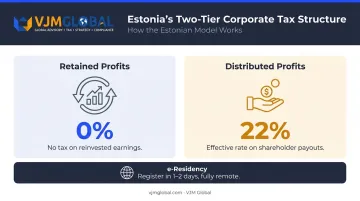
A US entrepreneur can register a fully EU-compliant company in Estonia in 1–2 days using the e-Residency digital identity, with no travel to Europe required. The corporate tax structure is particularly well-suited to growth-focused businesses:
- Undistributed profits: 0% tax
- Distributed profits: taxed at 22/78 of the net distribution (equivalent to 22% on a gross basis from 2025)
This makes Estonia ideal for SaaS companies, digital agencies, or e-commerce operations that reinvest profits rather than distribute them. One important clarification: e-Residency is a digital identity for online business management. It does not grant physical residency, citizenship, or an automatic right to live in Estonia.
| Factor | Detail |
|---|---|
| Corporate Tax Rate | 0% on retained profits; 22/78 rate on distributions |
| Company Setup | Typically 1–2 days via e-Residency digital ID |
| Key US Advantage | Fully remote registration and management — no physical presence required |
Germany
Germany is the EU's largest economy, with a 2025 GDP of EUR 4,470 billion and a population of 83.6 million. It leads in manufacturing, automotive, technology, and renewable energy, all sectors with strong US business presence.
What makes it stand out for US businesses:
Germany suits US companies that want a physical subsidiary with genuine local operations in the DACH region. Two recent developments have made setup more accessible:
- The Unternehmergesellschaft (UG) — a simplified GmbH variant — can be formed with as little as EUR 1 in share capital, retaining one-quarter of annual profits until reaching EUR 25,000. A standard GmbH still requires EUR 25,000 minimum.
- The revised Skilled Immigration Act (phased in from 2023–2024) lowered EU Blue Card salary thresholds and created new access routes for international workers, making talent acquisition easier for foreign-owned subsidiaries.
Germany's combined corporate tax burden — federal rate of 15%, solidarity surcharge, and municipal trade tax — averages approximately 30%, the highest on this list. That cost reflects the access it provides: Europe's largest single domestic market, with 83.6 million consumers.
| Factor | Detail |
|---|---|
| Corporate Tax Rate | ~30% combined (federal + solidarity surcharge + trade tax) |
| Company Setup | GmbH requires notarization; UG available from EUR 1 share capital |
| Key US Advantage | 83.6M consumer market; Skilled Immigration Act supports international hiring |
Poland
Poland is one of the EU's fastest-growing economies — real GDP grew 3.6% in 2025 — and a compelling lower-cost alternative to Western Europe for operations centers, back-office functions, or technology teams.
What makes it stand out for US businesses:
The cost differential is striking. Estimated 2025 hourly labor costs in Poland were EUR 18.10, compared to EUR 43.00 in Germany and EUR 47.90 in the Netherlands. For US companies building European operational infrastructure, that gap has a direct impact on margin.
Additional advantages:
- Standard corporate tax: 19%, with a reduced 9% rate for qualifying small taxpayers with annual revenue under EUR 2 million and first-year companies (excluding capital gains)
- Polish Investment Zone (PIZ) incentives — qualifying investments can receive CIT exemptions for 12–15 years, with aid intensity ranging from 0–50% depending on region and business size
- Central EU location supports logistics-heavy operations across both Eastern and Western Europe
Registration via the S24 online template targets a one-day court review; standard KRS applications target seven days.
| Factor | Detail |
|---|---|
| Corporate Tax Rate | 19% standard; 9% for qualifying small businesses |
| Company Setup | S24 online: one-day review target; standard KRS: seven-day target |
| Key US Advantage | Significantly lower labor costs vs. Western Europe; PIZ tax incentives |
What US Businesses Must Know Before Setting Up in Europe
US Worldwide Tax Obligations
Unlike most countries, the US taxes its citizens and businesses on worldwide income. Operating through a European entity does not eliminate US federal tax obligations. Key compliance requirements include:
- FATCA (Form 8938) — required for specified individuals and domestic entities with foreign financial assets above applicable thresholds
- FBAR (FinCEN Form 114) — required when aggregate foreign account value exceeds USD 10,000 at any point during the year; filing Form 8938 does not replace FBAR
- GILTI — US shareholders of controlled foreign corporations may face current US inclusions under Global Intangible Low-Taxed Income rules
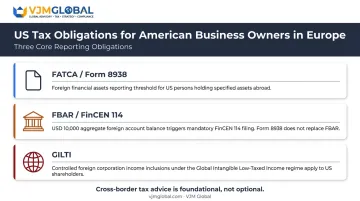
Cross-border tax advice from a qualified advisor is foundational, not optional.
Branch vs. Subsidiary
The entity structure decision has significant implications on both sides of the Atlantic:
- Branch: An extension of the US parent with no liability separation. The parent remains fully exposed, and EU regulatory compliance tends to be more complex
- Subsidiary: A locally incorporated EU entity that offers liability protection, local credibility, and cleaner tax treatment in most jurisdictions
For most US businesses entering Europe, a locally registered subsidiary is the right starting point.
Visa and Residency Considerations
Once the entity structure is decided, the next question is often personal: who runs it, and from where? US citizens have no automatic right to work or reside in any EU country, and each country runs its own programs:
- Ireland — STEP for American entrepreneurs (EUR 50,000 funding required)
- Netherlands — DAFT Treaty for US nationals (EUR 4,500 minimum investment)
- Estonia — e-Residency for remote company management (no physical residency granted)
Physical presence requirements vary significantly between programs. Some European countries also require a local director or registered agent for a company to maintain good standing.
One area where US businesses consistently need guidance is the interaction between European setup requirements and ongoing US tax obligations — particularly FATCA, FBAR, and GILTI reporting. VJM Global has worked with 500+ American business owners on cross-border compliance and can help you understand the full US-side tax picture before committing to a European jurisdiction.
How We Selected These Countries
Evaluation Framework
Each country was assessed across five criteria specific to US businesses:
- Availability of non-EU entrepreneur visa or bilateral treaty pathway
- Corporate tax rate and US double-taxation treaty status
- Speed and accessibility of company formation for foreign nationals
- English-language business environment
- Market size and economic stability
This list isn't exhaustive. Sweden, Denmark, and Switzerland are viable alternatives depending on industry and operational model.
Common Mistakes US Businesses Make
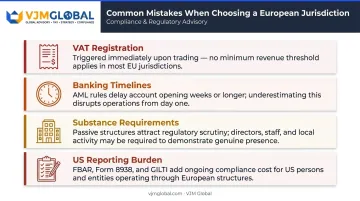
Even with solid criteria, US businesses frequently trip up on the details. Choosing a country based solely on the headline corporate tax rate is the most common misstep — here's what that number doesn't capture:
- VAT registration obligations — often triggered as soon as trading begins in an EU country
- Banking account timelines — EU anti-money-laundering rules mean account opening for foreign-owned entities can take weeks or longer in some jurisdictions
- Substance requirements — very passive structures with no genuine local activity attract regulatory scrutiny
- Ongoing US reporting burden — FBAR, Form 8938, and GILTI obligations add compliance cost regardless of which country you choose
Before committing to a jurisdiction, map out the full compliance cost — setup fees, annual filings, banking timelines, and US reporting obligations combined often exceed what the tax rate alone suggests.
Conclusion
Europe has real expansion potential for US businesses — but the right country depends on your business model, target market, and operational requirements. Ireland and the Netherlands offer the clearest entry paths for American founders. Estonia works best for remote-first or digital businesses that don't need physical EU presence. Germany and Poland suit companies building operational subsidiaries with local teams and physical infrastructure.
Before settling on a jurisdiction, get cross-border tax and structuring advice from professionals who understand the US regulatory environment and your target market's requirements. VJM Global brings 30+ years of experience in cross-border tax advisory and compliance, with a track record serving 500+ US-based businesses on international structuring decisions. Reach out to our team at [email protected] to discuss your expansion plans.
Frequently Asked Questions
Where is the best place to set up a business in Europe?
There's no single answer — it depends on industry, target market, and whether physical presence is needed. Ireland suits English-speaking tech and financial services firms; the Netherlands suits logistics and B2B companies (especially Americans via DAFT); Estonia works for remote digital businesses. The best choice requires evaluating tax, visa, and operational factors together.
Can an American start a business in Europe?
Yes. Americans can register a business in most European countries without EU citizenship, though requirements vary. The Netherlands (DAFT) and Ireland (STEP) offer dedicated programs for US entrepreneurs, while Estonia's e-Residency allows fully remote company registration — without granting physical residency.
Which European country has the lowest corporate tax rate for US businesses?
Ireland's 12.5% trading income rate is the lowest among major EU economies. Estonia offers a structurally different advantage — 0% tax on retained profits, with tax only applying when profits are distributed. Your effective rate depends on how profits are distributed and which US-EU tax treaty applies to your situation.
Do US businesses have to pay taxes in both the US and Europe?
Yes — the US taxes worldwide income, so a European operation doesn't eliminate US federal tax obligations. Bilateral tax treaties between the US and most EU countries, combined with the foreign tax credit, help reduce or eliminate dual taxation; professional cross-border tax advice is strongly recommended.
Do I need to live in Europe to own and run a European business?
It depends on the structure and country. Estonia's e-Residency requires no physical presence, but most EU countries require a local director or registered agent, and overly passive structures can face substance scrutiny. Many US owners manage EU entities remotely through a local compliance partner.
How long does it take to register a company in Europe as a US citizen?
Timelines vary: Estonia can take 1–2 days via e-Residency; Ireland and the Netherlands typically take several weeks for company formation. Opening a local bank account often adds additional time due to EU AML requirements. Plan for 4–8 weeks from start to fully operational status in most EU countries.