But many promising ventures stall before they earn a single pound. The usual culprits: picking an idea with no real demand, or skipping compliance steps like company registration, licensing and tax registration until it's too late.
This guide covers the most profitable UK small business ideas across trades, food, digital and care sectors. It also walks through the compliance steps needed to launch legally, so your business survives past year one.
Key Takeaways
- AI services, sustainability consulting and niche subscriptions lead UK growth segments for 2026
- Trade and care-based businesses offer low startup costs with consistent, year-round demand
- Digital-first businesses need minimal capital and can scale quickly online
- Sound company registration, licensing and tax setup from day one turns a side hustle into a real business
What Makes a Small Business Idea Profitable in the UK
Repeat demand, manageable costs and a legal structure that protects your margins decide whether a UK small business stays profitable—far more than whichever sector is trending.
Five factors decide whether an idea actually works:
- Market demand — is there consistent, provable need, or a temporary trend?
- Startup costs — tools, premises, insurance, qualifications
- Scalability — can income grow without your hours growing at the same rate?
- Regulatory barriers — licensing, safeguarding checks, sector-specific registration
- Skill alignment — do you already have relevant experience, or a steep learning curve?
Only 38.4% of UK businesses born in 2019 survived five years, according to ONS business demography data. That is a sobering filter on any “hot” idea. Market size alone doesn't predict survival; recurring revenue and pricing power do.
AI adoption offers a more specific signal. 28% of UK businesses with 0–9 employees now use at least one AI technology. That points towards a real opportunity in narrowly defined AI implementation and training services, not a blanket promise that every "AI agency" will thrive.
Market signals only get you so far if the setup is wrong. Legal structure matters as much as the idea: entity type, tax registration and licensing chosen at the outset shape both your tax bill and how credible you look to customers and suppliers.
Top Profitable Small Business Ideas to Start in the UK
Trade and Home Service Businesses
Skilled-trade shortages are creating real opportunity for qualified operators. The Federation of Master Builders found 61% of firms affected by skills shortages, with 49% experiencing delays and 23% facing cancelled jobs, per their H1 2025 State of Trade Survey.
Strong options in this space:
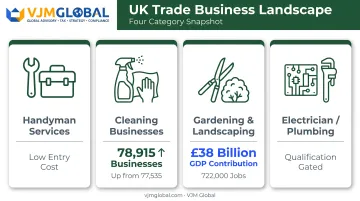
- Handyman services — low entry cost, broad demand across every UK postcode
- Cleaning businesses — the British Cleaning Council counted 78,915 cleaning, hygiene and waste businesses in 2025, up from 77,535 the year before
- Gardening and landscaping — horticulture contributed £38 billion to UK GDP and supported 722,000 jobs in 2023
- Electrician and plumbing services — qualification-gated, which limits competition
There's a growing green angle too. Household energy-efficiency upgrades, supported by government ECO and related energy-efficiency schemes, tie directly into the UK's net-zero push. Gas work must be carried out by Gas Safe registered engineers, and electrical work needs to follow Approved Document P, so factor certification time and cost into your plan.
Food, Hospitality and Retail Businesses
Lumina Intelligence estimated UK foodservice delivery would reach £14.8 billion in 2026, up 2.8% year on year. That's a large addressable market, but treat it as an estimate, not guaranteed revenue for any single operator.
Promising formats include:
- Cloud kitchens and street food — lower overheads, no dining room
- Artisan food businesses — built around provenance and quality
- Niche subscription boxes — direct-to-consumer sales
Any food business, including home-based or online-only operations, must register with the local authority at least 28 days before trading. Alcohol sales require a separate licence. Margins here can be thin once packaging, platform commissions and compliance costs are factored in, so price accordingly from day one.
Digital, Tech and AI-Driven Businesses
This category is particularly attractive to entrepreneurs entering the UK market remotely. Low overheads, national reach and no physical premises requirement make it a straightforward entry point for international founders.
Online retail penetration hit 28.3% of UK retail sales in December 2025, the highest in four years. Meanwhile, solo self-employed workers contributed an estimated £331 billion to the UK economy in 2023, according to IPSE.

Options worth exploring:
- AI-powered freelance services — automation setup, workflow consulting, staff training
- E-commerce and dropshipping — capitalising on rising online spend
- SEO and digital marketing — perpetual demand from SMEs lacking in-house skills
- Content creation — scalable once a niche and audience are established
- IT consulting — especially for smaller firms without dedicated tech teams
One caveat: platforms facilitating third-party sellers may need to report seller information to HMRC under rules effective from January 2024. Any business handling personal data should check ICO guidance on data-protection obligations before launch.
Care, Wellness and Education Businesses
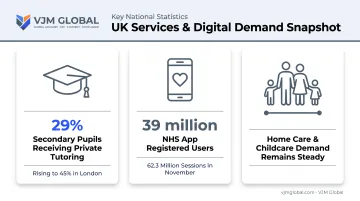
Trust-based, recurring-relationship businesses show some of the strongest demand signals in this research. The Sutton Trust found 29% of secondary pupils in England and Wales received private tutoring in 2026, rising to 45% in London.
Digital health engagement is similarly strong. The NHS App passed 39 million registered users by December 2025, logging 62.3 million sessions in November alone.
Solid business models here:
- Home care for the elderly — steady demand, ageing population
- Childcare services — consistent need across all regions
- Private tutoring — geographically uneven demand, strongest in London
- Wellness and coaching services — aligned with rising digital-health adoption
Any provider planning regulated health or social care activity must register with the CQC in England (or the equivalent regulator in Scotland, Wales or Northern Ireland). Tutoring and general wellness coaching aren't automatically classed as regulated care, but safeguarding checks and DBS requirements still apply for anyone working with children or vulnerable adults.
Low-Investment and Fast-Growing Ideas Worth Watching
Some of the most accessible UK business ideas require little more than a laptop and a skill worth selling.
Digital-first, low-capital models:
- Online tutoring in academic subjects, languages, or professional exams
- Translation and interpretation for firms trading across Europe and beyond
- Virtual assistant support for founders who need capacity without a full-time hire
- Freelance consulting built on expertise you already have in your field
Sustainable compliance consulting is another low-overhead niche with rising demand. UK Sustainability Reporting Standards are currently voluntary, but government and the FCA are actively considering mandatory categories. SMEs supplying listed companies or seeking finance are already fielding ESG data requests from clients and lenders, even without a fixed filing deadline.
On the consumer side, subscription models show similar momentum. Barclays research found UK spending on digital content and subscriptions rose 47.5% since January 2020, with 88% of consumers now paying for at least one. Content repurposing (turning one asset into posts, newsletters, and short video) is a practical low-capital service for creators and small brands serving younger, community-driven audiences.
How to Register and Set Up Your UK Business Compliantly
Getting your legal structure right from the start prevents the compliance headaches that sink otherwise good businesses.
Sole Trader vs Private Limited Company
Sole trader suits low-risk, low-turnover businesses. You register for Self Assessment once gross trading income exceeds £1,000 in a tax year. It's simple to run, but you carry unlimited personal liability.
Private limited company suits businesses planning to scale, hire, or attract investment. The company exists as a separate legal entity, limiting your personal liability, but it comes with more reporting obligations.
Companies House Registration
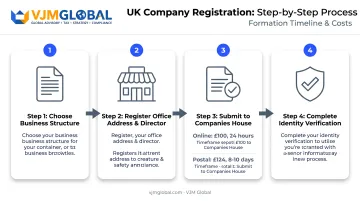
Setting up a limited company requires:
- A UK registered office address
- At least one director
- At least one shareholder
- A SIC code describing your business activity
Online incorporation costs £100 and is usually completed within 24 hours. Postal applications cost £124 and take 8–10 days. From 18 November 2025, directors and persons with significant control must also complete identity verification through Companies House.
Ongoing Compliance Obligations
Once registered, expect these recurring requirements:
- Corporation Tax — 19% on profits below £50,000, 25% above £250,000 (marginal relief applies between)
- VAT registration — mandatory once taxable turnover exceeds £90,000
- Annual accounts and Confirmation Statement — filed with Companies House each year
- PAYE payroll — if you hire staff, including Real Time Information submissions
This is where international entrepreneurs most often trip up. Cross-border tax rules, dual reporting obligations and unfamiliar HMRC processes catch out founders entering the UK from another market more often than local rule changes ever do.
VJM Global supports company formation, tax registration and ongoing accounting for businesses entering the UK, including CT600 filing, VAT registration and PAYE payroll.
Getting this foundation right early is what turns a promising idea into a business that's still trading in five years.
Frequently Asked Questions
What is the best business to start in the UK?
High-demand sectors include trades, food and hospitality, digital and AI services, and care. The "best" choice depends on your budget, existing skills and local market demand rather than any single universal answer.
What is the most successful small business?
Service-based businesses with low overheads and recurring demand, such as cleaning, care and digital services, tend to show the strongest survival and profitability rates. Repeat custom matters more than sector size.
What is the cheapest business to start in the UK?
Digital and service-based models like tutoring, freelancing and virtual assistance require minimal upfront capital. You typically only need a laptop, relevant skills and basic marketing to get started.
Do I need to register my small business with Companies House?
Only limited companies must register with Companies House. Sole traders register for Self Assessment with HMRC instead, which is a simpler process with fewer ongoing filing requirements.
How much does it cost to register a company in the UK?
Online registration costs £100 and is typically processed within 24 hours. Postal applications cost £124 and take 8–10 days to complete.
Can a non-UK resident start a small business in the UK?
Yes. Company law doesn't require directors to live in the UK, provided the company has a UK registered office address. Professional support, such as that offered by VJM Global, can simplify the identity verification and cross-border compliance involved.