Introduction
American entrepreneurs and BPO owners who want UK clients often hit the same wall: buyers want English-first, UK-based support—not another offshore queue. The upside is real too. GBP-USD economics still favour lean US-run operations when entity setup, banking, and compliance are handled correctly from abroad.
Cloud telephony, remote-work infrastructure, and digital-first company registration now let you build a UK call centre without ever boarding a plane.
Whether you're a solo founder, an agency owner diversifying markets, or a US company adding a UK support arm, the path is similar. This guide covers call centre fundamentals and the cross-border specifics: entity setup, banking, tax treaty basics, and remote management.
Key Takeaways
- Pick the model early: virtual or office-based, and inbound, outbound, or blended
- US citizens and companies can own a UK company 100% remotely—no UK residency required
- Core path: validate demand, choose structure, register, bank, tax/compliance, then hire and launch
- Break-even hinges more on pricing discipline than on where you locate
- Cross-border tax and banking—not call centre ops—is the biggest risk for US-based founders
What Is a Call Centre Business & Why the UK-USA Opportunity Works Now
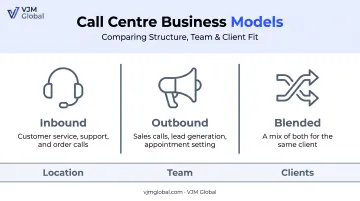
A call centre business handles phone-based customer interactions on behalf of other companies. Most fall into one of three categories:
- Inbound – answering customer service, support, or order calls
- Outbound – sales calls, lead generation, or appointment setting
- Blended – a mix of both, often for the same client
How you structure the business comes down to three choices:
- Location – home-based virtual setup or a small office
- Team – solo with contractors, or a hired team
- Clients – one exclusive account, or a multi-client model closer to traditional business process outsourcing (BPO)
Why the Timing Works for US Founders
The UK's outsourced call-centre segment is projected to generate £3.3 billion in revenue during 2025-26, following modest but steady growth of 0.8% annually over the past five years, according to IBISWorld's 2025 industry analysis. That points to a mature, stable market with predictable demand.
US-based founders are well positioned to serve it:
- English-language delivery removes the translation and cultural-fit friction some offshore providers face
- GBP-USD exchange dynamics can make US-run operations cost-competitive on client pricing
- Time-zone overlap allows a US morning shift to cover UK afternoon and early-evening hours
You can do this without relocating. The real work is getting entity setup, banking, and compliance right from day one.
What to Know Before You Start: Costs, Profitability & Realistic Expectations
Running this from the USA changes one thing above all: you'll need more delegation and a trusted on-ground contact than a founder physically based in the UK would. Time zones and distance make hands-off management risky in the early months.
Setup Costs Vary by Model
There's no single verified "total startup cost" figure for a UK call centre, but the building blocks are well documented:
- Software: Zendesk telephony plans run £45-£89 per agent/month; Salesforce CRM tiers run £20-£80 per user/month (voice priced separately)
- Office space: Prime regional rent runs roughly £46-£50 per square foot annually in Leeds and Bristol (office-based benchmark only, not all-in)
- Home-based setups: Cost significantly less, since you're skipping rent, rates, and fit-out entirely
These figures apply the same way regardless of whether the founder is sitting in London or Los Angeles.
Profitability Depends on Discipline, Not Geography
IBISWorld notes that UK call centre profitability has been volatile and runs below the average for the broader business-support sector, under pressure from rising wages and property costs. The National Living Wage jump from £11.44 to £12.21 in April 2025 adds direct pressure on labour-heavy operations.
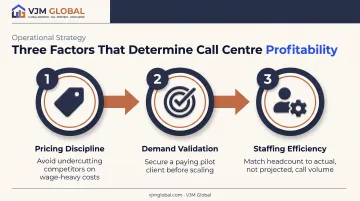
There's no standardized break-even timeline you can rely on. What actually determines profitability:
- Pricing discipline: undercutting UK competitors to win clients rarely survives contact with real wage costs
- Demand validation: securing a paying pilot client before scaling staff
- Staffing efficiency: matching headcount to actual call volume, not projected volume
Cross-Border Considerations That Matter
This is the section most US founders underestimate. Getting it wrong doesn't sink the call centre business itself. It stalls the launch before the doors open.
Three Entry Structures
- UK Limited Company — the most common route, allows 100% non-resident ownership and control
- UK branch of your existing US company — an extension of the parent, useful if you already have US corporate infrastructure you want to lean on
- Employer of Record (EOR) — lets you hire UK-based agents without incorporating anything at all, useful if you're testing the market before committing to a full entity
Registration and Identity Verification
UK company law is refreshingly flexible on residency. Directors and shareholders don't need to live in the UK — GOV.UK's official guidance confirms directors do not have to live in the UK, and a single person can hold both roles.
What you can't skip:
- A UK registered office address — a physical address, not a PO Box, in the same jurisdiction as incorporation
- Identity verification for directors and persons with significant control (mandatory since November 2025). Non-UK residents typically need at least one government-issued document, plus evidence of a 12-month address history
Most overseas founders route this through a formation agent that supplies the registered office and handles the identity-verification chain, since piecing this together solo from another country adds delay.
Banking Without a UK Branch Visit
Opening a UK business bank account remotely is the step that trips up the most founders. Traditional high-street banks like Lloyds typically require the applicant to be UK-resident with a UK mobile number, which rules them out for most US-based founders.
| Provider Type | Remote-Friendly for US Founders? | Typical Requirement |
|---|---|---|
| High-street banks (e.g., Lloyds) | Generally no | UK residency, UK mobile number |
| E-money institutions (e.g., Revolut Business) | Often yes | Company registered in UK/EEA with proof of physical presence |
| Digital business accounts (e.g., Wise, Airwallex) | Conditionally yes | Provider-specific KYC; document review often takes 1-3 business days |
Eligibility does not guarantee approval; each provider runs its own review. Digital and e-money accounts are still the practical starting point for founders who can't walk into a branch.
The Tax Treaty Piece
The US-UK tax treaty, in force since 2003, provides relief from double taxation primarily through foreign tax credits, subject to US domestic-law limits under IRC sections 901-908. In practice, this means:
- You generally won't pay full tax twice on the same income
- But credit relief has caps, and it doesn't eliminate US filing obligations
If you're a US person who owns or controls a foreign corporation like a UK Ltd, you likely have a separate reporting obligation. The IRS's Form 5471 instructions describe it as an information return required of certain US officers, directors, or shareholders in foreign corporations, separate from any tax actually owed.
That dual-country filing is what trips up generalist accountants who only know one side of the border.
Firms like VJM Global exist for precisely this gap. The firm handles UK entity formation, Employer of Record hiring, and multi-jurisdiction tax compliance for founders across 100+ countries. That includes coordinating UK-side filings such as Corporation Tax registration and Form CT600 with US-side obligations like Form 1116 foreign tax credit claims, so you are not left stitching together two advisers who never speak to each other.
How to Start a Call Centre Business in the UK from the USA – Step by Step
These steps take you from validating demand to launching remotely. The most common founder mistake: rushing registration before confirming anyone in the UK actually wants to pay for the service.
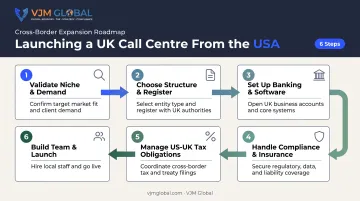
Step 1 – Validate Your Niche and UK Market Demand
Identify UK industries with strong outsourcing appetite. SMEs, e-commerce retailers, trade businesses, and agencies tend to outsource support fastest since they lack in-house capacity.
- Use LinkedIn, UK business forums, and direct outreach to test interest before spending a pound on setup
- Run a small pilot with one UK client to validate pricing and service fit
- Don’t assume US pricing and expectations transfer—UK buyers often want different SLA norms and contract terms
Step 2 – Choose Your Entry Structure and Register Your Company
Decide between a UK Limited Company, an EOR-based no-entity model, or a branch structure based on your growth plans and how much control you want.
- Companies House registration is done entirely online and can be completed from the US within a day using a formation agent for the registered office
- Corporation Tax registration happens automatically on incorporation; ICO data protection registration is separate and near-mandatory if you'll handle caller data
- A weak registered office address is a frequent mistake and can delay bank account approval later
Step 3 – Set Up UK Banking, Payments, and Your Software Stack
Compare remote-friendly digital accounts against traditional banks before committing.
- Budget for VoIP, CRM/call software, and headsets — home-based setups cost meaningfully less than office-based ones
- Decide how you'll invoice and collect in GBP to avoid unnecessary currency-conversion losses on every client payment
Step 4 – Handle UK Compliance: Data Protection and Insurance
Register with the Information Commissioner's Office if you'll handle caller data. Fees are tiered: £52 for small operations (turnover under £632,000 or fewer than 10 staff), rising to £3,763 for larger controllers.
- Build GDPR and UK Data Protection Act practices into call recording, consent, and storage from day one, not retroactively
- Secure employer's liability insurance (minimum £5m cover) the moment you hire UK staff — failing to insure carries penalties of up to £2,500 per day
- Add professional indemnity cover for client-facing work
Step 5 – Manage Your US-UK Tax Obligations
Track UK Corporation Tax and VAT registration thresholds separately from your US filing calendar. As a US person owning a foreign corporation, you'll likely face additional IRS reporting on top of UK obligations.
Most founders engage a cross-border adviser here rather than filing in both countries alone. VJM Global coordinates UK Corporation Tax, VAT, and IRS foreign-corporation reporting so deadlines and entity facts stay aligned on both sides.
Step 6 – Build Your Team and Launch Operations Remotely
Decide whether to hire UK agents directly, use an Employer of Record, or appoint a local operations lead.
- Set clear overlap hours between US and UK time zones for check-ins and escalations
- Launch client acquisition through UK-specific channels: Google Business Profile, LinkedIn UK groups, and referrals — not repurposed US marketing assets
- A trusted on-ground UK team lead cuts the risk of running everything by remote control—don’t skip that hire if you can fund it
Conclusion
Launching a UK call centre from the USA is achievable without relocating. Remote-friendly incorporation and banking options have made the mechanics workable for non-resident founders.
The harder part is getting cross-border entity structure, banking, and tax compliance right from day one. Long-term success comes down to validating demand first, stabilising operations second, and only then scaling across more UK clients or locations. If you want that foundation handled cleanly, a cross-border advisor such as VJM Global can support UK company formation, banking setup, and ongoing tax compliance while you focus on winning clients.
Frequently Asked Questions
Is opening a call centre profitable?
UK call centres can reach healthy margins with disciplined cost control and pricing, but industry-wide profitability runs below the broader business-support sector average. Client mix and staffing efficiency matter more than the industry itself.
What is the 80/20 rule in call centres?
It's the standard service-level benchmark: answering 80% of calls within 20 seconds. It's an industry convention for measuring customer experience, not a legal requirement.
Do I need to be a UK resident to register a call centre business there?
No. UK company law doesn't require directors or shareholders to live in the UK. You do need a physical UK registered office address, which most overseas founders source through a formation agent.
How do I open a UK business bank account from the USA?
Traditional high-street banks generally require UK residency, which rules most US founders out. Digital and e-money accounts like Wise, Revolut Business, or Airwallex are more accommodating but still run their own KYC checks.
Will I be taxed twice on my UK call centre profits, in both the US and UK?
The US-UK tax treaty provides double taxation relief mainly through foreign tax credits, though these credits are capped under US law. You'll still likely face separate US reporting obligations, such as Form 5471, simply for owning a foreign corporation.
How long does it take to set up a UK call centre business remotely from the USA?
Company registration itself can take as little as 24 hours. Banking approval, ICO registration, insurance, and staffing typically stretch the full launch timeline to several weeks.