Introduction
If you're an Indian entrepreneur weighing up where to build your next venture, the UK offers something most markets can't match: a built-in community. According to the ONS Census 2021, 1.86 million people identified as Indian in England and Wales alone — a ready-made customer base most new entrants underestimate.
That opportunity comes with real complexity, though. Visa routes, Companies House registration, HMRC compliance, and the nuances of UK tax law all create friction for first-time entrants. Many promising ventures stall not because the idea was wrong, but because the legal and regulatory groundwork wasn't laid properly.
This guide covers the strongest business opportunities for Indian entrepreneurs in the UK — from high-capital sectors like food and IT to lower-investment options like online tutoring and translation services. It also walks through the essential steps to set up legally and compliantly from day one.
Key Takeaways
- £47.9 billion in UK-India bilateral trade creates real commercial corridors for import-export and services businesses
- Top sectors for Indian entrepreneurs: IT services, Indian food and hospitality, ethnic retail, and education consulting
- Low-investment entry points: digital marketing, online tutoring, translation, and virtual assistant services
- Non-UK residents can register a UK private limited company remotely through Companies House
- The Innovator Founder Visa (£1,357) and Global Talent Visa (£766) are the two main routes for Indian entrepreneurs entering the UK
Why the UK Is a Strategic Market for Indian Entrepreneurs
The UK combines several advantages that are difficult to find in a single market: English as the primary business language, a transparent legal system, and direct access to a large, established Indian diaspora community.
The commercial relationship between India and the UK is substantial. According to the Department for Business and Trade's India factsheet, total UK-India trade reached £47.9 billion in the four quarters to Q4 2025 — with UK imports from India at £28.7 billion and UK exports to India at £19.3 billion.
India also ranked as the second-largest source of UK inward FDI projects in 2024-25, generating 106 projects and 6,067 new jobs.

A Built-In Customer Base
For Indian entrepreneurs, the diaspora itself is a commercial asset. With 1.86 million Indian-identifying residents in England and Wales — concentrated in cities like Leicester, Birmingham, London, and Bradford — there's consistent demand for:
- Authentic Indian food and groceries
- Cultural goods, fashion, and festivals
- Indian-language professional services
- Financial and advisory services that bridge both markets
Accessible Business Structures
The UK company formation process is straightforward for non-residents. GOV.UK requires at least one director and one shareholder, a UK registered office address, and an online registration fee of £100 — with most companies registered within 24 hours. There is no requirement for the director to be a UK resident.
For those planning to relocate, the Innovator Founder Visa (£1,357 for applications outside the UK) and the Global Talent Visa (£766 total) provide two of the most direct routes for entrepreneurs entering the UK.
Top Business Ideas for Indian Entrepreneurs in the UK
The strongest opportunities combine professional expertise, cultural knowledge, and genuine UK market demand. Here are the sectors with the clearest commercial case.
Indian Restaurant, Cloud Kitchen, or Catering Business
Indian cuisine has been embedded in British food culture for decades. The delivery-first model has changed the economics considerably — cloud kitchens eliminate the cost of front-of-house operations while capturing demand through platforms like Deliveroo and Uber Eats. Statista estimates the UK online food delivery market at approximately USD 48 billion in 2024, ranking the UK third globally.
Where Indian entrepreneurs have an edge:
- Authentic regional recipes and supplier relationships with Indian food importers
- Knowledge of spice sourcing, regional cuisine variations, and dietary requirements
- Community trust within the diaspora — often the most loyal early customers
What you'll need to start: Food businesses must register with the local authority at least 28 days before trading, and must maintain food safety management procedures under FSA requirements.
IT Services, Software Development, and Tech Consulting
For Indian professionals in the UK, IT services represent one of the clearest commercial opportunities. Grand View Research estimates the UK IT services outsourcing market at USD 45.7 billion in 2024, projected to reach USD 67.3 billion by 2030 at a 6.7% CAGR.
India commands a 55% share of the global sourcing market, according to IBEF. That built-in credibility matters — UK buyers already associate Indian tech professionals with delivery quality and cost efficiency.
The model works well because:
- Remote-first delivery keeps overheads low
- India-based delivery teams enable cost-competitive pricing for UK clients
- Demand spans software development, cloud migration, cybersecurity, and digital transformation

Import-Export Business (India-UK Trade)
DBT data confirms strong verified trade flows. Clothing from India to the UK reached £952.7 million in the four quarters to Q4 2025. Pharmaceutical and chemical products are also significant categories. In the other direction, machinery, metal products, and beverages flow from the UK to India.
Indian entrepreneurs benefit from existing supplier networks, language capabilities, and familiarity with Indian customs standards. Essential requirements:
- Understand commodity codes via the UK Trade Tariff
- Account for import VAT on goods entering Great Britain
- Partner with a reliable logistics provider for customs clearance
Indian Grocery, Fashion, and Ethnic Retail
The UK ethnic food market was estimated at USD 3.38 billion in 2024 by Grand View Research, expected to reach USD 5.69 billion by 2030. For Indian entrepreneurs, the opportunity is in curation — stocking regional products unavailable in mainstream supermarkets and sourcing directly from Indian manufacturers.
Both physical stores in high-density Indian communities and e-commerce models are viable routes. Key considerations for either format:
- Build loyalty through cultural events and community engagement
- Online stores serve diaspora buyers in smaller cities where physical retail is limited
- Direct sourcing from Indian manufacturers improves margins over distributor pricing
Education, Tutoring, and Test Preparation
Private tutoring has significant scale in the UK. The Sutton Trust reported in 2023 that 30% of 11-16-year-olds had received private tuition at some stage. Indian professionals — particularly in STEM subjects, competitive exam preparation, and language coaching — are well-positioned here. Entry barriers are genuinely low:
- Start as a solo tutor and build toward an agency model
- Offer both in-person and online sessions (online significantly expands geographic reach)
- GCSE, A-level, and university entrance preparation are consistently high-demand categories
Accounting, Finance, and Business Advisory
Professionally qualified Indian accountants — CAs, CPAs, and finance professionals — have a specific advantage here. UK SMEs, Indian-owned businesses, and NRIs managing cross-border financial obligations all need bilingual advisors who understand both the HMRC framework and Indian tax obligations.
Services with consistent demand include:
- UK corporation tax and VAT compliance
- DTAA (Double Taxation Avoidance Agreement) advisory for NRIs
- Cross-border transaction structuring and FEMA compliance
- Management accounts for Indian-owned UK businesses
Wellness, Yoga, and Ayurveda Services
A YouGov survey from June 2024 found 69% of Britons associated yoga with physical exercise, and MarketResearchFuture estimated the UK Ayurvedic products market at USD 480.72 million in 2024. UK consumers are actively seeking non-Western wellness approaches — and Indian practitioners bring authentic cultural credentials that carry real weight in this market.
Viable formats include yoga studios, mobile wellness coaching, Ayurvedic product lines, and online wellness programmes. Professional certification and appropriate public liability insurance are essential in this sector.
Best Low-Investment Business Ideas for Indians in the UK
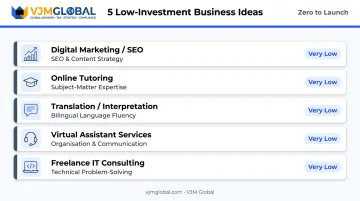
For those testing the UK market with limited capital, service-based and digital-first models require little more than expertise, a laptop, and a reliable internet connection.
| Business Idea | Startup Cost | Key Skill Required |
|---|---|---|
| Digital marketing / SEO agency | Very low | Digital marketing, analytics |
| Online tutoring | Very low | Subject expertise |
| Translation / interpretation | Very low | Bilingual proficiency |
| Virtual assistant / back-office services | Very low | Admin, bookkeeping, organisation |
| Freelance IT consulting | Very low | Technical / software skills |
Each of these models has a clear entry point for Indian professionals already in the UK:
- Digital marketing and SEO: Many UK SMEs — including Indian-owned businesses — need help with paid advertising and content strategy. The solo self-employed contributed £366 billion to the UK economy in 2024, confirming the commercial viability of freelance models.
- Translation and interpretation: Hindi, Gujarati, Punjabi, and Tamil speakers are in demand across legal, healthcare, and government settings. No premises needed — work can begin on a freelance basis immediately.
- Online tutoring and course creation: Platforms like Udemy and Teachable let Indian professionals monetise expertise in coding, mathematics, science, and competitive exam prep. Build once, sell repeatedly to students across the UK.
How to Register and Start a Business in the UK as an Indian National
Company Formation Basics
You have two main structural options:
- Sole trader — simpler to set up, personal liability for business debts
- Private limited company (Ltd) — legally separate entity, preferred for most trading businesses
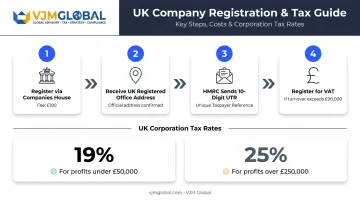
For a limited company, registration via Companies House costs £100 online and typically completes within 24 hours. Requirements include a UK registered office address (a Royal Mail PO Box cannot be used), at least one director, and at least one shareholder.
After registration, HMRC automatically sets up corporation tax, sending a 10-digit UTR to the registered office. VAT registration is required once taxable turnover exceeds £90,000.
Corporation Tax rates (from April 2026):
- 19% for profits under £50,000
- 25% main rate for profits over £250,000
Visa Options for Indian Entrepreneurs
| Visa Route | Fee (Outside UK) | Key Requirement |
|---|---|---|
| Innovator Founder Visa | £1,357 (+ £1,000 endorsement) | Business assessed by an approved endorsing body |
| Global Talent Visa | £766 total | Recognised leader or emerging talent in tech, arts, or academia |
The Innovator Founder Visa suits those with an innovative, scalable business idea. The Global Talent Visa works for tech founders, researchers, and those with demonstrated sector leadership.
Non-UK residents can also register a UK limited company remotely without a UK visa — relevant for Indian entrepreneurs operating from India while building UK client relationships before relocating.
Getting the Compliance Right
Once registered, ongoing compliance demands immediate attention. Indian entrepreneurs managing obligations in both markets typically face:
- VAT returns and annual accounts filing
- Payroll and employer obligations
- Cross-border tax duties under the UK-India DTAA
- FEMA compliance for funds moving between countries
Working with advisors who understand both HMRC requirements and Indian tax law is practical, not optional. VJM Global's team of Chartered Accountants and CPAs has supported 250+ UK businesses across 15+ industries, with hands-on experience in cross-border tax advisory, DTAA compliance, and FEMA regulations for entrepreneurs operating across both markets.
Conclusion
The UK offers Indian entrepreneurs a genuine combination of advantages: a large diaspora customer base, £47.9 billion in bilateral trade with India, accessible company formation for non-residents, and consistent demand across food, technology, education, wellness, and professional services.
A successful UK launch depends on getting three things right from the start: choosing the appropriate business structure, meeting HMRC tax obligations, and understanding your cross-border compliance requirements as an Indian national operating abroad.
If you're an Indian entrepreneur planning to enter the UK market, VJM Global offers hands-on support across UK company formation, cross-border tax advisory, and ongoing accounting compliance — built specifically for Indian entrepreneurs navigating both markets. Contact the team at [email protected] or call +91 9213397070 to discuss your plans with an advisor who understands both markets.
Frequently Asked Questions
What business is best to start in the UK?
High-demand sectors include technology services, food and hospitality, healthcare, and professional services. Indian entrepreneurs tend to gain a faster edge in areas that draw on cultural expertise — Indian cuisine, IT consulting, import-export, or bilingual advisory services — rather than entering an unfamiliar market from scratch.
What business can I start in the UK with little or no money?
Freelance IT consulting, digital marketing, online tutoring, and translation services all require minimal startup capital — a laptop and professional expertise are sufficient. These models also allow you to test UK market demand before committing to higher-overhead operations.
Can an Indian national start a business in the UK without being a UK resident?
Yes. Non-UK residents can legally register a UK private limited company remotely through Companies House. Running the business from within the UK, however, typically requires an appropriate visa such as the Innovator Founder Visa or Global Talent Visa.
What visa do I need to start a business in the UK as an Indian citizen?
The Innovator Founder Visa (£1,357 + £1,000 endorsement fee) is for entrepreneurs with an innovative, scalable idea vetted by an approved endorsing body. The Global Talent Visa (£766 total) suits those with recognised expertise in digital technology, research, or the arts.
Do I need a UK partner or director to register a company in the UK?
No. There is no legal requirement for a UK-based director or local partner. A single Indian national director is sufficient, though the company must have a valid UK registered office address — a virtual office address from a registered provider satisfies this requirement.
What are the most profitable business sectors for Indian entrepreneurs in the UK?
IT and technology services, food and hospitality, and professional services (accounting, finance, advisory) consistently generate strong returns. Import-export businesses bridging India-UK trade corridors — particularly in clothing, pharmaceuticals, and machinery — also perform well, supported by UK Department for Business and Trade figures.