Most founders don't think about it until someone else does. A bank underwriter asks for it. An investor's due diligence checklist flags it. A regulator ties a filing deadline to it. That's usually the first moment founders realize this single date carries more weight than they expected.
This is especially true for foreign entrepreneurs setting up shop in a new country like India, where compliance calendars, audit triggers, and filing deadlines all run off one number they may have barely noticed on their registration paperwork.
This guide breaks down what the incorporation date actually means, why it matters more than most founders assume, how to track it down, and how it differs from similar-sounding terms that often get confused with it.
Key Takeaways
- The incorporation date is the official day a company becomes a separate legal entity
- It anchors compliance deadlines, including annual filings, audits, and board meeting timelines
- This date is permanent and cannot be reset except by forming an entirely new legal entity
- This date differs from both the business start date and, in some jurisdictions, the registration date
What Is a Company's Incorporation Date?
The incorporation date is the day a government authority formally approves and registers a company's incorporation documents. In India, that's the Registrar of Companies (RoC) under the Ministry of Corporate Affairs (MCA). In the US, it's the Secretary of State in the relevant state. In Australia, it's the Australian Securities and Investments Commission (ASIC).
This date gets recorded on the official incorporation certificate:
- India: Certificate of Incorporation, issued under Section 7(2) of the Companies Act, 2013
- UK: Certificate of Incorporation
- US: Certificate of Incorporation (Delaware's specific term) or Articles of Incorporation, depending on the state
- Australia: Certificate of Registration, which states the "day of commencement of registration"
Why This Date Is Permanent
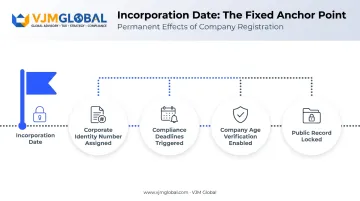
Once set, the incorporation date doesn't move. In India, Section 9 of the Companies Act makes the subscribers and future members a body corporate from the date stated in the certificate — and on that same date, the Registrar allots a unique Corporate Identity Number (CIN) tied permanently to that date.
The same logic applies elsewhere:
- Australia issues a 9-digit Australian Company Number (ACN) at registration
- US (Delaware) links the incorporation date to a state file number
- India's CIN stays fixed to the original certificate date
Here's the part many founders miss: changing directors, shareholders, the registered office, or even the company name later doesn't touch this date. It's locked in as part of the permanent public record.
This fixed starting point is also what makes claims about company age verifiable. A business that says it has operated for 20 or 30 years can be checked against its incorporation certificate, turning a marketing claim into a matter of public record.
Why the Incorporation Date Matters
Think of the incorporation date as the legal "start line." Before this date, there's no company, just people with an idea and some paperwork. After it, the company can sign contracts, own property, hire staff, and sue or be sued in its own name.
That single shift creates ripple effects across four areas.
Credibility and Financial Trust
Banks, lenders, and investors use the incorporation date to gauge company age, stability, and creditworthiness. A five-year-old company applying for a loan looks fundamentally different from one incorporated last month, regardless of how good the balance sheet looks on paper.
Statutory Compliance Timelines
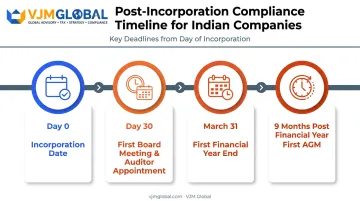
In India, several critical deadlines are calculated directly from this date:
| Requirement | Deadline | Trigger |
|---|---|---|
| First Board meeting | Within 30 days | Date of incorporation |
| First auditor appointment | Within 30 days | Date of registration |
| First financial year end | March 31 (following year if incorporated after January 1) | Date of incorporation |
| First AGM | Within 9 months | Close of first financial year |
One nuance worth flagging: not every deadline runs directly off incorporation. The first AGM depends on when the financial year closes, and filings like AOC-4 (30 days) and MGT-7 (60 days) are counted from the AGM date, not the incorporation date itself. Founders who assume everything ties back to day one often miscalculate their filing windows, which is why many foreign-owned entities lean on advisory firms like VJM Global to track these staggered deadlines correctly.
Due Diligence in Deals
When companies raise funding, get acquired, or enter partnerships, the incorporation date shows up early in data rooms and information memoranda. It's one of the first facts due diligence teams verify, because it confirms the entity actually exists as claimed and establishes its operating history.
Annual Renewal Cycles
Licence renewals, registration anniversaries, and filing cycles frequently anchor to the incorporation date. Missing this anchor point by even a few weeks can cascade into missed deadlines further down the compliance calendar.
How to Find a Company's Incorporation Date
Three reliable sources exist, and each serves a slightly different purpose.
Check the Certificate of Incorporation
This is issued immediately after registration and lists:
- Company name
- Registration number (CIN in India, ACN in Australia, state file number in the US)
- The exact incorporation date
If you're a founder, this document should be sitting in your company's records right now.
Search the Government Registry
If the certificate isn't readily available, the next option is the public registry. Every major jurisdiction maintains a public registry:
- India: MCA's Master Data search (via CIN or company name)
- US: Secretary of State websites, state by state — Delaware's free entity search shows the incorporation date, file number, and registered agent details
- Australia: ASIC's company and organisation registers, searchable by name, ACN, or ARBN
Review Internal Statutory Registers
The company's minute book or statutory registers should record the incorporation date as their very first entry. If a company can't produce this quickly, it's often a sign its record-keeping needs attention.
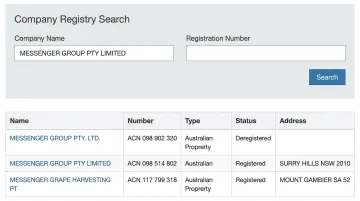
These three methods work well when you're checking your own company's records. Looking up another company's incorporation date follows a similar process, with one key difference: you're relying entirely on public sources.
Finding a Company's Incorporation Date for a Third Party
Because incorporation details sit on the public record, you don't need permission to look up another company's incorporation date. Vendors, partners, and investors do this routinely during due diligence.
Simply search the relevant registry by company name or registration number:
- India's MCA portal for domestic and foreign-registered Indian entities
- The Secretary of State registry in the relevant US state
- ASIC's public registers for Australian companies
This is a standard first step before signing a contract with an unfamiliar counterparty, and it costs nothing beyond a few minutes of searching.
Incorporation Date vs Related Business Terms
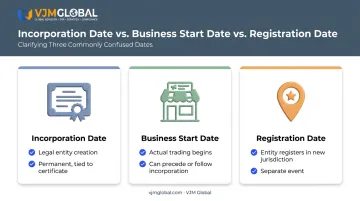
These terms get used interchangeably all the time, and that's where confusion creeps in. Here's how incorporation date differs from three commonly confused terms:
Incorporation Date vs. Business Start Date
The incorporation date marks legal existence. The business start date reflects when actual trading began, which can happen before or after incorporation.
A founder might freelance under their own name for months before formally incorporating. Alternatively, they could incorporate a shell entity and not begin operations for a year.
Incorporation Date vs. Registration Date
In some cases, a company incorporated in one jurisdiction later registers to do business in another. California, for example, allows an out-of-state entity to "qualify" or "register to transact business" locally.
That registration date is separate from the entity's original incorporation date (and doesn't replace it).
Incorporation Date vs. LLC Formation Date
LLCs aren't technically "incorporated." They're "formed," and the equivalent document is often called Articles of Organization rather than Articles of Incorporation.
Functionally, though, the formation date does the same job: it anchors compliance timelines and legal existence, just under different terminology.
Incorporation Date Considerations for Foreign Businesses Expanding into India
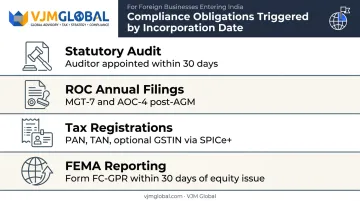
For US, UK, and Australian businesses entering India, the MCA-issued incorporation date does more than mark a legal milestone. It triggers a cascade of India-specific obligations:
- Statutory audits — every Indian company must appoint an auditor within 30 days of registration, regardless of foreign ownership or size.
- ROC annual filings — annual returns (MGT-7) and financial statements (AOC-4) follow strict post-AGM deadlines
- Tax registrations — PAN and TAN are now integrated into the SPICe+ incorporation workflow, though GSTIN registration through the linked AGILE-PRO-S form remains optional at that stage.
- FEMA reporting — if foreign equity is issued, Form FC-GPR must be filed within 30 days of the equity issue date (not the incorporation date)
A delayed or bungled incorporation process pushes back this critical date, dragging banking setup, hiring timelines, and contract execution along with it. Getting the paperwork right from day one matters more than most founders realize.
This is precisely where VJM Global's Chartered Accountants and business setup professionals add practical value. The firm has helped 500+ American, 250+ UK, and 250+ Australian businesses navigate Indian company formation, tracking compliance timelines accurately from the very first day rather than scrambling to catch up after deadlines slip.
Frequently Asked Questions
How do I find a company's incorporation date?
Check the Certificate of Incorporation, or search the relevant registry — MCA in India, Secretary of State in the US, ASIC in Australia. Both sources should show the same date.
Does an LLC have an incorporation date?
LLCs technically have a "formation date" rather than an incorporation date, since LLCs are formed under state statute, not incorporated. The formation date serves the exact same legal and compliance function.
Can I choose my incorporation date?
Generally no. The date is set when the registering authority approves the application. Some jurisdictions, including Delaware, allow a requested future effective date, but it typically can't exceed 90 days from filing.
What is the difference between incorporation date and registration date?
The incorporation date marks when a company was originally formed in its home jurisdiction. The registration date applies when that company later registers to do business elsewhere — a separate event that doesn't replace the original date.
Can a company's incorporation date be changed later?
No, it's permanent. The only exception is when a new legal entity forms through a merger or conversion, in which case that new entity receives its own fresh incorporation date.
Why does the incorporation date matter for compliance in India?
MCA and ROC filing deadlines, statutory audit timelines, and the first board meeting requirement are all calculated based on this date. Getting it wrong at the start creates a compounding compliance headache later.