Introduction
Incorporation is the legal process of forming a separate business entity, a corporation or LLC, recognized by the state. That's the short version.
Here's what most founders get wrong: they confuse incorporation with registering a business name, or think getting an EIN counts as forming a company. These are separate steps, and mixing them up costs time and money, especially once you see how many businesses are choosing formal structures each year.
In Delaware alone, businesses formed 334,461 new entities in 2025, with 70.4% as LLCs and 22.3% as corporations, according to the Delaware Division of Corporations 2025 annual report. That's just one state.
This guide breaks down what incorporation actually means, why US businesses do it, and how to pick the structure that fits your goals, without the legal jargon.
Key Takeaways
- Incorporation separates your personal assets from business liability while letting the entity sign contracts and raise capital
- Forming a business means picking a structure, filing state paperwork, and securing an EIN
- LLCs and corporations differ mainly in taxation and fundraising ability, with no universal "better" choice
- Picking the wrong state or structure early is expensive to fix later
What Is Incorporation, and Why Do US Businesses Do It?
Incorporation is the formal act of forming a corporation or LLC through a state's Secretary of State office. It creates a legal entity distinct from its owners — one that can own property, sign contracts, and be sued independently of the people who run it.
A quick clarification on terminology: Corporations file Articles of Incorporation. LLCs file Articles of Organization. Both create separate legal entities, but "incorporating" technically refers to corporations, while "formation" is the umbrella term covering LLCs too.
Once formed, the entity can:
- Enter contracts and lease property under its own name
- Hire employees and open business bank accounts
- Raise funding from investors or issue stock
- Protect owners from personal liability for business debts
Why It Matters for US Businesses
Without incorporation, you're operating as a sole proprietorship or general partnership by default. That means:
- You're personally liable. Business debts and lawsuits can reach your personal assets — your house, your savings, your car.
- Banks and investors won't engage. Most business bank accounts, institutional loans, and licenses require a formally registered entity.
- Growth is capped. You can't issue stock or bring on shareholders without a corporate structure.
Delaware's 2025 numbers show the LLC-heavy trend clearly: 235,393 LLCs versus 74,716 corporations formed in that state alone last year. Most small businesses and solo founders lean LLC for simplicity. Startups chasing venture capital tend to go corporate.
How the Incorporation Process Works: Step-by-Step
At a high level, incorporation involves four moving parts: choosing a structure and state, filing formation documents, appointing a registered agent, and securing your tax IDs. The state's approval of your formation documents is the actual moment your entity becomes legally real. That approval is when you receive your certificate of incorporation or formation.
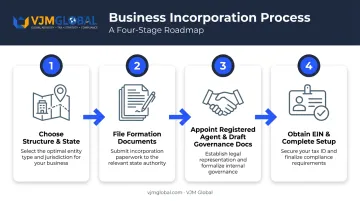
You'll need to have ready:
- A business name that complies with state naming rules
- A registered agent with a physical address in your filing state
- Names and addresses of owners, directors, or managers
- Your Articles of Incorporation (corporations) or Articles of Organization (LLCs)
Step 1: Choose Your Business Structure and State
Decide between an LLC, C-Corp, or S-Corp status first. This choice shapes everything downstream, including taxes and fundraising options.
Then pick your state. Most businesses incorporate where they actually operate. Some choose Delaware or Nevada for specific legal or tax advantages, but that decision carries trade-offs covered later in this guide.
Step 2: File Formation Documents
This is the core filing step. Corporations submit Articles of Incorporation; LLCs submit Articles of Organization, both filed with the Secretary of State along with a filing fee.
Texas, for example, requires different details depending on entity type:
| Filing | Key required fields |
|---|---|
| LLC (Form 205) | Entity name, registered agent address, member/manager structure, organizer signature |
| Corporation (Form 201) | Entity name, registered agent address, initial director, authorized shares, organizer signature |
Source: Texas Secretary of State business filing forms
Step 3: Appoint a Registered Agent and Draft Governing Documents
Every state requires a registered agent — someone with a physical address in the filing state who receives legal and official mail on the business's behalf.
You'll also need internal governance documents:
- Bylaws for corporations — define how the board operates, votes, and makes decisions
- Operating agreements for LLCs — outline ownership percentages, profit splits, and management structure
These aren't filed with the state, but skipping them creates ownership disputes down the line.
Step 4: Obtain an EIN and Complete Post-Incorporation Setup
Once your entity is approved, apply for an Employer Identification Number directly through the IRS. It's free, and approved applications get an EIN immediately online. You'll need an SSN or ITIN as the responsible party, and the IRS caps applications at one EIN per responsible party per day.
From there:
- Open a business bank account using your EIN and formation documents
- Register for state and local tax obligations
- Set up payroll if you're hiring
LLC vs Corporation vs S-Corp: Choosing the Right Structure
Choosing between an LLC, C-Corp, and S-Corp comes down to taxation, ownership flexibility, and fundraising goals.
LLCs offer pass-through taxation by default — profits flow to your personal tax return, avoiding corporate-level tax. A single-member LLC is disregarded for tax purposes, while multi-member LLCs default to partnership taxation. Ownership is flexible, and compliance is lighter than a corporation.
C-Corps face double taxation: profits are taxed at the corporate level, then again when distributed as dividends to shareholders. But C-Corps can issue multiple stock classes and unlimited shareholders, making them the default choice for startups planning to raise venture capital.
S-Corp status isn't a separate legal entity — it's a federal tax election available to eligible LLCs or corporations. Filing Form 2553 lets qualifying businesses pass income through to shareholders, avoiding double taxation. Eligibility requires domestic status, no more than 100 shareholders, one class of stock, and no ineligible shareholder types.
The election deadline for Form 2553 is 2 months and 15 days after the start of the tax year you want it to apply to.
Understanding this election clears up the tax question, but a separate confusion trips up many founders: whether an LLC even counts as "incorporated."
LLC or Incorporated? Here's the Real Answer
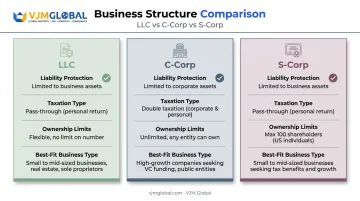
Both LLCs and corporations are "incorporated" in the legal sense — both are formally recognized state entities. The real question isn't LLC vs. incorporated. It's which structure fits your goals:
| Factor | LLC | C-Corp | S-Corp (election) |
|---|---|---|---|
| Liability protection | Yes | Yes | Yes |
| Taxation | Pass-through (default) | Double taxation | Pass-through |
| Ownership limits | Flexible | Unlimited shareholders | Max 100 shareholders |
| Best for | Small businesses, solo founders | VC-backed startups | Eligible small corps/LLCs wanting tax savings |
Costs, Timelines & Key Factors That Affect Incorporation
Filing fees vary widely by state. A few real examples:
- Kentucky: $40 for LLC or corporation formation [21]
- Colorado: $50 for either structure [49]
- Texas: $300 flat fee for LLCs and corporations [97][99]
- Massachusetts: $500 for LLCs; $275+ for corporations depending on authorized shares [20][60]
That's a $40 to $500 range just for state filing, before adding registered agent fees or legal help. Processing speed varies just as much, and filing method often determines whether you wait days or get approved instantly:
- Colorado online filings process in real time, while paper filings take roughly 7-10 business days [6]
- California offers 24-hour expedited service for $350, or same-day for $750 on top of standard fees [8]
Ongoing State-Specific Costs
Formation fees are only a starting point. Several states also impose recurring costs that continue for as long as the business exists:
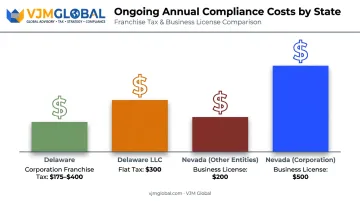
- Delaware corporations owe an annual report plus franchise tax due March 1, with a minimum franchise tax of $175 (or $400 under an alternate calculation method) [34]
- Delaware LLCs skip the franchise tax report but owe a flat $300 annual tax due June 1 [66]
- Nevada charges an annual State Business License renewal: $500 for corporations, $200 for other entities [80]
If you operate in multiple states, you'll likely need foreign qualification: registering as an out-of-state entity in any location where you have a physical presence, employees, or significant revenue [3]. Factoring in these ongoing and multi-state costs upfront helps avoid budget surprises after formation.
Common Mistakes to Avoid When Incorporating
Even a properly filed entity can run into trouble if these common missteps go unchecked. Here are the three that trip up new business owners most often:
- Assuming your registered name is trademarked. It isn't. The USPTO makes clear that registering a business name with a state gives you zero federal trademark rights — that protection requires a separate federal application.
- Chasing Delaware or Nevada without doing the math. These states offer real legal advantages, but if you operate primarily elsewhere, you'll still owe foreign qualification fees in your home state. That often means double annual fees, double compliance filings, and sometimes double taxes.
- Thinking formation equals compliance. Filing your Articles is step one, not the finish line. States require ongoing annual reports, franchise tax filings, and updated records to maintain "good standing." Skip these, and your entity can be administratively dissolved.
After Incorporation: Staying Compliant & Expanding Globally
Formation is just the starting line. Keeping your entity in good standing requires ongoing attention:
- Annual or biennial reports: Washington, for example, requires all entities to file annually by their formation anniversary month
- Franchise taxes: vary by state and structure, as shown above
- Registered agent maintenance: you must keep a valid agent on file at all times
- Corporate records: keep minutes, resolutions, and ownership changes documented consistently
Once your entity is stable and compliance is on autopilot, many founders start looking beyond domestic borders. India has become one of the fastest-growing destinations for US companies, but expanding there introduces a fresh layer of entity setup, tax registration, and regulatory compliance that looks nothing like US incorporation.
VJM Global works with US businesses making that move, handling entity setup, accounting, tax compliance, and back-office support in India. Our team has supported over 500 American business owners through this transition, along with similar work for UK and Australian companies entering the Indian market.
Frequently Asked Questions
What does it mean if a company is incorporated?
It means the business is legally registered as a separate entity — a corporation or LLC — with its own legal identity. This entity can contract, sue, and be sued independently of its owners.
Is it better to be an LLC or incorporated?
LLCs are also a form of incorporation. The right choice depends on whether you want simple pass-through taxation and flexibility (LLC) or the ability to raise investment and issue stock (C-Corp).
How long does it take to incorporate a business in the US?
It varies by state and filing method. Some states process online filings same-day, while standard paper filings can take up to a few weeks.
Do I need a lawyer to incorporate my business?
No, you can file independently or use an online formation service. Professional guidance is recommended for complex ownership structures or multi-state operations.
Can I incorporate my business in a state where I don't live or operate?
Yes. Businesses often incorporate in Delaware or Nevada for legal or tax advantages, but must register as a "foreign entity" in their home state if they operate there too.
What happens if I don't incorporate my business?
Your business defaults to a sole proprietorship or general partnership, leaving you personally liable for all business debts, lawsuits, and obligations.