That last part matters more than most founders expect. Mainland setups go through the DED (or DET in Dubai), while each Free Zone — DMCC, IFZA, JAFZA, and dozens of others — runs its own application process with its own document list. There's no single master checklist that works everywhere.
Incomplete or mismatched documentation is one of the most common reasons applications stall or get sent back for correction. This guide walks through exactly what you'll need: personal documents, company documents, and the attestation steps for anything issued outside the UAE. Founders juggling multiple jurisdictions — say, a UAE entity alongside plans to enter India — often benefit from advisors like VJM Global, whose team has spent over 30 years helping US, UK, and Australian founders structure cross-border operations.
Key Takeaways
- UAE registration needs personal documents (passports, Emirates ID) and company documents (MOA, trade name approval, lease)
- Requirements shift meaningfully between mainland, free zone, and offshore structures
- Foreign-issued documents need full legalization, since the UAE isn't part of the Hague Apostille Convention
- Correct paperwork the first time saves weeks of back-and-forth with licensing authorities
Personal Documents Required for Shareholders, Directors & Managers
Every shareholder, director, and manager named on a UAE trade license needs a set of personal documents ready before submission. Authorities like DMCC sight originals via video call and collect copies for the file, so nothing here is optional paperwork you can skip.
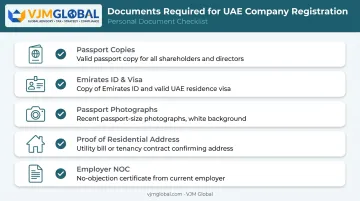
Standard personal document checklist:
- Passport copies for all shareholders, directors, and managers, plus originals available for verification
- Emirates ID and UAE residence visa copy for UAE residents; a valid entry stamp for foreign nationals entering to register
- Passport-size photographs matching the specific format the licensing authority requests
- Proof of residential address — a recent utility bill, bank statement, or tenancy contract, typically within the last three months
- No Objection Certificate (NOC) from a current employer, where the authority or activity requires one
Why Passport Validity Trips People Up
UAE immigration authorities generally require passports valid for at least six months before issuing a residence permit. Since most shareholders and directors will also need a residence visa tied to the company, an expiring passport creates a bottleneck even if the trade license itself doesn't strictly demand it. Renew before you apply, not after a rejection notice.
Documents for Local Sponsor or Service Agent (If Applicable)
Some mainland professional licenses still require a UAE national to act as a local service agent, even though 2021 reforms opened most sectors to full foreign ownership. Where this applies, expect to provide the local service agent's Emirates ID and passport copy, plus a family book (Khulasat Al Qaid) if the specific authority requests it. The local service agency agreement itself typically needs notarization. Note that many onshore branches no longer require a service agent at all under current commercial companies law. Confirm your specific license category before assuming you need one.
Company-Specific Documents for UAE Registration
Beyond personal paperwork, the company itself needs its own documentation trail. This is where mainland and free zone requirements start to diverge sharply.
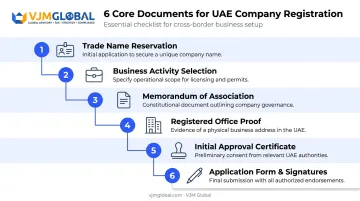
Core company documents include:
- Trade name reservation: proposed names must avoid offensive or religious references, avoid duplicating an existing registration, and include the correct legal-form suffix. Preparing two or three backup names guards against rejection.
- Business activity selection: tied to a specific activity code. DMCC alone lists more than 1,000 approved activities across 20 sectors, and picking the wrong one can cause problems later, from bank account rejections to costly license amendments.
- Memorandum of Association (MOA): for mainland LLCs, this must be in Arabic and authenticated through the courts before it's valid. Free zones typically replace this with a standardized constitutional document generated through the authority's own system.
- Registered office proof: an Ejari-registered lease for mainland companies; a flexi-desk or shared-office agreement for most free zones.
- Initial Approval Certificate confirming the authority has no objection to your proposed activity.
- Completed application form and specimen signatures for all shareholders and the appointed manager.
This table shows where mainland and free zone rules diverge:
| Document | Mainland | Free Zone |
|---|---|---|
| Trade name | DED approval | Free zone authority |
| MOA | Arabic, court-authenticated | Standard template |
| Office proof | Ejari lease | Flexi-desk agreement |
Getting the business activity code right the first time saves real headaches. Banks cross-check your license activity against your account purpose, and mismatches are a frequent cause of frozen accounts.
Mainland vs Free Zone vs Offshore: How Documentation Differs
The structure you choose changes almost every document on your list. Here's how the three main paths compare:
| Requirement | Mainland | Free Zone | Offshore |
|---|---|---|---|
| Office proof | Ejari-registered lease mandatory | Flexi-desk or shared-office accepted | Registered agent's address, not an operating office |
| Constitutional document | Arabic, notarized MOA | Authority-generated e-form (varies by zone) | Registry MOA/AOA plus agent filings |
| Local agent | Required for select professional licenses | Not applicable | Mandatory registered agent |
| Visa sponsorship | Available | Available | Generally not available |
A few jurisdiction-specific notes worth flagging:
- DMCC, IFZA, and JAFZA each publish separate application forms: don't assume a checklist from one zone applies to another
- JAFZA Offshore and RAK ICC require incorporation through a licensed registered agent; you cannot self-file
- RAK ICC's standard structure doesn't support UAE residence visas, though its Premium Product (through a RAKEZ subsidiary) does
- Offshore companies generally can't lease physical UAE office space or sponsor employee visas — confirm this with your registered agent rather than assuming it across every offshore registry
If your plans involve holding assets or structuring investments rather than trading locally, offshore might fit. If you need a working office and staff on the ground, mainland or free zone is the realistic choice.
Document Attestation & Corporate Shareholder Requirements
Any document issued outside the UAE, whether personal or corporate, usually needs to pass through a legalization chain before UAE authorities accept it.
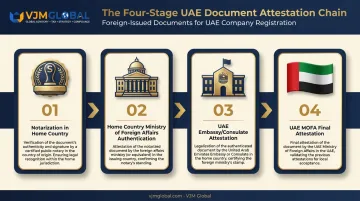
The standard attestation sequence:
- Notarization in the home country
- Authentication by the home country's Ministry of Foreign Affairs
- Attestation by the UAE Embassy or Consulate in that country
- Final attestation by UAE MOFA
Here's a detail that trips up a lot of founders: the UAE isn't a member of the Hague Apostille Convention. So even if your document was apostilled in an eligible country, that alone won't satisfy UAE requirements. Full legalization through the chain above is still the safe route.
MOFA's own attestation step typically takes 1-3 working days once documents reach them, though the full end-to-end process (notary through embassy) can run several weeks depending on your home country's processing speed. Non-English or non-Arabic documents also need certified Arabic translation.
Corporate Shareholders, UBO Declarations, and Power of Attorney
If a corporate entity holds shares in your UAE company, expect additional paperwork:
- Certificate of Incorporation (attested)
- Parent company MOA/AOA
- Board Resolution approving the investment
- Current Certificate of Good Standing
Every UAE company type must file an Ultimate Beneficial Owner (UBO) declaration, identifying anyone with 25% or more ownership or control. The register is due within 60 days of licensing, and any changes must be updated within 15 days.
Penalties escalate fast:
- Failing to establish or maintain the register: warning, then AED 50,000, then AED 100,000
- Failing to update changes: warning, then AED 15,000, then AED 30,000
For shareholders who can't travel to sign in person, a notarized Power of Attorney covering specific actions (signing the MOA, executing a lease, opening a bank account) is the standard workaround, though confirm exactly which actions your POA needs to name with the authority handling your application.
Common Documentation Mistakes & Tips to Avoid Delays
Most rejection notices trace back to a handful of recurring issues, based on what licensing authorities themselves flag:
- Passport validity under six months — a routine cause of residence visa delays
- Incorrect business activity selection, discovered only when the bank flags it later
- Trade name duplication with an existing registration
- Missing sponsor NOC, required by some authorities like JAFZA for UAE residents
- Inconsistent signatures across the MOA, application form, and specimen signature card
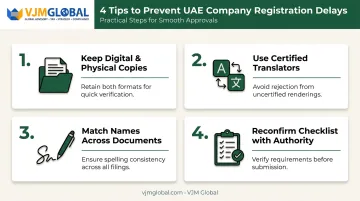
Practical steps to avoid the back-and-forth:
- Keep both digital and physical copies of everything, organized by document type
- Use certified legal translators for any non-Arabic, non-English paperwork
- Make sure your name appears identically across every single document
- Reconfirm the checklist directly with your chosen DED or free zone before submitting, since requirements are revised periodically and last year's process may not apply now
For founders whose plans don't stop at the UAE, this is also where cross-border advisors earn their keep. VJM Global has spent over 30 years guiding US, UK, and Australian entrepreneurs through international structuring.
The firm's particular strength lies in helping founders who've already set up a UAE entity extend operations into India, covering entity structuring, FEMA compliance, and transfer pricing between the two jurisdictions. If your UAE company is a stepping stone rather than the final destination, that kind of coordinated support is worth having in place early.
Frequently Asked Questions
What documents are required for company registration in the UAE?
You'll need passport copies, trade name approval, a selected business activity, proof of office address, an Initial Approval Certificate, and, for mainland setups, a notarized MOA. Exact requirements vary by authority.
Is a physical office required for company registration in the UAE?
Mainland companies must have an Ejari-registered lease. Many free zones, including DMCC, accept a flexi-desk or shared-office agreement instead, which is cheaper for early-stage founders.
Can a foreigner register a company in the UAE without residency?
Yes. A valid passport and complete business details are enough to start the license application. Residency visa processing typically follows once the trade license is issued.
How long does document attestation take for UAE company registration?
The full legalization chain (notary, home-country ministry, UAE embassy, UAE MOFA) can take several weeks depending on your home country. There's no Hague Apostille shortcut since the UAE isn't a convention member.
What documents are needed if a company, not an individual, is a shareholder?
You'll need the parent company's Certificate of Incorporation, its MOA/AOA, a Board Resolution approving the investment, and a current Certificate of Good Standing, all properly attested.
What happens if my trade name application gets rejected?
You'll need to submit alternative names that comply with naming rules. Pre-screening a few backup options against the authority's naming guidelines before you apply reduces this risk considerably.