The catch: your UAE paperwork doesn't automatically work in India. Passport copies, board resolutions, and certificates of incorporation issued in the UAE need a specific legalisation chain before Indian authorities will accept them. Skip a step, and your registration stalls.
This guide breaks down exactly which documents you need for each entity type, how UAE attestation actually works, and what compliance filings follow right after incorporation.
Key Takeaways
- Five entity options exist for India entry: subsidiary, LLP, branch, liaison, or project office — each with its own document list
- Every director and shareholder needs a passport, address proof, photographs, DSC, and DIN, regardless of nationality
- Parent companies acting as shareholders must supply Certificate of Incorporation, MOA/AOA, and a Board Resolution
- Attest documents via UAE Ministry of Foreign Affairs and Indian Embassy legalisation; apostilles are not accepted
- File on the MCA SPICe+ portal — incomplete attestation is the top cause of rejection
Business Structure Options for UAE Companies Entering India
Before you start gathering paperwork, pick your entity type. The documentation burden changes dramatically depending on which route you choose, and reworking this decision mid-process wastes weeks.
Four structures dominate UAE-to-India entry:
- Wholly owned subsidiary (Private Limited Company): A separate Indian legal entity. Requires the fullest document set but gives full operational freedom to trade, hire, and invoice in India.
- Limited Liability Partnership (LLP): A separate Indian entity with partnership-style flexibility. Available under the automatic route only where 100% FDI is permitted with no sector performance conditions.
- Branch Office (BO): Extends the UAE parent's business into India. Needs RBI approval plus proof of a 5-year profit-making track record and USD 100,000 net worth.
- Liaison Office (LO): A representative, non-commercial presence. Needs a 3-year track record and USD 50,000 net worth, and cannot earn Indian income.
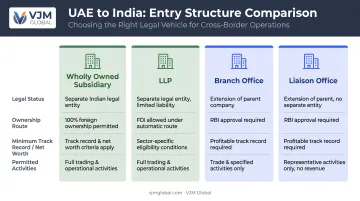
A wholly owned subsidiary or LLP suits most UAE promoters who want to actually trade and invoice from India. Branch and liaison offices remain extensions of the parent company. They carry the added weight of RBI Form FNC approval and audited financials that prove the parent's financial standing.
Core Documents Required for Company Registration in India from the UAE
Company incorporation in India runs under the Companies Act, 2013, filed electronically through the MCA's SPICe+ portal. This single form bundles incorporation, PAN, TAN, and GST registration into one submission, which saves UAE applicants from filing separately across multiple agencies.
Identity and Address Documents for Directors and Shareholders
Every director and subscriber needs a core identity set. UAE-based (foreign) applicants should prepare:
- Passport copy — mandatory for foreign directors and shareholders (Indian nationals use PAN and other prescribed ID instead)
- Address proof — bank statement, utility bill, UAE Emirates ID, or driving licence, not older than 2 months under the Companies (Incorporation) Rules
- Photographs and contact details — passport-size photos, plus a working email and mobile number for each subscriber
- Digital Signature Certificate (DSC) — required for e-filing; UAE-based directors complete this remotely via video verification, with no travel needed
- Director Identification Number (DIN) — up to three DINs can be applied for inside the SPICe+ form itself
Names must match exactly across the passport and application. A minor spelling mismatch is a common reason applications bounce back.
Corporate Documents Required When a UAE Company Is the Shareholder
When a UAE company (not an individual) holds shares in the Indian entity, additional documents come into play:
- Certificate of Incorporation of the UAE parent, establishing its legal existence
- Memorandum & Articles of Association, confirming ownership structure and authority
- Board Resolution from the UAE parent approving the India investment and naming the signing authority
If you open a branch or liaison office instead of a subsidiary, RBI goes further. It requires a net worth certificate and audited financial statements from the UAE parent to confirm track-record thresholds. Skipping these is a frequent cause of Form FNC rejection.
Registered Office Documents
Your Indian entity needs a registered address, backed by:
- Lease/rent agreement or ownership deed for the premises
- No Objection Certificate (NOC) from the property owner
- Recent utility bill confirming the address, generally within 2 months
If you haven't finalised office space at incorporation, Indian law lets you file it separately via Form INC-22 within 30 days of incorporation, so office paperwork need not delay the initial filing.
Apostille and Attestation Requirements for UAE-Issued Documents
Here's where most UAE-based founders get tripped up. The UAE is not a signatory to the Hague Apostille Convention, confirmed by the HCCH's current status table listing 130 member countries. That means a simple apostille stamp won't work for Indian authorities. You need full consular legalisation instead.
The Attestation Chain
For any corporate document issued in the UAE (Certificate of Incorporation, MOA/AOA, or Board Resolution), the typical path is:
- Notarisation in the UAE, confirming the document's authenticity
- UAE Ministry of Foreign Affairs (MOFA) attestation
- Indian Embassy or Consulate attestation, completing the legalisation for use in India
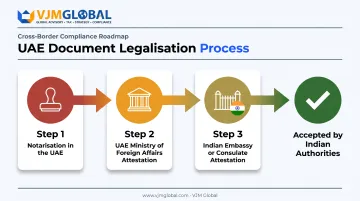
Indian authorities accept the document as valid only after this full chain.
Timelines You Should Actually Plan For
MOFA's own service page states that eligible digital documents can be attested within 2 hours during working hours. Courier-based submissions take 1-3 business days, according to MOFA's attestation services page. The Indian Embassy in Abu Dhabi typically processes its portion the same day.
Sounds fast on paper. In practice, gathering original documents, arranging UAE notarisation, and coordinating between two government bodies routinely stretches this into weeks rather than days, especially if any document needs correction and resubmission.
MCA filing deadlines don't pause for attestation delays. If your name reservation window is closing while your Board Resolution is still stuck in the attestation queue, you're forced to restart. The fix is simple: start attestation for corporate documents in parallel with name reservation, not after it.
Compliance and Common Documentation Mistakes to Avoid
Getting the Certificate of Incorporation isn't the finish line. Post-incorporation obligations and simple documentation errors both catch UAE promoters off guard.
Resident Director Requirement
Section 149(3) of the Companies Act requires every Indian company to have at least one director who has stayed in India for 182 days during the financial year. Boards made up entirely of UAE-based directors need to source this externally (often through a nominee director arrangement) before incorporation, not after.
FC-GPR Filing
When a UAE parent invests in the Indian entity, the company must file Form FC-GPR with an Authorised Dealer Bank within 30 days of share allotment to report the FDI inflow to RBI. Miss this window, and the delay becomes a FEMA reporting contravention requiring separate regularisation.
Documentation Errors That Delay Applications
Separate from those post-allotment filings, the incorporation application itself is where most UAE applicants lose time:
- Expired passports at the time of filing
- Address proof older than the permitted window
- Missing or incomplete attestation stamps on corporate documents
- Name mismatches between the passport and the SPICe+ application
Catching these before submission saves weeks of back-and-forth with the Registrar.
How VJM Global Helps UAE Businesses Register in India
UAE companies entering India are one of VJM Global's core client segments. The firm has supported 250+ UAE businesses, from startups to established enterprises, across industries from fintech to manufacturing.
The recurring pain point matches what this guide covers: UAE founders often underestimate how long attestation and documentation review take. VJM Global manages the process end-to-end so founders are not reconstructing missing paperwork under deadline pressure.

Pre-incorporation support includes:
- Full document checklist management
- Tracking which corporate papers need MOFA and Indian Embassy attestation
- Coordination of DSC, DIN, and SPICe+ filings
- Nominee director arrangements when a UAE-only board lacks an India-resident director (Section 149(3))
Registration is only the starting point. VJM Global also runs the Indian entity's ongoing compliance so incorporation and day-to-day work stay with one team:
- Bookkeeping and accounting setup
- GST registration and returns (GSTR-1, GSTR-3B, GSTR-9)
- ROC filings including AOC-4 and MGT-7
Frequently Asked Questions
What are the documents required for company registration in India?
Requirements fall into three categories: director/shareholder identity and address proof, corporate documents when a foreign company is the shareholder, and registered office proof. UAE-issued items need MOFA and embassy attestation before submission.
How do you get a company registration certificate in India?
The Registrar of Companies issues the Certificate of Incorporation once the SPICe+ form, MOA/AOA, and supporting documents are approved. It's typically downloadable directly from the MCA portal.
Do UAE-issued documents need to be apostilled or attested by the UAE Ministry of Foreign Affairs?
Yes. Since the UAE isn't part of the Hague Apostille Convention, documents need MOFA attestation followed by Indian Embassy legalisation, rather than a standard apostille stamp.
Can a UAE national register a company in India without travelling to India?
Yes. DSC, DIN, and most SPICe+ filings can be completed remotely through video verification alongside notarised and attested documents, with no in-person visit required.
How long does document authentication take for company registration in India from the UAE?
MOFA attestation can take as little as a few hours to a few days, but coordinating notarisation, MOFA, and embassy legalisation together often adds several weeks. Start this process alongside name reservation, not after.
Does India require a minimum capital investment to register a company from the UAE?
No. India removed the fixed minimum paid-up capital requirement for private companies in 2015. Incorporation and ongoing compliance costs still apply regardless of capital size.