Introduction
UAE-based entrepreneurs are looking west in growing numbers. Total US-UAE goods trade reached $39.0 billion in 2025, with US exports to the UAE climbing 16.2% year over year, according to the Office of the United States Trade Representative.
That trade relationship makes US market entry an obvious next step for many UAE founders. But here's where things get messy: a UAE applicant's paperwork doesn't map neatly onto a typical US registration checklist.
Translation, notarization, and attestation requirements add layers that catch most founders off guard.
This guide breaks down exactly which documents you need across four categories: personal identification, business formation, tax registration, and UAE-specific attestation steps. We'll also flag the mistakes that cause the most rejections.
Key Takeaways
- Register a US entity (LLC or C-Corp) and obtain an EIN before any other step can proceed
- Emirates ID and similar Arabic-language documents often need certified translation and MOFAIC attestation
- US registered agent address is mandatory; a UAE address will not work for incorporation or banking
- Inconsistent names, addresses, or expired documents cause the majority of application delays
Understanding US Company Registration Basics for UAE-Based Founders
Most UAE founders choose between two structures, and the choice affects which documents you'll need later.
LLCs offer pass-through taxation and operational flexibility. A single-member LLC defaults to disregarded-entity tax treatment; multi-member LLCs default to partnership treatment. Either can elect corporate taxation using Form 8832 if that suits your situation better.
C-Corps work best if you're planning to raise venture capital, since institutional investors generally require a corporate structure that can issue preferred stock.
Why Delaware and Wyoming Dominate
These two states attract the bulk of UAE founder registrations, for different reasons:
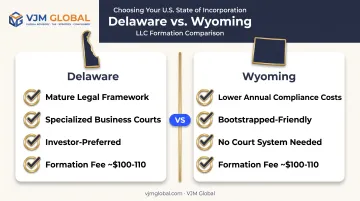
- Delaware has a mature legal framework with specialized business courts and decades of case law that investors trust.
- Wyoming keeps formation and annual fees lower, which appeals to bootstrapped founders who don't need Delaware's court system.
Formation fees run close to $100-$110 for an LLC in either state, though annual compliance costs diverge more sharply depending on the state and entity type.
This guide focuses specifically on documentation — not the full filing walkthrough, which varies by service provider and state.
Documents Required to Register a Company in the USA from the UAE
Personal Identification Documents for UAE Applicants
Every director, member, or shareholder must provide identity proof. Exact requirements vary slightly by who is asking: the state, your registered agent, or eventually your bank.
- Passport copies for all directors, members, or shareholders, with enough remaining validity to avoid mid-process expiration
- Emirates ID or UAE residency proof to confirm identity and residency status
- Proof of address, such as a recent utility bill or bank statement
- Passport-sized photographs and specimen signatures, if your registered agent or state requests them
An English-language utility bill or bank statement is often simpler than a translated Emirates ID. It skips certified translation entirely, since it is already in the language US institutions need.
Business Formation Documents
This is where your entity legally comes into existence. The exact instrument name depends on structure and state:
| Entity Type | Delaware | Wyoming |
|---|---|---|
| LLC | Certificate of Formation | Articles of Organization |
| C-Corp | Certificate of Incorporation | Articles of Incorporation |
Beyond the core filing, you'll need:
- Registered agent confirmation with a physical US street address in your formation state (a P.O. box does not qualify in Delaware, Wyoming, or most other states)
- Operating Agreement (LLC) or Corporate Bylaws (C-Corp) covering ownership and management — kept on record, not filed with the state
- Business name confirmation that the name is available and does not conflict with existing state registrations or USPTO trademarks
Tax Identification Documents (EIN)
Your Employer Identification Number (EIN) is the US equivalent of a UAE Trade License or Tax Registration Number. You need it for taxes, hiring, and opening a US bank account.
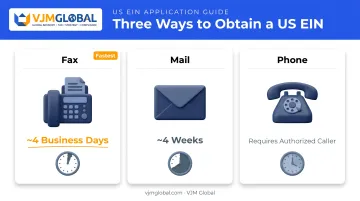
Here's the complication: UAE applicants without a US office or Social Security Number can't use the IRS's online EIN application. That leaves three routes:
- Fax — Send Form SS-4 to the IRS international fax line; the IRS instructions for Form SS-4 state an EIN typically returns within 4 business days when a return fax number is included
- Mail — Roughly a 4-week turnaround, sent to the IRS's Cincinnati international operations unit
- Phone — International applicants can call the IRS directly during specified hours, though the caller must be authorized to answer Form SS-4 questions on the founder's behalf
On Form SS-4, line 7b asks for the responsible party's SSN or ITIN. If that person has neither and is not eligible for one, enter "foreign" or "N/A."
Apply 4–5 weeks before you actually need the EIN. Mail timelines are long enough that waiting until a bank requests it will stall account opening.
Special Documentation Requirements for UAE Nationals: Translation, Notarization & Attestation
This is the section that trips up most UAE founders, mainly because the requirements aren't always obvious until a document gets rejected.
Translation and Notarization
Any document originally issued in Arabic, the Emirates ID being the most common example, needs certified English translation before US authorities or banks will accept it. After translation, a licensed UAE notary public must notarize it before it's usable abroad.
The MOFAIC Attestation Step
Once notarized, certain documents require attestation through the UAE Ministry of Foreign Affairs and International Cooperation (MOFAIC). Attestation authenticates signatures and seals on the document, according to MOFAIC's official attestation service page. It doesn't validate the document's content, just confirms it's genuine.
This step matters most for corporate documents signed on behalf of a UAE entity, and for power of attorney documents if you're authorizing a representative or advisor to sign on your behalf.
MOFAIC processes documents through either a courier route or a digital route, depending on the issuing authority and document type. Neither route accepts laminated originals, and the digital route requires an unaltered, verifiable PDF.
The Shortcut Most Founders Miss
If you need proof of address, skip the Emirates ID chain entirely. Use an English-language bank statement or utility bill instead. It bypasses translation, notarization, and attestation altogether, saving weeks in some cases.
Documents Needed After Registration: Opening a US Business Bank Account
Formation documents and your EIN confirmation letter (the IRS's CP 575) are prerequisites. Banks will not open your application file without them. Once those are in hand, expect a further checklist:
- Passport copies of all beneficial owners holding 25% or more of the company
- Ownership breakdown documentation showing the full cap table
- Proof of UAE address for each owner
- Business activity proof: a website, signed contracts, or a business plan showing the company actually operates
Banks apply customer due diligence rules that require identity verification for every owner above the 25% threshold, plus at least one person with significant control. That bar is separate from, and stricter than, anything required for state formation.
VJM Global supports UAE founders through formation, EIN filing, and the bank-ready document set so applications are complete and consistent the first time.
Common Documentation Mistakes UAE Founders Make (and How to Avoid Them)
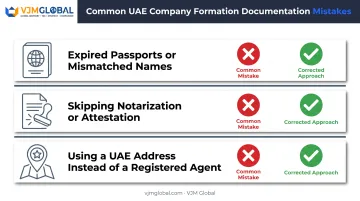
Most rejections trace back to a handful of repeat offenders:
- Expired passports or mismatched names — Keep at least six months of passport validity and use the exact same name spelling on every state filing, bank form, and ID.
- Skipping notarization or attestation — Notarize and MOFAIC-attest Emirates ID translations and Powers of Attorney before filing; unattested copies get rejected when those steps are required.
- Using a UAE address instead of a US registered agent — Use a US registered agent address on the formation filing only. A UAE address disqualifies the filing in most states.
None of these checks are optional. A registered agent address also cannot double as your general business mailing address. An experienced cross-border firm like VJM Global catches name mismatches, missing attestations, and address errors before they turn into rejected filings.
Frequently Asked Questions
Where can I get company documents?
- Formation documents (Articles of Organization or Incorporation): your state's Secretary of State
- EIN confirmation: the IRS
- UAE attestations: a licensed UAE notary public and MOFAIC
What documents are needed to register a company in the USA?
You'll typically need:
- Personal ID (passport; Emirates ID if used)
- Articles of Organization or Incorporation
- Registered agent details
- Operating Agreement or Bylaws
- EIN confirmation from the IRS
Do UAE documents need to be translated for US company registration?
Generally yes: Arabic-language documents such as the Emirates ID need certified translation, notarization, and MOFAIC attestation, unless you use an English-language alternative like a bank statement.
How long does it take to gather all documents to register a company in the USA from the UAE?
EIN processing (about 4 days to 4 weeks, depending on method) and UAE attestation timelines drive most of the wait. Plan on several weeks end to end.
Can a UAE resident register a US company without traveling to the US?
Yes. State formation, EIN applications, and even bank account opening through select fintech providers can typically be completed remotely with the right documents.
Is an Emirates ID accepted as proof of identity for US company registration?
It's generally accepted alongside a passport, though it may require certified translation and notarization depending on the state or bank involved.