Here's the timing trap. A tax year 2025 return is filed in 2026 (calendar-year filers were due March 16, 2026). A tax year 2026 return is generally filed in 2027. The IRS has posted only a draft 2026 form, and drafts must not be filed, so check the final IRS materials for the year you're reporting.
This guide covers who files, what to gather, how to complete each schedule, deadlines, e-filing, penalties and cross-border points for Australian-based owners.
Key Takeaways
- Confirm the S election, shareholder eligibility and tax year before you prepare anything.
- Reconcile the books, Schedule K, each K-1 and Schedule L before filing.
- Form 7004 extends filing time by six months, not payment time.
- Australian residents cannot directly own S corporation shares as nonresident aliens.
What Is Form 1120-S and Who Must File It?
Form 1120-S, U.S. Income Tax Return for an S Corporation, reports the corporation's income, deductions, gains, losses, credits and ownership details.
Items generally pass through to shareholders, who report their share on personal returns using Schedule K-1. The corporation can still owe entity-level tax on built-in gains or excess passive income.
A C corporation differs: it files Form 1120 and pays corporate income tax itself.
Who generally files Form 1120-S
An entity files when its Form 2553 S election was accepted and is effective for the tax year. To verify, find the IRS CP261 acceptance notice and keep it. Item A on the return records the effective date.
Inactivity doesn't end the election. The 2025 instructions list no zero-activity exemption, so assume a filing is still required unless the election has terminated.
S corporation eligibility and Australian ownership
The corporation must meet these tests:
- Domestic corporation
- No more than 100 shareholders
- One class of stock (voting differences don't create a second class)
- Only eligible shareholders: individuals, estates, certain exempt organisations and certain trusts
- Not an ineligible corporation, such as certain banks, insurers or DISCs
Partnerships, corporations and nonresident alien individuals cannot be direct shareholders. That catches many Australian founders, Australian companies and foreign parent structures.
An ITIN or a treaty claim doesn't create an exception. A nonresident alien can be a potential current beneficiary of an ESBT, but that isn't direct ownership.
A disqualifying shareholder can terminate the election, so verify each proposed shareholder before filing.

Form 1120-S compared with other returns
| Form | Filer | Treatment |
|---|---|---|
| 1120-S | S corporation | Generally pass-through; some entity-level taxes remain |
| 1120 | Domestic C corporation | Corporation pays income tax |
| 1065 | Partnership | Profits and losses pass to partners via K-1 |
Check the 2026 instructions
When final 2026 materials appear, compare them with the 2025 set. The 2025 instructions included:
- Mandatory e-filing at 10 returns
- Updated K-2/K-3 exceptions
- New line 17d codes
- Direct-deposit fields on lines 28c-28e
Look for similar changes in line descriptions, schedules and attachments.
Key Documents to Gather Before Filing
Start with the IRS recordkeeping guidance, which stresses that source documents support every return entry. For an S corporation, collect:
- Year-end profit and loss statement and balance sheet
- General ledger or trial balance
- Bank records and payroll reports
- Fixed-asset and depreciation schedules
- Inventory or cost-of-goods-sold records
- Tax payment confirmations
- Prior-year Form 1120-S and K-1s, plus the CP261 notice
- Documentation for foreign transactions or international shareholders
Shareholder data is just as important:
- Legal names, addresses and taxpayer identification numbers
- Ownership changes and dates of ownership
- Capital contributions and distributions
- Shareholder loan balances and written loan notes
- Beginning and ending stock basis
Distributions reduce stock basis, and those exceeding basis may produce capital gain. Personal guarantees alone generally don't create debt basis.
Map each document to the schedule it supports. A simple checklist (P&L to page 1, balance sheet to Schedule L, ownership log to K-1s) exposes gaps before preparation starts.

VJM Global's US team prepares balance sheets and fixed-asset registers in a format suited to auditor review, which makes this mapping easier.
How to Complete Form 1120-S and Its Main Schedules
Header, income, deductions and tax
Enter tax year, legal name, address, EIN, incorporation date, S-election effective date, business activity code and total assets. Tick the boxes for final return, name or address change, amended return, or S-election termination where they apply.
Next, complete the income and deductions section. Report gross receipts, returns and allowances, cost of goods sold, gains or losses on business property and other income from reconciled books. Deductions include:
- Officer compensation and employee wages
- Rent, repairs, taxes and licences
- Interest, depreciation and advertising
- Employee benefits and retirement contributions
Watch these areas closely:
- Shareholder-officer pay: treat amounts paid to an officer as wages to the extent of reasonable compensation.
- Personal expenses: keep them out of the business.
- Repairs versus capital items: capitalise improvements.
- Depreciation: keep support on file.
On the tax and payments lines, Line 23a covers excess net passive income tax and LIFO recapture. Line 23b covers tax from Schedule D, including built-in gains tax. Estimated payments, overpayment and amount-due lines follow. Confirm line numbers against the 2026 instructions.
Schedules B, K, K-1, L, M-1 and M-2
Schedule B collects accounting method, activity, ownership and compliance answers. Question 16 asks about digital assets, including cryptocurrency and NFTs, and must be answered Yes or No. Don't leave it blank.
Schedule K totals pass-through items. Each K-1 allocates a shareholder's share. Mid-year ownership changes and unequal allocations are where errors creep in. Give shareholders their K-1 copies by the return due date, since they need them for their own filings.
Schedule L is the book balance sheet and should tie to your ledger. M-1 reconciles book income to tax income. M-2 analyses shareholder equity accounts.
Question 11 on Schedule B lets you skip L and M-1 only if both total receipts and year-end total assets are under $250,000. At $10 million in assets, file Schedule M-3 instead of M-1.

International schedules and attachments
Schedules K-2 and K-3 report international tax items. The 2025 domestic filing exception applies when foreign activity is none or limited, shareholders were notified, and nobody requested a K-3 by the one-month date (August 17, 2026, for an extended calendar-year return).
Common supporting forms:
- Form 1125-A: cost of goods sold
- Form 4562: depreciation and amortisation
- Form 4797: sales of business property
- Schedule D (Form 1120-S): capital gains and built-in gains
- Form 8825: rental real estate
- Form 3800: general business credit
Attach them after page 5 in the instructions' order: schedules alphabetically, forms numerically. An authorised officer must sign, and paid preparers complete their own section.
2026 Filing Deadlines, Extensions, E-Filing, and Penalties
Deadlines
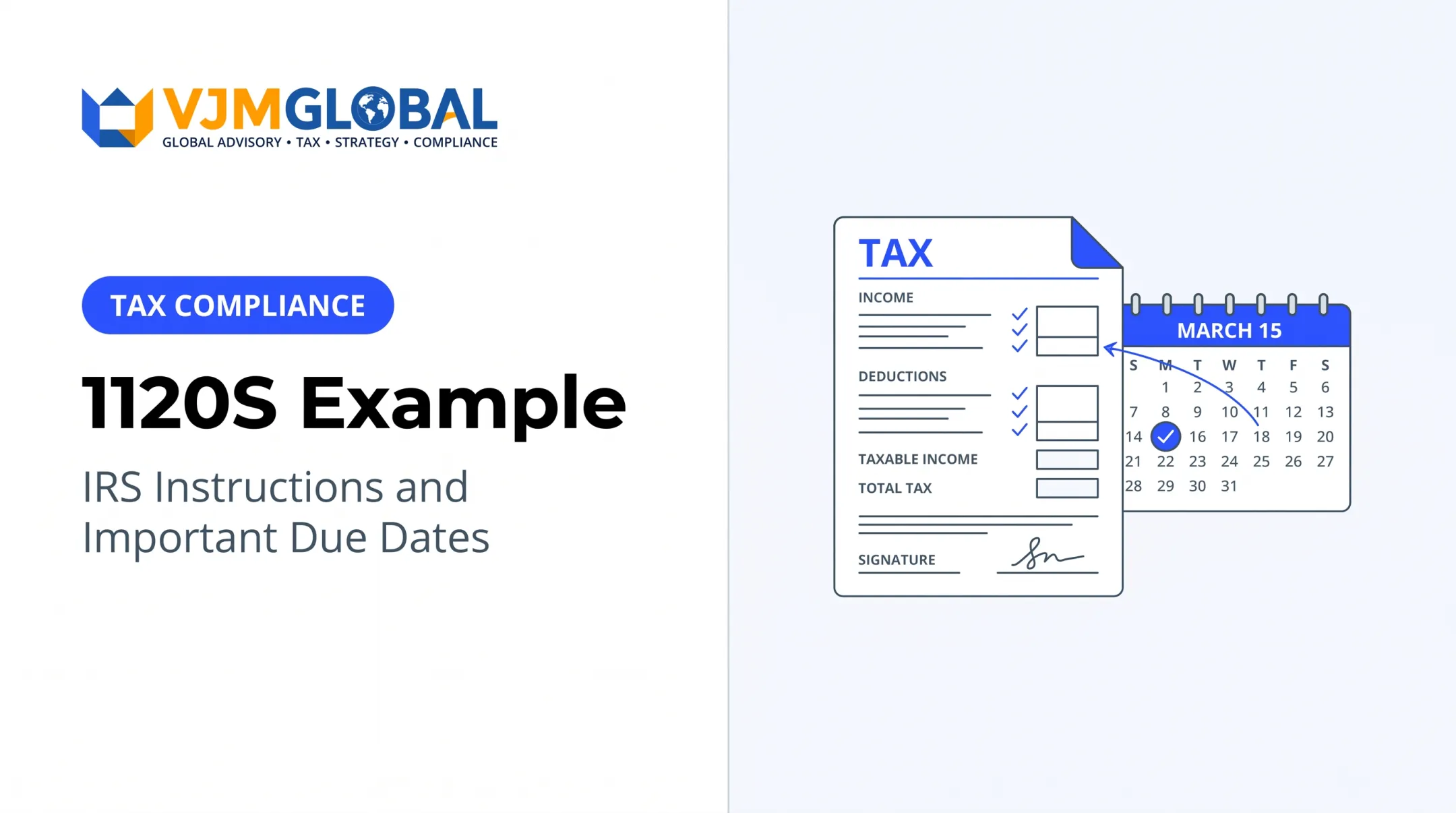
Returns are due on the 15th day of the third month after year-end. Because March 15, 2026 falls on a Sunday, the calendar-year TY2025 deadline moves to March 16, 2026. Fiscal-year filers follow the same third-month rule.
Dissolved corporations file by the 15th day of the third month after dissolution. If S status ends, the S short-year return is due with the C short-year return.
Extensions with Form 7004
File Form 7004 by the regular due date for an automatic six-month extension. For a calendar-year TY2025 return, that means September 15, 2026. It extends filing only. Estimate and pay any tax by the original deadline.

E-filing and paper filing
An S corporation must e-file if it files 10 or more returns of any type in the calendar year, counting income, employment, excise and information returns. Hardship waivers and a religious-belief exemption exist.
- The MeF acknowledgement is the official accepted or rejected notice.
- Rejections carry error codes. Fix and retransmit within 10 calendar days for Form 1120-S (5 for Form 7004).
- Required e-filers who cannot complete e-filing should contact the e-Help Desk before using paper.
- Paper filers use Kansas City or Ogden addresses depending on state and asset size, so check the IRS "where to file" page.
Keep the filed return, acceptance record, payment and extension confirmations, and all supporting statements.
Penalties
For returns required in 2026:
- Late filing: $255 per shareholder per month or part-month, up to 12 months. With tax due, add 5% of unpaid tax monthly, capped at 25%.
- Minimum penalty: for returns over 60 days late, the lesser of tax due or $525.
- K-1 or K-3 failures: $340 per schedule, rising to $680 or 10% of the amount required to be reported for intentional disregard.
- Late payment: 0.5% of unpaid tax per month, capped at 25%.
- Interest: 6% annually for Q4 2026 corporate underpayments, compounded daily.
Reasonable cause can relieve penalties. Fire, disaster, serious illness and unobtainable records are examples. First Time Abate is a separate route for those who qualify.
Cross-border support
For Australian-based or multinational owners, VJM Global's tax and accounting team can help coordinate bookkeeping, shareholder data and US schedules. It supports the process but doesn't replace advice on your specific facts, particularly on eligibility.
Common Errors and Final Review Checklist
These filing mistakes trigger IRS notices and processing delays most often:
- Using an outdated form or the wrong tax year
- Filing Form 1120 instead of 1120-S
- Filing before confirming the S election was valid
- Mismatches between books, Schedule K, K-1s and Schedule L
- Wrongly omitting L and M-1 under the $250,000 test
- Leaving Schedule B Question 16 blank
- Missing K-1s (the IRS flags "K-1 missing" on follow-up notices)
- Skipped attachments for depreciation, cost of goods sold, asset sales, rental income, credits, or foreign items
Run this final pass before you file:
- Confirm all required schedules and attachments are included.
- Check names and EINs.
- Review signatures and preparer details.
- Confirm extension and payment status.
- Validate shareholder K-1 copies.
- Submit through the correct channel.
- Retain proof of filing.
Frequently Asked Questions
What is Form 1120-S used for?
It reports an S corporation's annual income, deductions, gains, losses and credits. Most items pass through to shareholders on Schedule K-1.
Who must file Form 1120-S?
An entity files when its accepted S election is effective for the tax year. Confirm shareholder eligibility first, as a nonresident alien shareholder can end the election.
When is Form 1120-S due in 2026?
Calendar-year TY2025 returns are due March 16, 2026. Fiscal-year filers use the 15th day of the third month after year-end, adjusted for weekends and holidays.
Can I get an extension for Form 1120-S?
Yes. File Form 7004 by the original due date for six more months to file. It doesn't extend the time to pay.
What schedules are required with Form 1120-S?
Schedules B, K and K-1 are central. Schedules L, M-1, M-2, K-2, K-3 and extra forms depend on size, records and international activity.
What happens if you file 1120 late?
Form 1120 is for C corporations. Its late penalty is 5% of unpaid tax per month, up to 25%. Late Form 1120-S filing costs $255 per shareholder per month, plus late-payment penalties and interest, subject to reasonable-cause relief.