This guide is for Australian shareholders, investors, expatriates, and businesses connected to a US S corporation. Accurate K-1 handling matters for US federal reporting, and it also feeds any separate Australian tax review.
The K-1 is often quoted and rarely understood. Shareholders copy figures without knowing where they belong. Below, we cover the form's parts, the preparation process, reporting flow, deadlines, and common errors.
Key Takeaways
- Each K-1 reports one shareholder's allocated share, not the corporation's full return.
- Corporations prepare each K-1 from Form 1120-S, Schedule K, and ownership records.
- Amounts flow to Form 1040 and supporting schedules by tax character.
- Australian taxpayers must separately review residency, foreign income, and offset rules.
What Is Schedule K-1 (Form 1120-S) and Why Is It Used?
An S corporation issues a K-1 to each person who held shares at any time during the tax year. It differs from Form 1120-S (the corporation's return), Schedule K (the summary of all shareholders' shares), and Form 1040 (the individual's return).
The pass-through idea
The corporation reports its business results, and each shareholder receives an allocation to use on their own return. A shareholder may owe US tax on allocated income whether or not any cash was distributed. That income is not self-employment income.
The three parts of the form
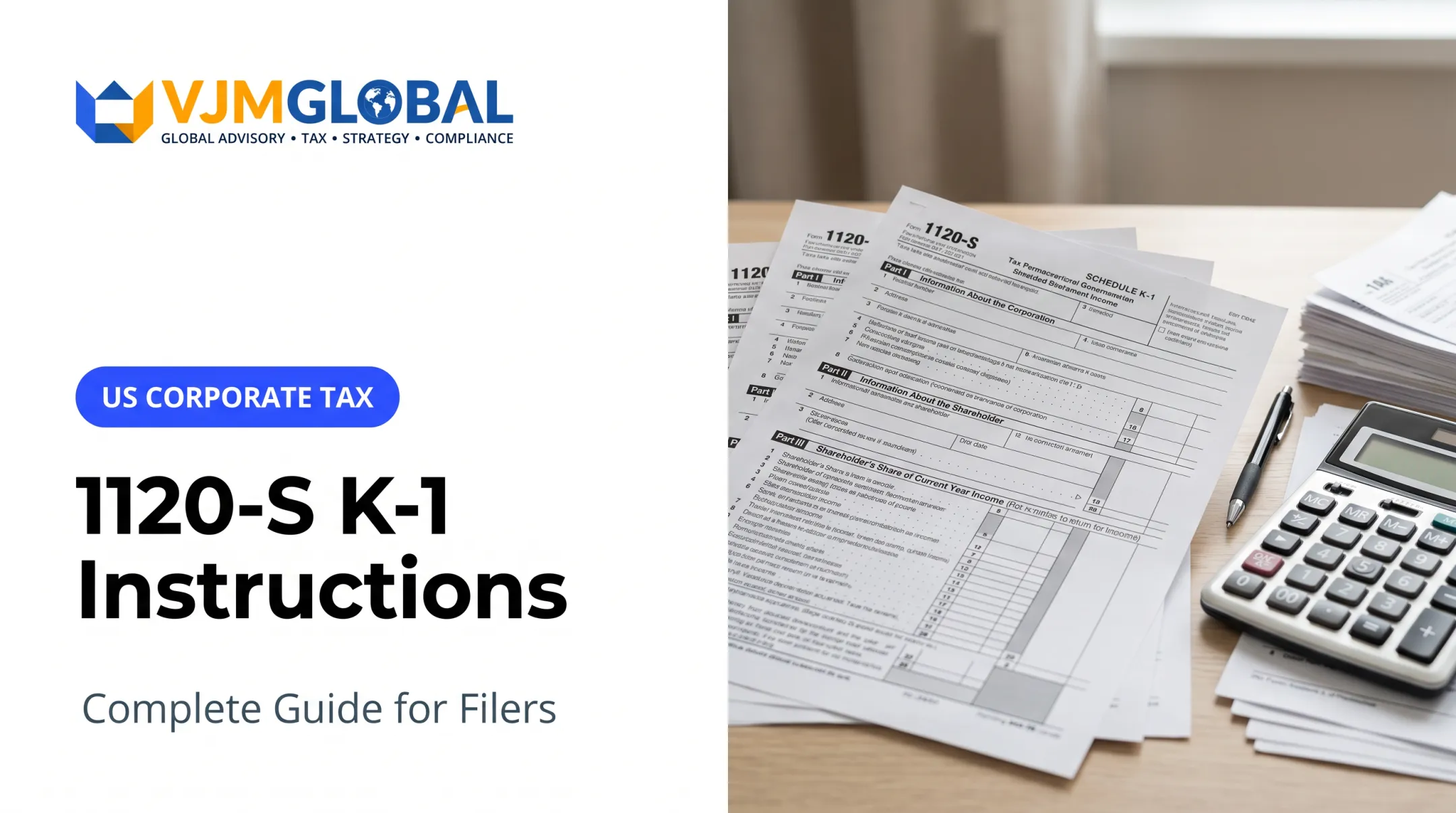
- Part I: identifies the corporation
- Part II: identifies the shareholder and ownership details
- Part III: reports the shareholder's share of income, deductions, credits, and other items
The form supports consistent allocation among owners and accurate personal returns. Always work from the current IRS Shareholder's Instructions for Schedule K-1 (Form 1120-S); 2025 is the latest set.
K-1 for S corporations versus partnerships
Schedule K-1 (Form 1065) is a different form for partnerships. Entity type decides which form, boxes, codes, and rules apply. Mixing them up causes real errors.
How the 1120S K-1 Process Works: Step-by-Step
The flow runs annually. The corporation closes its books, prepares Form 1120-S and Schedule K, allocates items to each shareholder, and issues individual K-1s. Shareholders then carry the information to their own returns.
Records needed before preparation:
- Final income statement and balance sheet
- Shareholder register and ownership changes
- Contributions, distributions, and shareholder loans
- Payroll records
- Prior-year K-1 and basis information
- Any attached tax schedules
Step 1: Complete Parts I and II
Verify against corporate records and prior-year filings:
- Corporation name, address, and EIN
- Shareholder identification details
- Ownership percentage and share counts
- Shareholder loans
A wrong EIN or taxpayer identification number is among the most common causes of mismatch notices.
Step 2: Complete Part III
The preparer uses Schedule K and supporting statements to report the shareholder's share of:
- Ordinary business income or loss
- Rental items, interest, dividends, and royalties
- Capital gains or losses and Section 179 deductions
- Charitable contributions and credits
- Foreign tax items and other coded information
Items are generally allocated daily according to shares held each day.
Step 3: Review, issue, and use the K-1
The corporation reconciles the K-1 with Form 1120-S, ownership records, distributions, and attached statements. It then gives a copy to the shareholder and files a copy with its return.

The shareholder keeps the K-1. The IRS instructions say not to file it with the individual return, except where backup withholding is reported in Box 13, code O.
Where the K-1 amounts go
| K-1 item | Typical destination |
|---|---|
| Box 1 ordinary income/loss | Schedule E |
| Boxes 2-3 rental income/loss | Schedule E |
| Box 4 interest; Box 5a/5b dividends | Form 1040 lines 2b, 3b, 3a |
| Boxes 7, 8a capital gain/loss | Schedule D |
| Box 9 Section 1231 gain/loss | Form 4797 |
| Box 11 Section 179 | Form 4562 |
| Box 12 charitable contributions | Schedule A |
Foreign taxes in Box 17, code F are not used for Form 1116. Use Schedule K-3 instead.
When it happens
Form 1120-S is generally due on the 15th day of the third month after year-end. For calendar-year 2025, the due date was 16 March 2026 because 15 March fell on a Sunday.
Form 7004 gives an automatic six-month extension, and K-1s are due by the Form 1120-S due date.
Take extra care after:
- Ownership changes or stock transfers
- Shareholder loans
- Final returns or amended filings
Key Factors That Affect K-1 Accuracy and Tax Treatment
Ownership and allocation records
Beginning and ending share counts, partial-year ownership, and transfers must match legal and accounting records. A shareholder disposing of stock is treated as a shareholder on the disposal day.
Basis and loss limits
A K-1 can show a loss that you cannot fully deduct yet. The 2025 instructions apply basis, at-risk, passive-activity, and excess-business-loss limits in that order. Form 7203 is required when you:
- Claim an aggregate S corporation loss
- Receive a non-dividend distribution
- Dispose of stock
- Receive a loan repayment
Basis-limited losses carry forward indefinitely, subject to basis in a later year.
Wages versus K-1 income
An S corporation must pay reasonable compensation to a shareholder-employee. Wages, reimbursements, distributions, and pass-through income are separate items. Don't report them in the same place.
Special items and K-2/K-3
Coded entries, Section 179 amounts, rental activity, and credits may need extra worksheets. For cross-border activity, check whether Schedules K-2 and K-3 apply. The domestic filing exception requires limited foreign activity, shareholder notification, and no K-3 request. A small-corporation exception applies when receipts and year-end assets are both under $250,000.

The Australian side
Australia's income year runs 1 July to 30 June, and self-lodged returns are generally due 31 October. The US calendar-year timeline does not line up with that.
Australian residents must declare foreign income, and the ATO may allow a foreign income tax offset for foreign tax actually paid. If the claim exceeds A$1,000, you must work out the offset limit. US reporting does not decide the Australian treatment. No general ATO guidance classifies a US S corporation, so get advice on your specific facts.
IRS guidance excludes nonresident alien shareholders from S corporation eligibility. For an individual, US tax status matters more than nationality, so confirm yours.
Common Issues, Misconceptions, and When a K-1 May Not Be Appropriate
Frequent misunderstandings
- A K-1 is not a tax bill. It reports allocations; tax is calculated on your return.
- Cash is not the whole story. Undistributed income can still be taxable.
- Not every box needs an amount. Blanks are normal, but review referenced statements.
- A K-1 is not a separate return. Don't file it as one.
Errors to check before filing
- Incorrect EIN or taxpayer identification number
- Wrong ownership percentage or inconsistent share counts
- Distributions that don't match records
- Missing statements
- Figures that don't reconcile with corporate records
If something looks wrong, ask the corporation for a corrected K-1 rather than editing the form. If you can't resolve it, file Form 8082 with the IRS to report the inconsistent items.
Late furnishing carries a $340 penalty per K-1, rising to $680 for intentional disregard, as stated in the Form 1120-S instructions. That penalty falls on the corporation, which is why chasing a late K-1 early makes sense.

When to get professional review
Self-preparation gets risky when you face:
- Ownership changes or suspended losses
- Shareholder loans
- Foreign tax items
- Missing or amended K-1s
- Multiple jurisdictions
- US and Australian reporting that must stay aligned
VJM Global supports Australian businesses with accounting and US tax compliance, including Form 1040 and 1040-NR preparation.
Conclusion
Form 1120-S K-1 instructions connect the S corporation's annual reporting to each shareholder's personal return by putting the right tax items with the right owner.
Review ownership data, basis, supporting statements, and current IRS instructions rather than copying figures blindly. For complex US-Australian situations, get qualified tax advice.
Frequently Asked Questions
What are the instructions for completing Schedule K-1 on form 1120-S?
Complete Part I (corporation), Part II (shareholder), and Part III (allocated items) using Form 1120-S, Schedule K, and ownership records. Allocate each item to shareholders by shares held, and follow the current IRS instructions.
How do I put K1 on my tax return?
K-1 amounts go to Form 1040 and supporting schedules by tax character, not as one combined figure. Ordinary income goes to Schedule E, for example. Check the IRS instructions or use a professional.
What is Schedule K-1 (Form 1120-S), and who receives it?
It is the statement of a shareholder's share of an S corporation's tax items. The corporation generally prepares one for each person who held shares during the tax year.
Do I file Schedule K-1 separately from Form 1040?
No. The corporation files its copies with Form 1120-S, and you keep yours to prepare your return. Confirm current IRS rules, since backup withholding in Box 13, code O is an exception.
Can I owe tax on K-1 income if I did not receive a distribution?
Yes. Allocated income can be taxable without any cash payout. Basis and other limits may still restrict deductions and the tax treatment of distributions.
What should I do if my 1120-S K-1 is missing or incorrect?
Contact the corporation or its preparer and request a corrected K-1. Check whether an extension explains the delay, and get professional guidance before filing a return that conflicts with the K-1.