This guide is built for entrepreneurs, startups, and foreign companies, including businesses based in India, the UK, the EU, and across APAC, that want a US presence without the legal or banking headaches that come from incomplete registration. Skipping a step doesn't just risk a fine. It can block you from opening a business bank account or signing enforceable contracts.
Below, we cover eligibility, the exact filing sequence, real costs, realistic timelines, and the compliance mistakes that trip up even experienced founders.
Key Takeaways
- Complete a SilverFlume state filing plus a city or county business license.
- No state corporate or personal income tax exists, but filing fees and annual renewals still apply.
- Six steps apply: structure, name, formation docs, licensing, tax registration, and employer setup.
- Baseline state costs start at $425 for an LLC and $725 minimum for a corporation.
- Foreign companies need a Nevada registered agent and budget for annual filings.
What Is Business Registration in Nevada?
Business registration in Nevada means formally filing with the Nevada Secretary of State through the SilverFlume portal to create a legal entity and obtain a state business license. Once complete, your company has a legal identity separate from you personally.
For LLCs and corporations, this separation creates liability protection. It also unlocks basics you will need:
- Opening a business bank account
- Signing contracts under the company name
- Hiring employees legally
- Applying for business credit or financing
One distinction trips up a lot of first-time filers: entity registration is not the same as a DBA (doing business as) filing. A DBA, handled at the county level, only registers an assumed name for an existing entity or sole proprietor. It does not create a new legal structure.
Your EIN is separate too. It comes from the IRS, not the Nevada Secretary of State, and requires its own application.
Why Register a Business in Nevada?
Nevada draws entrepreneurs for one obvious reason: there's no state corporate income tax, no personal income tax, and no franchise tax. That said, don't assume Nevada means zero taxes altogether. Businesses generating more than $4 million in Nevada gross revenue owe the state's Commerce Tax, and sales/use and payroll-related taxes still apply where relevant.
Nevada currently ranks 20th overall in the Tax Foundation's 2026 State Tax Competitiveness Index. That ranking tracks real structural advantages on corporate, individual, and property tax bases.
Privacy and Asset Protection
Nevada's statutes offer strong charging-order protections and don't require member or manager names on public formation documents in many cases. That privacy layer is why holding companies and multi-entity structures often land here when founders want separation between personal and business assets.
The Cost of Skipping Registration
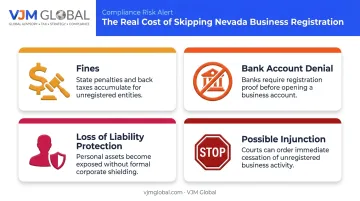
Operating without proper registration isn't a grey area. Consequences include:
- Fines from the state and local jurisdictions
- Inability to open a business bank account (most banks require a filed entity and EIN)
- Loss of liability protection, meaning personal assets become exposed
- Possible injunctions preventing you from operating at all
Cross-Border Entry Point
Foreign companies also use Nevada as a US market entry point. Tax treatment plus privacy rules simplify cross-border structuring without forcing founders onto the public record.
VJM Global works with companies of any origin on Nevada entity formation, registered agent arrangements, and the compliance work that follows. That ongoing piece matters more than most founders expect once the first anniversary filing comes due.
How to Register a Business in Nevada: Step-by-Step Process
Nevada centralizes most of this through SilverFlume, its online business portal. File correctly and the full process typically takes 1-3 weeks, though online filings usually move faster than mail.
Step 1: Choose Your Business Structure
Your options: sole proprietorship, general partnership, LLC, or corporation.
- Sole proprietorships and general partnerships don't require a formation filing with the Secretary of State under Nevada law, though local licenses may still apply.
- LLCs are the most common choice for small businesses and foreign entrants because they combine liability protection with pass-through taxation.
- Corporations suit businesses planning to raise venture capital or issue stock, since the structure supports multiple share classes and outside investors more cleanly.
Step 2: Choose, Search, and Reserve Your Business Name
Run a name check using the Nevada SOS Business Entity Search tool before you get attached to anything. Your name must:
- Include a required identifier (LLC, L.L.C., Inc., Corp., etc., depending on entity type)
- Be distinguishable from existing filed or reserved names
- Avoid restricted terms like "bank," "trust," or "engineering" without prior approval
Want to lock in a name before you're ready to file? Reserve it for 90 days for $25 through SilverFlume.
Step 3: File Your Formation Documents
This is where your entity legally comes into existence. File Articles of Organization (LLC) or Articles of Incorporation (corporation) through SilverFlume.
- LLC filing fee: $75
- Corporation filing fee: $75 minimum, scaling up with authorized capital
Every entity must designate a Nevada-based registered agent with a physical street address in the state. A PO box or mail drop alone won't satisfy this requirement.
This is the single biggest hurdle for foreign companies without a US presence, which is why most work with a Nevada-based formation service or registered agent provider.
Step 4: File the Initial List and Obtain the State Business License
These typically get bundled into the same filing packet as your formation documents.
| Entity Type | Formation Fee | Initial List Fee | State Business License | Total Mandatory Baseline |
|---|---|---|---|---|
| LLC | $75 | $150 | $200 | $425 |
| Corporation | $75 minimum | $150 | $500 | $725 minimum |
Both filings are required before you can legally operate, regardless of entity type.
Step 5: Register for a Federal EIN and State Tax Accounts
Most businesses need an EIN from the IRS for banking, hiring, and tax filing. Applying directly through the IRS is free. International applicants who can't use the online tool should follow the IRS's international EIN process rather than paying a middleman for something that costs nothing.
If you're selling taxable goods or services, register separately with the Nevada Department of Taxation through the My Nevada Tax portal for a sales/use tax permit. Get your State Business License first; the tax registration follows.
Step 6: Obtain Local City or County Licenses and Permits
State-level registration doesn't replace local licensing. Requirements and fees vary significantly by jurisdiction:
- Clark County (unincorporated area): $45 nonrefundable application fee, plus a category-specific fee
- City of Las Vegas: Requires state license and tax registration first, then a separate city application
- Washoe County (unincorporated area): Annual fee starting at $57.75, scaling with gross receipts up to $657.75
- City of Reno: $70 annually for receipts up to $20,000, rising with revenue tiers
- Carson City: Required if operating in or from Carson City; verify current fees directly with the city
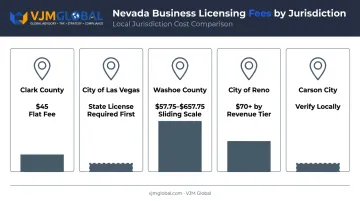
Always check the specific jurisdiction where you'll physically operate. It changes the fee and the process.
Step 7: Register for Workers' Compensation and Unemployment Insurance
Hiring even one employee triggers additional obligations:
- Workers' compensation is mandatory once you have one or more employees. Skipping this can mean fines up to $15,000, forced closure, and exposure to injury liability claims.
- Unemployment insurance registration with Nevada's Department of Employment, Training and Rehabilitation (DETR) is generally required once wages hit $225 in a calendar quarter. The 2026 new-employer UI rate is 2.95% on wages up to a $43,700 taxable wage base.
Nevada Business Registration Costs, Fees, and Timeline
State filing fees are fixed. Optional add-ons and local licenses sit on top of that baseline.
Mandatory SOS costs:
- LLC: $425 (Articles + Initial List + State Business License)
- Corporation: $725 minimum, higher with larger authorized capital
Optional costs:
- Name reservation: $25
- Certificate of good standing: $50
- Third-party registered agent service: varies by provider
- Certified copies: verify current fee directly with the SOS
Ongoing annual costs: Both LLCs and corporations must file an Annual List and renew the State Business License by the last day of the entity's anniversary month. These filings repeat every year for the life of the entity.
Processing timelines: Most SilverFlume filings process the same day at no extra cost. Need it faster? Nevada offers paid expedite tiers:
- 24-hour service: $25–$125 additional
- 2-hour service: $500 additional
- 1-hour service: $1,000 additional
Mail filings take longer and aren't recommended unless online filing isn't an option.
Foreign companies juggling currency conversion, cross-border banking, and unfamiliar fee structures often bundle formation, registered agent service, and ongoing compliance into one package. VJM Global coordinates that end-to-end for international clients—from the state filing through local license applications.
Common Mistakes and Post-Registration Compliance Requirements
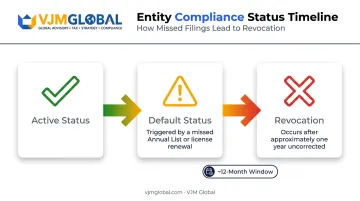
Here's a misconception that trips people up: an "Active" status on the Secretary of State's website does not mean you're fully compliant. Miss your Annual List or license renewal, and your entity slides into Default status, even while still showing as active in some search results.
Frequent mistakes:
- Forgetting to file the Annual List by the anniversary month deadline
- Letting your registered agent lapse (agents can resign, and you won't always get a heads-up)
- Confusing a county DBA filing with actual state-level entity registration
- Skipping required local licenses because the state license "seemed like enough"
What happens if you stay non-compliant: Default status that isn't corrected within roughly one year leads to revocation, meaning the entity loses its right to transact business entirely. At that point, you're not just paying late fees, you're rebuilding legal standing from scratch.
Registering in Nevada purely for perceived tax advantages, without genuine US operations, does not eliminate obligations in your home country. Controlled foreign corporation rules, permanent establishment tests, and deemed income attribution can still apply depending on where you're based.
Run cross-border questions past a tax advisor before assuming Nevada registration solves everything on its own.
Frequently Asked Questions
How much does it cost to register a company in Nevada?
Mandatory state costs start at $425 for an LLC and $725 for a corporation, covering Articles filing, the Initial List, and the State Business License. Local licenses and optional add-ons push totals higher.
How do I register a company in Nevada?
Choose your structure, search and optionally reserve your name, file formation documents through SilverFlume, secure your state and local licenses, then register for an EIN and applicable state taxes.
Why do businesses register in Nevada?
Nevada has no state corporate or personal income tax and no franchise tax, plus strong privacy and asset-protection statutes. The regulatory environment is also comparatively light for small businesses.
Does a Nevada LLC need a business license?
Yes. Every Nevada LLC needs a State Business License, and in most cities and counties, a separate local business license as well.
How long does it take to register a business in Nevada?
Online filings through SilverFlume typically take 1–3 weeks start to finish, including licensing. Mail-in filings take longer.
Can a foreign (non-US) company register a business in Nevada?
Yes. Foreign companies can form a domestic Nevada entity or register as a foreign-qualified entity, provided they appoint a Nevada-based registered agent. VJM Global assists companies from any country with this process.