Here's what most first-time filers miss, though. The paperwork itself is the easy part. What actually determines whether your US entity runs smoothly or turns into an expensive compliance headache comes down to three decisions made before you ever click submit: entity type, state of formation, and how you handle tax filings afterward.
Get any of those wrong and you could face duplicate state taxes, missed IRS information returns, or a bank application that goes nowhere. This guide walks through the exact registration process, the structural options available, what to prepare in advance, and the mistakes that trip up even well-funded founders.
Key Takeaways
- Non-US citizens and companies can own US LLCs or corporations outright—no residency required
- Your entity type and formation state determine tax exposure, liability protection, and filing costs
- Registering a US company grants no immigration rights; work authorization requires a separate process
- Foreign-owned entities trigger IRS obligations from day one, including EIN, Form 5472, and FinCEN BOI reporting
How to Register a Foreign Company in the US: Step-by-Step Process
Registration itself is a state-level filing. But the sequence you follow, and the decisions embedded in each step, shape everything that comes after.
Step 1: Decide Your Entry Structure, Entity Type, and State
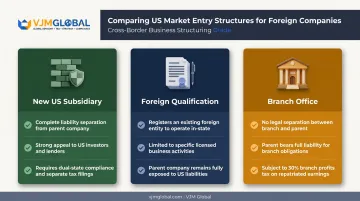
Foreign founders generally choose between three entry paths:
- New US subsidiary: a fresh domestic entity owned by your overseas company, keeping liability separate
- Foreign qualification: registering your existing overseas entity to legally transact business in a US state
- Branch office: operating directly under the foreign company's name, with no separate legal shield
Your choice should track expected liability exposure, whether you're courting US investors, and how large your actual US footprint will be.
Entity type matters just as much:
| Factor | LLC | C-Corporation |
|---|---|---|
| Federal filing | Pass-through by default; foreign-owned single-member LLCs still file Form 5472 | Flat 21% corporate tax rate, standard Form 1120 |
| Investor appeal | Limited: most US venture funds avoid LLCs | Standard structure for venture-backed companies |
| Treaty access | Often complicated for foreign owners | Generally cleaner access to tax treaty provisions |
Delaware remains the default choice for investor-backed startups. Delaware's own corporate code makes the point explicit: any person, partnership, association, or corporation may incorporate there "without regard to such person's or entity's residence, domicile or state of incorporation," according to Delaware's General Corporation Law.
But incorporation state and operating state are different questions. If your employees, inventory, or office sit in California, forming in Delaware won't exempt you from California's rules.
Corporations doing business there generally owe an $800 minimum franchise tax regardless of where they were formed. Compare filing fees and annual franchise or report taxes across your shortlisted states before committing to one.
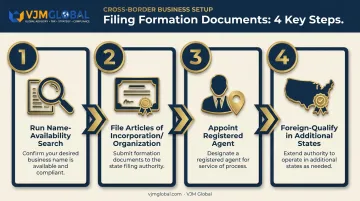
Step 2: File Formation Documents and Appoint a Registered Agent
Once you've settled on structure and state:
- Run a name-availability search through the Secretary of State to confirm your chosen name isn't taken
- File Articles of Incorporation (for corporations) or Articles of Organization (for LLCs) with that state
- Appoint a registered agent who maintains a physical street address in the formation state and is available during business hours to receive legal notices
- Foreign-qualify in additional states if you'll operate beyond your formation state, since this requires a Certificate of Good Standing from your home state plus a separate registration filing
Skipping step four is one of the most common oversights. Operating in a state without qualifying there can expose you to back taxes, penalties and, in some states, an inability to bring a lawsuit until you're properly registered.
Step 3: Obtain an EIN and Open a US Bank Account
An Employer Identification Number is non-negotiable for banking, hiring, and tax filing. Here's the catch: the IRS's online EIN system generally requires a responsible party with a US Social Security Number or ITIN.
Most foreign owners don't have either, so the application shifts to two alternate channels: by phone at 267-941-1099 (the international applicant line), or by fax or mail using Form SS-4, marking "foreign" on the responsible-party line.
Banking adds its own friction. Traditional banks often ask foreign owners for in-person verification or extensive supporting documentation before opening an account.
Some founders find fintech and neobank platforms more accommodating for remote account opening. Still, it's worth verifying the provider's banking charter and deposit insurance status before relying on it for day-to-day operations.
Step 4: Establish Ongoing Tax and Compliance Systems
Registration is the beginning, not the end. Foreign-owned entities carry recurring obligations most domestic founders never encounter:
- Form 5472 with a pro forma Form 1120 attached, required for 25%-foreign-owned corporations and foreign-owned disregarded LLCs with reportable transactions
- State annual reports and franchise taxes, due regardless of whether the business turned a profit
- A possible FinCEN BOI filing for entities formed under foreign law that register to do business in a US state
Missing Form 5472 isn't a minor paperwork slip. The IRS imposes an initial $25,000 penalty for a late or incomplete filing, with another $25,000 for every 30-day period the failure continues after IRS notice, per the IRS instructions for Form 5472.
Because these obligations span IRS forms, state filings, and sometimes FinCEN, most founders bring in a cross-border accounting partner from the outset.
Firms like VJM Global, whose team includes CPAs and Chartered Accountants with experience across the US, UK, and Australia, coordinate EIN applications, bookkeeping, and multi-jurisdiction filings so nothing falls through the cracks in year one.
Subsidiary vs Foreign Qualification vs Branch Office: Choosing Your Structure
Not every foreign company needs a brand-new subsidiary. The right structure depends on your scale, liability exposure, and whether US investors are in the picture.
New US Subsidiary
This structure makes sense when you're raising capital from US investors or want a genuine liability wall between the US operation and the parent company. It also tends to simplify banking and hiring. The trade-off: added corporate governance, and potential dual-state compliance costs if the subsidiary later expands beyond its formation state.
Foreign Qualification of the Existing Entity
Foreign qualification works best for limited or temporary US activity, such as a single contract, a short-term project, or a pilot customer. The downside: your foreign parent becomes directly exposed to US lawsuits, tax filings, and public disclosure requirements, with no separate entity absorbing that exposure.
Branch Office
A branch office suits a simple, short-term US presence with minimal setup. There's no liability separation from the parent. Branch profits can also face a 30% branch profits tax under US tax law, though treaties may reduce this rate in some cases. This setup also forfeits certain treaty benefits available to a properly structured subsidiary.
What You Need Before Registering a Foreign Company in the US
Preparation prevents costly delays with banks, tax authorities, and state agencies. Have these ready before you file anything.
Entity and Documentation Requirements
- A cleared company name, confirmed through a state name-availability search
- Articles of Incorporation or Organization, drafted and ready for filing
- Registered agent details, including a physical in-state address
- Ownership and cap table information for every beneficial owner
- Sector-specific licensing or sanctions review, if you're entering banking, defense, telecom, or cannabis
EIN, Tax ID and Banking Prerequisites
Your responsible party will need to provide an SSN or ITIN if one exists, or accept the longer mail or fax application process if not. Banks typically request passport copies, incorporation documents, and proof of a US business address.
Gathering this paperwork can get complicated fast. Working with a firm experienced in foreign-owned entity setups (such as VJM Global) to prepare the EIN application and organize supporting documentation reduces the risk of a rejected bank application.
Compliance and Advisory Readiness
Before filing, confirm three things:
- Your immigration strategy, if founders plan to work inside the US
- Your tax treaty position, based on your home country's treaty with the US
- Your beneficial ownership reporting status, since FinCEN BOI exemptions have changed more than once
Key Factors That Affect Your US Registration Success
Outcomes vary widely based on a handful of structural decisions made at the time of filing.
| Factor | Why It Matters | Impact on Compliance |
|---|---|---|
| State of formation vs. operation | Forming in Delaware or Wyoming doesn't exempt you from registering and paying tax where you actually operate — employees, inventory, offices | Mismatched choices create duplicate compliance costs and penalties for unregistered "doing business" activity |
| Entity tax classification | LLCs create pass-through and Form 5472/1120 complexity for foreign owners; C-Corps often offer cleaner liability and treaty treatment | Wrong classification can trigger unexpected filings or forfeit treaty benefits |
| Industry-specific regulation | Banking, defense, telecom, and cannabis sectors impose ownership or licensing restrictions on foreign investors | Missing a required sector review can delay registration or block it entirely |
| Beneficial ownership reporting status | Foreign-formed entities registering in a US state may still owe a FinCEN BOI report, even though US-formed entities are currently exempt | Missing this filing can trigger civil penalties |
FinCEN's 2025 interim final rule removed BOI reporting obligations for entities formed under US law. However, the requirement still applies to entities formed under foreign law that register to do business in a US state, according to FinCEN's rule change announcement.
Verify your current status rather than assuming no BOI report is due, since this rule has shifted before and could change again.
Common Mistakes to Avoid When Registering a Foreign Company in the US
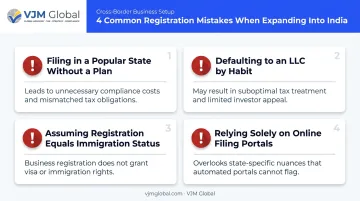
- Filing in a "popular" state without a plan — Delaware, Nevada, and Wyoming look appealing, but forming there while operating elsewhere creates duplicate registration and tax obligations
- Defaulting to an LLC by habit — skipping a tax review first can backfire, since a missed Form 5472 filing triggers a $25,000 penalty before you earn any revenue
- Assuming registration equals immigration status — forming a US company grants no right to live or work there; that requires a separate visa strategy entirely
- Relying solely on online filing portals — DIY platforms rarely flag cross-border tax and accounting requirements, leaving gaps that surface later as costly corrections
Frequently Asked Questions
Can a foreign company be incorporated in the US?
Yes. Non-US individuals and foreign companies can generally form and own US LLCs or corporations. Neither citizenship nor US residency is a legal prerequisite in most states.
Can a US LLC be owned by a foreign company?
Yes, this is common. However, a foreign-owned LLC treated as a disregarded entity must file a pro forma Form 1120 with Form 5472 attached, reporting transactions with its foreign owner.
What is the best state for a foreign-owned LLC?
There's no universal answer. Delaware suits investor-backed companies chasing venture capital, but if your team, inventory, or customers sit elsewhere, forming there often cuts duplicate registration and tax costs.
Does forming a US company help me get a US visa or work authorization?
No. Company ownership and immigration status are separate legal processes entirely. Founders who want to work inside the US still need a qualifying visa or other employment authorization.
Do I need an EIN to register a foreign company in the US?
Generally yes — an EIN is required for banking, hiring, and tax filing. Foreign responsible parties without an SSN or ITIN typically apply by phone, fax, or mail rather than online.
Can I open a US business bank account remotely as a foreign owner?
Some traditional banks require in-person identity verification for foreign owners. Fintech and neobank platforms sometimes offer more remote-friendly account opening, though eligibility and protections vary by provider.