This guide walks through every formation step, the mandatory state fees, ongoing compliance obligations, and the situations where Nevada may — or may not — be the right fit for your business.
Key Takeaways
- Nevada LLC formation costs $425 upfront: Articles of Organization ($75), Initial List ($150), and State Business License ($200) filed simultaneously
- No personal or corporate state income tax applies to LLC profits passing through to members
- Every Nevada LLC must appoint a registered agent with a physical Nevada street address
- Online filings via SilverFlume typically process the same business day
- Annual compliance costs $350/year; missing deadlines triggers penalties and administrative dissolution
Why Form an LLC in Nevada?
The Tax Advantage (With Important Caveats)
Nevada imposes neither personal nor corporate state income tax. For a pass-through LLC, this means profits flow to members without state-level taxation — a genuine advantage over high-tax states like California or New York.
Two business taxes do remain, though:
- Commerce Tax: Applies only when Nevada-source gross revenue exceeds $4 million per fiscal year (July 1–June 30). Most small and mid-sized LLCs will never hit this threshold. Rates vary by industry. (Nevada Department of Taxation)
- Modified Business Tax (MBT): Applies to employers. The general business rate is 1.17% of quarterly wages above $50,000, after health-benefit deductions
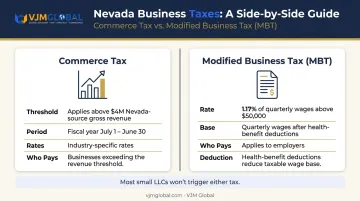
Nevada is not a zero-tax state — but for businesses without employees and below the Commerce Tax threshold, the tax burden is minimal.
Asset Protection and Privacy
Under NRS 86.401, a charging order is the exclusive creditor remedy against an LLC membership interest — applying to both single- and multi-member LLCs. A creditor cannot foreclose on your membership interest, demand distributions, or inspect company records. They must wait for distributions you choose to make. Few other states extend this charging-order exclusivity to single-member LLCs, making Nevada's protection genuinely distinctive.
Privacy rules follow a similar pattern — strong, but not absolute:
- Members' names are not required in the Articles of Organization
- Passive members of a manager-managed LLC are not publicly disclosed
- Managers and managing members are listed in the Initial List, which is a public record
Nevada offers real privacy advantages — just not complete anonymity.
Reduced Administrative Burden
Nevada Chapter 86 imposes no annual meeting or meeting minutes requirements on LLCs. An operating agreement may add those formalities if you want them, but the state does not.
When Nevada May Not Be the Right Choice
The biggest trap: forming in Nevada while actually operating elsewhere.
Example: A business operated entirely from California forms a Nevada LLC hoping to avoid California taxes. Result — it still must register as a foreign LLC in California ($70 registration fee) and pay California's $800 annual LLC tax. Add Nevada's $425 formation cost and $350 annual renewals, and the owner is paying more than if they'd simply formed in California from the start.
If your operations, employees, or customers are primarily in another state, Nevada's advantages largely disappear. The upfront cost of $425 and annual renewal of $350 are also above the national average — not ideal for early-stage businesses with no Nevada presence.
How to Form an LLC in Nevada: Step-by-Step
Nevada LLC formation involves eight sequential steps. All are manageable without an attorney. The SilverFlume portal is the fastest submission method, with most filings processed the same day.
Step 1: Choose and Reserve Your LLC Name
Per NRS 86.171, your name must include one of these designators: "Limited-Liability Company," "LLC," "L.L.C.," "LC," "L.C.," "Limited," or "Ltd."
The name must also be distinguishable from all existing Nevada business names. Search availability using the Nevada SilverFlume Business Search before filing.
Optional: Reserve your name for 90 days by paying a $25 reservation fee — useful if you're not ready to file immediately.
Step 2: Appoint a Registered Agent
Nevada law (NRS 77.300) requires every LLC to maintain a registered agent with a physical Nevada street address. A P.O. box alone does not qualify.
Your options:
- Self-serve: If you have a physical Nevada address and meet residency requirements, you can serve as your own agent
- Individual Nevada resident: Any qualifying adult with a Nevada address
- Professional registered agent service: The most practical option for out-of-state founders — fees typically range from $50–$300/year depending on the service
Step 3: File the Articles of Organization
The Articles identify your LLC's name, registered agent details, organizer information, and management structure (member-managed vs. manager-managed). NRS 86.161 requires listing the names and addresses of initial managers or, for member-managed LLCs, initial members.
Filing fee: $75. Submit via SilverFlume for same-day processing, or by mail (no guaranteed turnaround published).
Expedited options (additional fees):
| Service | Additional Fee |
|---|---|
| 24-hour | $125 |
| 2-hour | $500 |
| 1-hour | $1,000 |
Source: Nevada Secretary of State Forms & Fees
Step 4: Submit the Initial List of Managers or Members
The Initial List reports the names, titles, and business or residence addresses of all managers or managing members. Filing fee: $150.
While the Nevada SOS packages the Initial List with the Articles for convenience, NRS 86.263 technically allows it to be filed by the last day of the first month following Articles approval. This same filing must be renewed every year.
Step 5: Obtain the Nevada State Business License
All standard Nevada LLCs must obtain a State Business License at formation. Fee: $200. It's filed alongside the Articles and Initial List, making the combined submission total $425.
NRS Chapter 76 includes limited exemptions, so verify whether your LLC qualifies for any exception. County and city-level licenses (Clark County, Washoe County, etc.) are separate requirements and may also apply.
Step 6: Draft an Operating Agreement
Nevada does not require filing an operating agreement with the state. But every LLC — especially one with multiple members — should have one as an internal governance document.
A well-drafted operating agreement covers:
- Ownership percentages and member roles
- Profit and loss distribution
- Voting rights and decision-making authority
- Procedures for adding or removing members
- Dissolution and wind-down provisions
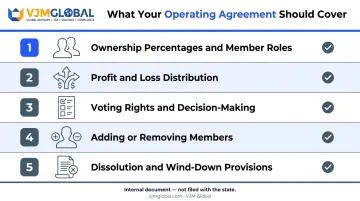
Most banks also require an operating agreement to open a business checking account.
Step 7: Obtain an EIN
An Employer Identification Number is issued free by the IRS and received immediately via online application at IRS.gov.
Who needs one:
- Multi-member LLCs: Required — defaults to partnership taxation
- Single-member LLCs with employees: Required
- Single-member LLCs without employees: Not strictly required by the IRS, but strongly recommended — avoids using your Social Security Number for business purposes and is typically required to open a bank account
International founders note: The IRS online EIN tool requires the principal business to be in the US or a US territory. Non-US residents must apply by phone, fax, or mail — factor this into your timeline.
Step 8: Register for State and Local Taxes
Nevada employers must register for the Modified Business Tax through the Nevada Department of Employment Security Division. MBT returns are filed quarterly through mynevadatax.nv.gov.
Local licensing varies by location:
- Clark County (Las Vegas area): Six separate licensing jurisdictions exist — unincorporated Clark County uses county licensing, while incorporated cities (Henderson, Las Vegas, North Las Vegas) license businesses within their city limits
- Washoe County (Reno area): Unincorporated Washoe County uses county licensing; Reno and Sparks use city licensing
If your business operates across multiple Nevada jurisdictions, confirm which county and city registrations apply before your first operating quarter — requirements differ significantly by location and business type.
Nevada LLC Costs and Timeline
Forming a Nevada LLC involves predictable upfront costs and manageable annual fees. Here's a full breakdown so you can budget accurately before filing.
Formation Costs (One-Time)
| Required Filing | Fee |
|---|---|
| Articles of Organization | $75 |
| Initial List of Managers/Members | $150 |
| State Business License | $200 |
| Total Upfront | $425 |
Annual Ongoing Costs
Once formed, Nevada LLCs carry straightforward annual obligations to stay in good standing.
| Annual Requirement | Fee |
|---|---|
| Annual List renewal | $150 |
| State Business License renewal | $200 |
| Total Annual | $350 |
Annual filings are due by the last day of the LLC's anniversary month — the same calendar month in which the Articles were originally approved.
Additional Variable Costs to Budget
- Registered agent service: $50–$300/year (if using a professional service)
- EIN application: Free via IRS Form SS-4 (online or by mail)
- Operating agreement: $0 if self-drafted; $100–$500 with professional drafting
- Name reservation: $25 (optional)
- Local/county business licenses: Varies by jurisdiction
- Expedited SOS processing: $125–$1,000 depending on speed needed
Nevada LLC Post-Formation Compliance Requirements
Annual List and Business License Renewal
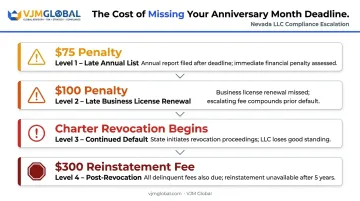
Every Nevada LLC must file an updated Annual List and renew its State Business License by the last day of its anniversary month each year. Missing these deadlines carries real consequences:
- Late Annual List: $75 penalty
- Late Business License renewal: $100 penalty
- Continued default: Charter revocation begins on the first day of the first anniversary month following the due date
- Reinstatement after revocation: Requires all delinquent filings, fees, penalties, plus a $300 reinstatement fee — and is unavailable after five consecutive years of revocation
Commerce Tax
The Commerce Tax applies only to businesses with Nevada-source gross revenue above $4 million for the July 1–June 30 fiscal year, with returns due around August 14 each year. Most small LLCs won't come close to this threshold. For businesses that do qualify, industry-specific rates are published by the Nevada Department of Taxation.
Employer Payroll Obligations
LLCs with Nevada employees face three layers of payroll compliance:
- Modified Business Tax: 1.17% of quarterly wages above $50,000 (general business); 1.554% for financial institutions and mining
- Federal payroll taxes: IRS Forms 941 (quarterly), 940 (annual FUTA), W-2/W-3
- Nevada unemployment insurance: Filed with the Employment Security Division
Missing any of these filings — particularly the Modified Business Tax — can trigger back penalties that compound quickly. Getting payroll compliance right from the start is far less costly than catching up later.
Common Mistakes to Avoid When Forming a Nevada LLC
1. Forming in Nevada without operating there
This is the most frequent and costly error. If your business has employees, a physical office, or customers in another state, that state may require foreign LLC registration regardless of where you formed. A California-based operation with a Nevada LLC still owes California's $800 annual LLC tax plus the $70 foreign registration fee — on top of Nevada's fees.
2. Treating formation as the finish line
Approval of your Articles does not complete your legal obligations. These requirements continue after formation:
- Annual List and Business License renewal (due each anniversary month)
- Commerce Tax monitoring if gross revenue exceeds $4 million
- MBT registration if you hire employees in Nevada
Many LLCs fall into default simply because founders missed the anniversary-month deadline.
3. Assuming Nevada provides complete anonymity
Nevada's privacy protections are real: passive members of a manager-managed LLC are not required fields on the Articles or Initial List. However, managers and managing members are publicly listed in the Initial List, which is a filed public record. If anonymity matters, work with a registered agent and confirm exactly what is and isn't shielded before treating Nevada privacy as a primary reason to form there.
Frequently Asked Questions
How long does it take to get an LLC approved in Nevada?
Online filings through SilverFlume typically process the same business day at no extra charge. Mail filings have no published guaranteed turnaround. Expedited options (24-hour, 2-hour, 1-hour) are available for additional fees ranging from $125 to $1,000.
Is Nevada a good state to form an LLC?
Nevada is an excellent choice for businesses with genuine operations or revenue in the state — no income tax and strong NRS 86.401 asset protection are real advantages. Businesses primarily operating elsewhere often face double compliance costs through foreign registration in their home state, which can negate the tax advantage.
How much does it cost to form an LLC in Nevada?
The mandatory upfront total is $425 ($75 Articles + $150 Initial List + $200 Business License). Annual renewals add $350 per year. Verify current fees at the Nevada Secretary of State's fee schedule before filing.
Do I need a registered agent to form an LLC in Nevada?
Yes — Nevada law requires every LLC to have a registered agent with a physical street address in the state. Owners can serve as their own registered agent if they have a qualifying Nevada address, or appoint a professional registered agent service.
What are Nevada's ongoing LLC compliance requirements after formation?
Nevada LLCs face three recurring obligations:
- Annual List + State Business License renewal — due by the last day of the anniversary month each year
- Modified Business Tax + federal payroll filings — required for any employer
- Commerce Tax — applies if Nevada gross revenue exceeds $4 million annually
Can a non-US resident or foreign entrepreneur form an LLC in Nevada?
Yes — NRS 86.151 sets no citizenship or residency requirement. Non-US founders can form and own a Nevada LLC but must still appoint a Nevada registered agent. Obtaining an EIN typically requires IRS phone or mail procedures, and US banks have separate identification requirements for account opening.