Introduction
If you live in Australia and earn income that has no U.S. tax withheld, you may owe the IRS estimated tax before you ever file Form 1040. Pick the wrong payment channel or tax period and the payment can bounce, land on the wrong year, or cost you extra in fees.
Form 1040-ES is the worksheet that calculates your current-year estimate. You don't pay by mailing the worksheet. You pay through an IRS channel such as Direct Pay, a card processor or a wire.
That payment is separate from Australian PAYG instalments, which prepay Australian tax and never reach the IRS.
This guide covers eligibility, calculating the amount, secure payment options (including without a U.S. bank account), confirmation records, deadlines and underpayment risks.
Key Takeaways
- Confirm you need to pay, calculate the amount, and check the tax year before opening any payment page.
- Direct Pay and IRS Online Account need a U.S. bank account; cards and wires work from Australia.
- Start at IRS.gov, ignore unsolicited links, and save every confirmation.
- Dates, fees and wire details change, so verify them before paying.
What Form 1040-ES Is, Who May Need to Pay, and How to Calculate the Amount
What Form 1040-ES Is and Who May Need to Pay
Form 1040-ES helps you estimate and pay current-year U.S. federal tax, including income tax and self-employment tax. Form 1040 is the annual return that reports the completed tax year and claims those payments as credits.
Common triggers include:
- Self-employment, freelance or business income
- Rental income
- Interest and dividends
- Capital gains
- Prizes and awards
- Wages or pensions with too little withholding
For 2026, the Form 1040-ES instructions apply a two-part test. You generally must pay if both of these hold:
- You expect to owe at least $1,000 after withholding and refundable credits.
- Your withholding and credits will be below the smaller of 90% of your 2026 tax or 100% of your 2025 tax (the 2025 return must cover 12 months).
If your 2025 AGI exceeded $150,000 ($75,000 if married filing separately), the prior-year figure becomes 110%.
You owe nothing if you were a U.S. citizen or resident for all of 2025 and had no 2025 tax liability. Farmers and fishers have a 66 2/3% current-year test.
U.S. citizens and resident aliens abroad stay taxable on worldwide income, and the estimated-tax rules generally stay the same. Nonresident aliens use Form 1040-ES (NR), which this article doesn't cover.
How to Calculate the Amount Before Paying Online
Gather these first:
- Your prior-year U.S. federal return
- Current income records and expected deductions and credits
- Self-employment and foreign income details
- Any U.S. withholding and estimated payments already made
You then have two routes. The prior-year safe harbour is simple: pay based on last year's tax.
If your Australian income is seasonal or uneven, the annualised income method may suit you better. It uses the Annualized Estimated Tax Worksheet in Publication 505, and you must file Form 2210 with Schedule AI.
Foreign currency adds complexity. For most taxpayers, foreign income and taxes are translated into U.S. dollars at the rate on the date received or paid. Foreign earned income exclusion has its own worksheets in Publication 505.
Don't assume Australian tax already paid covers your U.S. estimate. The ATO describes PAYG instalments as Australian prepayments, and they aren't IRS remittances. Qualifying Australian tax may earn a foreign tax credit, usually on Form 1116, so build any allowable credit into your estimate.

For complex cross-border situations, VJM Global can help with tax compliance reviews, estimate preparation, organised payment records and Form 1040 return preparation. You still authorise the payment yourself through the IRS.
Compare the Fastest and Most Secure Ways to Pay IRS Estimated Tax Online
How to Choose Between the Main IRS Payment Channels
| Channel | Needs U.S. bank account? | Key notes |
|---|---|---|
| Direct Pay | Yes (U.S. routing number) | Free, no sign-in, schedule up to 365 days ahead |
| IRS Online Account | Yes | Shows up to 5 years of payment history |
| EFTPS | Yes | Individual access ending; check IRS.gov |
| Card or digital wallet | No | Processor fees apply |
| International wire | No | Same-day, in U.S. dollars |
Direct Pay and Online Account. Both pull from a checking or savings account at a U.S. financial institution. The IRS says its online systems don't accept foreign-bank payments.
An Australian account without a U.S. ABA routing number won't work. Choose Online Account if you want payment history and pending-payment visibility.
EFTPS. The IRS page says individuals can no longer create new accounts and that individual payments ended on 12 November 2026. Existing users may continue "for now", so check the live page before relying on it.
Cards and digital wallets. The IRS lists Pay1040 and ACI Payments. Fees on the IRS page as of 22 October 2026:
- Pay1040: debit $2.15; credit 1.75% (minimum $2.50)
- ACI Payments: debit $2.10; credit 1.85% (minimum $2.50)
The IRS page doesn't say whether foreign-issued cards are accepted, and your bank may add foreign-exchange charges. Confirm at checkout.
International wire. A wire needs no U.S. personal bank account, but your Australian bank must have a relationship with a U.S. bank. Payment must be in U.S. dollars.
Wires received after 5 p.m. ET are rejected, not held overnight, so allow for time zones and your bank's cut-off. Expect currency conversion and possibly intermediary fees.
Your bank will need:
- Receiving ABA number 091036164
- Institution name US TREAS SINGLE TX
- A separate Same-Day Taxpayer Worksheet for each tax period
- Your taxpayer ID, name control, tax type and tax year

Check the IRS foreign-payment page for the individual tax-type code.
How to Pay Form 1040-ES Online With IRS Direct Pay
This route suits anyone with a U.S. bank account.
Start at the Official IRS Direct Pay Page
Go to IRS.gov/payments and follow the link. Don't follow links from an email, text, search ad or social post.
Select the Correct Payment Classification
On the Tax Information screen, choose Estimated Tax, apply the payment to Form 1040 - Income Tax, and pick the correct tax period. You don't have to assign the payment to a quarter. Screen labels change, so read them carefully.
Complete Identity Verification
Direct Pay checks your details against a prior federal return. Enter your name, address and ID exactly as on that return. For joint filers, use the person listed first.
- Use the most recent return; the system may accept one up to 5-6 years old.
- If verification fails, recheck the details or try another eligible year.
- If you've never filed, or this is your first return, Direct Pay isn't available. Use a card or wire instead.
Enter and Review the Bank Payment
Provide the account type, routing number, account number, amount, debit date and an email for the receipt. Check every digit and make sure the funds are there.
Submit, Confirm, and Troubleshoot
Review the summary, then sign. Save the confirmation number. Use Payment Lookup with that number to view, change or cancel a payment until 11:45 p.m. ET two business days before the date.

A confirmation proves submission, not withdrawal. Check your bank statement for the debit.
Payments submitted after 3 p.m. ET, or on weekends and bank holidays, may debit the next business day. If the bank took the money and two business days after the payment date it is still missing from your IRS account, contact the IRS. Don't send a second payment without checking first.
Pay Securely, Confirm the Debit, and Keep Proof of Payment
Security Checklist for Online IRS Payments
- Confirm the address is genuine IRS.gov, or an IRS-listed processor reached from IRS.gov/payments.
- Use a private, updated device and avoid public Wi-Fi for banking.
- Turn on your bank's security features.
- Never send tax ID numbers or bank logins by email or text.
IRS scam guidance says the IRS generally makes first contact by U.S. mail and doesn't discuss tax debts by email, text or social media. It doesn't demand a specific payment method, and it never accepts gift cards. Treat urgent demands, fake penalty notices and links away from IRS.gov as red flags.
Understand the Difference Between Submission and Posting
A payment request, confirmation, bank debit and posting to your IRS account can all happen on different days. Direct Pay confirmation isn't proof of posting. Same-day wires follow bank cut-offs and the 5 p.m. ET (US Eastern Time) rule.
Cash at U.S. retailers is not available as a remote option from Australia.
Keep Complete Payment Records
Keep:
- Confirmation number and email receipt
- Payment date, amount, tax year and period
- Bank statement entry, wire receipt or card receipt
- Any IRS correspondence
Match these to the estimated payments you claim on Form 1040. An IRS Online Account shows up to 5 years of payment history, and an online tax-account transcript can help if a payment is missing or misapplied.
Deadlines, Penalties, and a Final Online-Payment Checklist
Estimated Tax Payment Deadlines
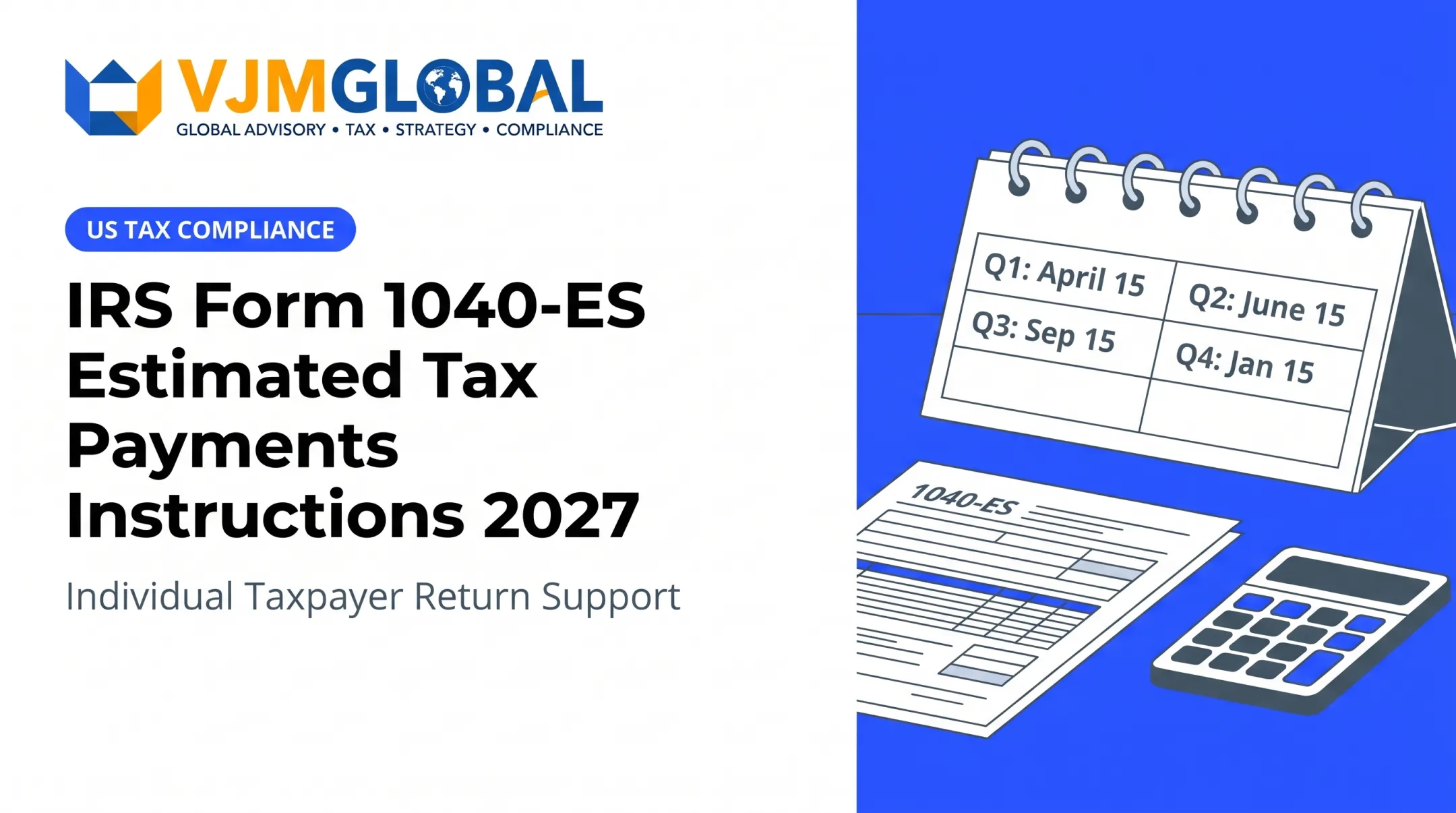
For calendar-year 2026, instalments fall on:
- 15 April 2026
- 15 June 2026
- 15 September 2026
- 15 January 2027
You can skip the January payment if you file the 2026 return by 1 February 2027 and pay the full balance. If a date lands on a weekend or legal holiday, the next business day applies. Fiscal-year filers use the 15th of the 4th, 6th and 9th months, plus the first month of the next year.
The automatic two-month extension for taxpayers abroad addresses the annual return and its balance. The IRS page doesn't say it postpones estimated instalments, so don't assume it does. Disaster-relief notices, such as the 2026 Indiana one, apply only to affected areas.
Underpayment Risks and Safe-Harbour Planning
The IRS calculates the penalty by instalment, from the amount underpaid, how long it stayed unpaid and the quarterly interest rate. You can be penalised even if your return later shows a refund. The rate for 1 October to 31 December 2026 is 7% per year, compounded daily.

Form 2210 handles the calculation, and Schedule AI covers uneven income. Get professional review if you have irregular income, a large one-off gain or foreign tax credits.
Final Online-Payment Checklist
- Calculate your liability and confirm you must pay.
- Verify the tax year and payment period.
- Choose a channel that fits your bank access.
- Check fees and exchange costs.
- Start from IRS.gov.
- Save the confirmation number.
- Monitor the debit.
- Keep records and reconcile on Form 1040.

Screens, dates, eligibility rules and fees change, so confirm the latest IRS instructions before you submit.
Frequently Asked Questions
Where can I pay my estimated federal taxes online?
Start at IRS.gov/payments. Use Direct Pay or Online Account with a U.S. bank account, an IRS-listed card processor, or an international wire if you have no U.S. account.
What is the best way to pay estimated taxes to the IRS?
It depends on your access. Direct Pay is free with a U.S. bank account. From Australia, cards are convenient but carry fees, and wires suit larger amounts despite bank and exchange charges.
What is the most secure way to make a payment to the IRS?
Begin at IRS.gov and use an official channel. Verify the tax year and period, ignore unsolicited links, and keep your confirmation.
What types of payments does the IRS accept?
Bank debit, cards and digital wallets through listed processors, wires, and cheque or money order with Form 1040-ES vouchers. Cash works only at participating U.S. retailers. EFTPS availability for individuals has changed, so verify it.
What is estimated tax?
It's an advance payment toward current-year federal tax on income without enough withholding. Self-employed people, investors, landlords and some overseas taxpayers often need to pay it.