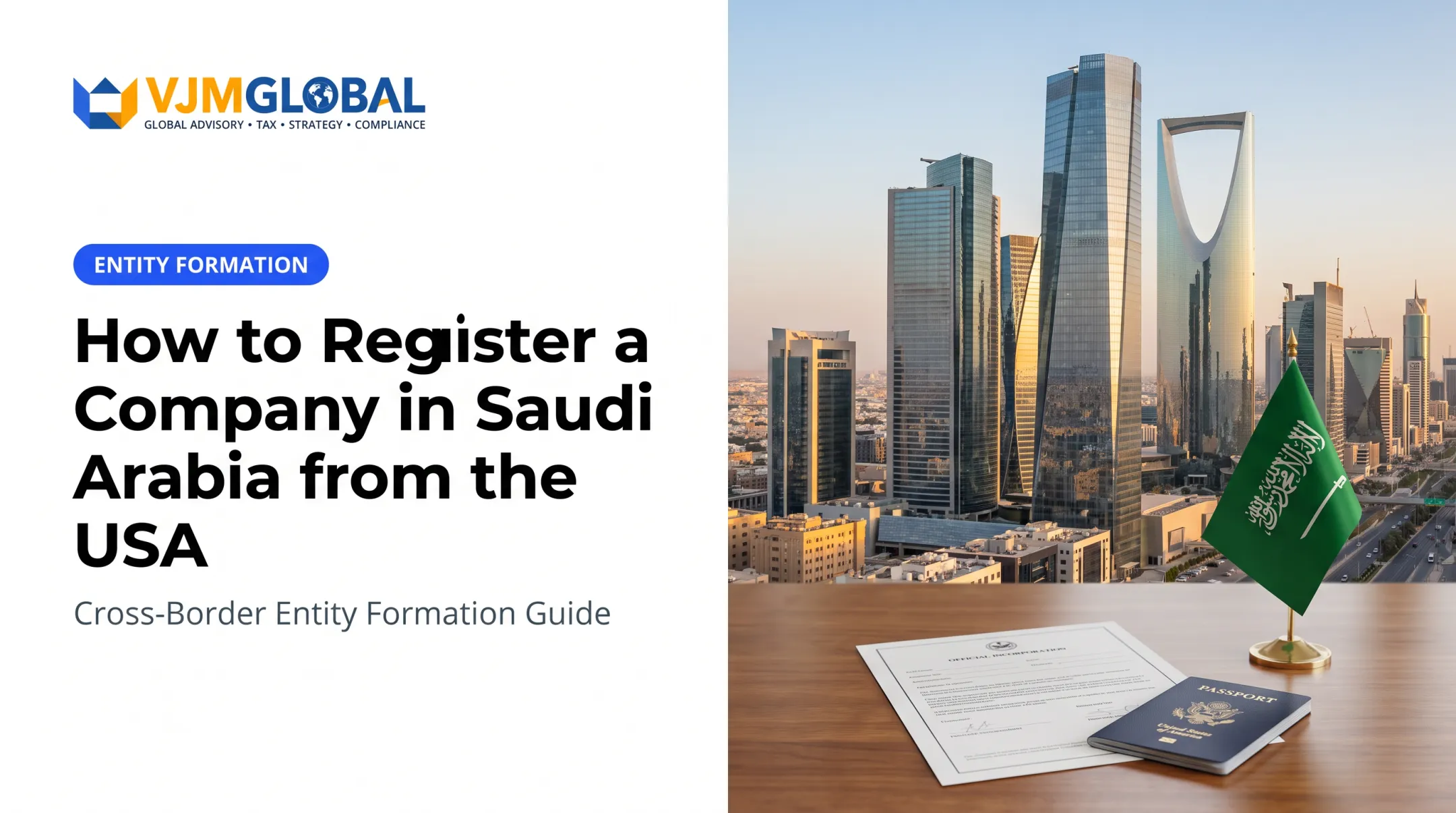
Many American business owners assume UAE registration means finding a local sponsor, sitting through in-person government appointments, or drowning in paperwork nobody explains. That's outdated thinking. Most of the process happens online.
This guide walks through the exact steps, costs, and documents a US-based founder needs to register a company in Sharjah remotely, plus where professional support like VJM Global's fits in.
Key Takeaways
- Register a Sharjah company remotely from the US via Free Zone (100% foreign ownership) or Mainland
- Core path: pick activity and jurisdiction, reserve a trade name, file documents, and pay fees
- Free zone licenses often start from AED 5,500; mainland setups run AED 15,000–30,000+ in year one
- US documents typically need notarization and authentication before Sharjah filing
- VJM Global can handle document coordination, jurisdiction advice, and post-registration compliance
Why US Entrepreneurs Are Choosing Sharjah for Business Expansion
Sharjah sits next to Dubai but runs on a leaner cost structure. It gives you access to UAE and Gulf Cooperation Council (GCC) markets, plus proximity to major ports and airports, without Dubai's premium price tags on office space and licensing.
Core advantages for US founders:
- 0% corporate tax on taxable income up to AED 375,000, rising to 9% above that threshold under UAE Corporate Tax rules
- 100% foreign ownership available in free zones and most mainland activities
- Full profit repatriation — investors can send earnings back to the US without restriction, per the UAE Ministry of Economy's investment incentives page
- Specialized free zones with distinct industry focuses across media, logistics, industry, and tech
These are the free zones US founders use most often:
| Free Zone | Best Suited For |
|---|---|
| SHAMS | Media, gaming, creative services |
| SAIF Zone | Logistics, trade, light manufacturing |
| Hamriyah | Industrial, oil & gas, maritime |
| SRTIP | Technology, renewable energy, R&D |

One important caveat: free zone tax treatment isn't automatic. Your business needs to meet "Qualifying Free Zone Person" conditions, including adequate substance and qualifying income, to actually get the 0% rate.
Sharjah Mainland vs Free Zone: Choosing the Right Jurisdiction from the USA
Your jurisdiction choice comes down to one question: do you want to trade across the UAE mainland and bid on government contracts, or are you focused on international trade and free zone activity?
Free Zone Structures
Free zones remain the most remote-friendly option for US founders. You'll typically pick between:
- Free Zone Establishment (FZE) — single shareholder structure
- Free Zone Company (FZC) — multiple shareholders
Both SHAMS and SAIF advertise fully online setup processes. SHAMS claims licenses issued in as little as 60 minutes; SAIF offers a three-step digital process from home.
These are official service claims, not guarantees for every application, but they reflect a remote-friendly system.
Mainland Structures
Mainland setup, licensed by Sharjah's Economic Development Department (SEDD), now allows 100% foreign ownership for most activities. This followed amendments removing the previous 51% Emirati-ownership requirement for many business categories.
That said, local involvement can still apply in some cases. Some official UAE government guidance still references a local service agent for companies fully owned by non-GCC residents, particularly for certain activity types. Confirm your specific activity's requirements with SEDD before assuming either extreme.
Quick comparison:
| Factor | Free Zone | Mainland |
|---|---|---|
| Market access | International + free zone | UAE-wide, government contracts |
| Ownership | 100% (standard) | 100% for most activities |
| Office requirement | Often flexible/virtual | Typically physical premises |
| Remote registration | Strongly supported | Possible; confirm with SEDD |

If your customers are outside the UAE or you're trading internationally, free zone is usually the simpler path. If you need to sell directly into the UAE mainland market, mainland registration is the better fit.
Legal Structures Available to Foreign Owners
After you choose a jurisdiction, US owners setting up remotely typically pick one of these legal forms:
- LLC (mainland)
- Sole establishment (single owner)
- Branch of a foreign company — the Ministry of Economy confirms branches don't require a local national sponsor
- Civil company (professional services activities)
Step-by-Step Process to Register a Company in Sharjah from the USA
- Define your business activity and license type. Commercial, service, or industrial license: this determines everything downstream.
- Choose your jurisdiction and legal structure. Free zone versus mainland, based on ownership needs and where your customers are.
- Reserve a trade name. SEDD's trade-name service is typically processed within one working day and doesn't require you to be physically present.
- Submit notarized and apostilled documents. File through a local registered agent or consultant (covered in detail below).
- Pay license and registration fees. You'll receive your trade license, MOA/AOA, and Certificate of Incorporation once approved.
- Apply for an investor visa (if relocating) and open a corporate bank account. This is where most US applicants hit their first real friction point.

Most free zone steps happen online. Mainland registration is less consistently documented as fully remote. Some steps may require attendance by a legal representative, so working with a local agent matters more here.
Where delays typically happen: banking and document authentication. UAE banks apply risk-based onboarding, meaning even if you submit everything online, a bank may still request a video call or additional verification before approving your account.
Documents Required for US Applicants
Standard requirements for a US-based applicant include:
- Notarized passport copies
- Proof of US residential address (utility bill or bank statement)
- Passport-sized photographs
- A business plan
- Completed application form
On authentication: US documents generally need notarization followed by authentication before Sharjah authorities will accept them.
The US is a member of the Hague Apostille Convention, but confirm with your registered agent which authentication route Sharjah requires for your document type. Do not assume a US apostille alone is automatically sufficient.
If you're appointing someone in the UAE to complete registration on your behalf, you'll also need a notarized Power of Attorney. This is especially relevant for founders who don't plan to travel during setup.
Cost to Register a Company in Sharjah from the USA
Here's a rough breakdown based on published fee indications:
| Item | Estimated Cost (AED) |
|---|---|
| Free zone license (starting at) | 5,500 |
| Other free zone packages | 5,500–15,000 |
| Mainland license (first year) | 15,000–30,000+ |
| Investor visa | 3,000–7,000 |

Treat these as indicative ranges rather than fixed quotes. Actual pricing depends heavily on your activity, office or lease requirements, and chosen free zone.
Additional costs US applicants should budget for:
- US document apostille and Arabic translation fees
- Courier charges for physical document exchange
- Remote setup or registered agent service fees
Sharjah generally comes in below Dubai on setup costs, largely because of lower office and warehouse requirements in most Sharjah free zones. Exact comparisons vary by activity, so get a written quote once your license activity and free zone are scoped—VJM Global can provide that breakdown before you commit.
Ongoing costs to plan for annually:
- License renewal fees
- Accounting and audit compliance
- Visa renewals (if applicable)
How VJM Global Helps US Businesses Register and Stay Compliant in Sharjah
VJM Global brings over 30 years of cross-border entity formation experience and has served more than 500 American business owners entering new markets globally.
Its UAE practice covers mainland, free zone, and offshore formation routes, including the trade-name reservation, licensing, and Memorandum of Association steps that a Sharjah registration requires.
The firm's support for US-based founders spans:
- Activity selection and jurisdiction advisory (free zone vs mainland)
- Document coordination ahead of submission
- Trade license processing through the appropriate Sharjah authority
- Post-registration accounting, tax, and compliance, including UAE Corporate Tax and VAT registration
Because VJM Global delivers services locally using each market's own regulators and statutory instruments, US founders don't need to navigate UAE bureaucracy solo or travel just to keep paperwork moving.
For a Sharjah engagement, request a written quote covering your chosen structure so you know exactly what's included before you commit.
Frequently Asked Questions
How much does it cost to open a company in Sharjah?
Costs range from around AED 5,500 for entry-level free zone licenses to AED 30,000+ for mainland companies. Add investor visa fees (AED 3,000–7,000) and bank account setup costs on top.
Can a US citizen fully own a company in Sharjah?
Yes. Free zones allow 100% foreign ownership as standard, and most mainland activities now permit full foreign ownership too. A small number of restricted or strategic-impact activities may still have special controls.
Do I need to visit the UAE to register a Sharjah company?
Most free zone steps can be completed remotely, including trade name reservation and document submission. Bank account opening is the step most likely to require some form of in-person or video verification.
Which is better for a US business: Sharjah Free Zone or Mainland?
Free zones suit founders trading internationally or within free zone networks, with lower costs and stronger remote-setup support. Mainland suits businesses wanting direct access to the UAE-wide market and government contracts.
How long does it take to register a company in Sharjah from the USA?
Free zone licenses can be issued in as little as a day once documents are ready, based on published free zone timelines. Mainland registration and document authentication can add several days to a few weeks depending on your situation.
What documents does a US applicant need to notarize or apostille?
You'll typically need notarized passport copies, proof of US address, and a notarized Power of Attorney if someone is registering on your behalf. Confirm the exact authentication route with your registered agent before submitting anything.