That backdrop is why UAE free zones keep coming up in conversations about global expansion. Most of what gets discussed, though, stays at the surface: "0% tax," "100% ownership," "set up in days." Those claims are true, but they're not the whole story.
The real value shows up later, once a company is operational and dealing with banking, ownership consolidation, and cross-border reporting. This article breaks down what actually matters for US businesses considering a UAE free zone company, not just the pitch.
Key Takeaways
- Free zones give US owners full control with no local UAE sponsor required
- 0% tax is conditional—US reporting duties (GILTI, FBAR, Form 5471) still apply
- Registration can move fast, but banking and compliance setup often take longer
- AED's dollar peg removes currency risk for US businesses invoicing across the region
- Real value depends on matching license type, tax registration, and US filings from day one
What Is a UAE Free Zone Company (Brief Context)
What Is a UAE Free Zone Company
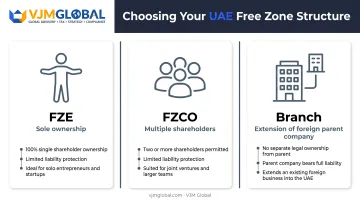
A UAE free zone company is a business entity licensed by a specific Free Zone Authority rather than a general municipal regulator. Depending on ownership structure, it's set up as an FZE (single shareholder), an FZCO (multiple shareholders), or as a branch of an existing foreign company.
Free zones were built for cross-border activity, not local retail. That's why they suit:
- International trading and re-export businesses
- E-commerce brands selling outside the UAE
- Consulting and professional services firms
- SaaS and tech companies serving regional or global clients
- Holding companies for IP, investments, or subsidiaries
For a US business, a free zone company is a vehicle for a specific outcome: testing the GCC market, structuring IP ownership, or running tax-efficient regional operations without giving up control back home. It is not a one-to-one stand-in for a US LLC.
Key Advantages of a UAE Free Zone Company for US Businesses
The advantages below aren't abstract "tax haven" talking points. They're the outcomes US businesses actually track: who controls the entity, what the effective tax rate looks like, how fast they can enter a market, and whether cash can move freely.
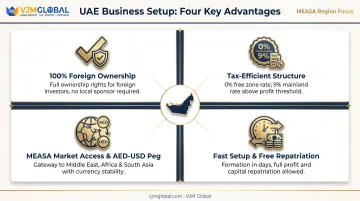
100% Foreign Ownership and Full Operational Control
Free zones have always permitted full foreign ownership. The UAE Ministry of Economy and Tourism confirms up to 100% foreign ownership across free zones, and authorities like DMCC state plainly that no local partner is required.
That matters more than it might sound. Many US founders still assume a UAE entity needs a local sponsor holding equity, a leftover assumption from older mainland rules. With a free zone structure:
- The US parent retains full equity and voting control
- IP assigned to the UAE entity stays under US-side authority
- Consolidating the entity into US financial statements is straightforward, since there's no minority local stakeholder muddying ownership
That setup suits US SMEs and startups testing UAE or wider GCC demand. They can enter without handing decision-making or profit share to a local partner.
Tax-Efficient Structure With US Compliance Considerations
The headline claim is 0% corporate tax. The accurate version is more specific: under the UAE's Qualifying Free Zone Person (QFZP) regime, a qualifying entity pays 0% tax on Qualifying Income and 9% on income that doesn't meet that definition.
Qualifying entities also need to keep non-qualifying revenue below the lower of AED 5 million or 5% of total revenue. Miss that threshold and you risk losing QFZP status for that period and the following four tax periods.
There's no UAE personal income tax either. But none of this changes US obligations. American citizens and US-owned entities still report worldwide income, meaning GILTI calculations, FBAR filings, and Form 5471 for foreign corporation ownership don't go away.
The IRS takes this seriously. Failing to file a complete Form 5471 can trigger a $10,000 penalty, and if it's not corrected within 90 days of an IRS notice, additional $10,000 penalties apply every 30 days, up to a $50,000 cap.
The advantage here is a lower effective tax burden on the UAE side, not tax elimination. It works best when paired with:
- Clean transfer pricing documentation (Master File, Local File, and intercompany agreements)
- UAE tax registration coordinated with US-side disclosure from the start, not bolted on afterward
Strategic Access to MEASA Markets With Currency Stability
The UAE sits between the US, Europe, Asia, and Africa, which is why it works as a logistics and trade hub for Middle East, Africa, and South Asia (MEASA) coverage—not only as a low-tax address. Two-way US-UAE goods trade hit $39.02 billion in 2025, with US exports to the UAE at $31.41 billion.
The AED's peg to the US dollar removes a variable most international founders have to manage constantly: currency swings. A US consultancy invoicing clients across the Gulf doesn't need to hedge forex risk the way it would with a floating currency.
This combination matters most for:
- US exporters using the UAE as a regional distribution base
- Consultants and agencies billing GCC, African, or South Asian clients
- E-commerce businesses that want a single operational base covering multiple regional markets
Fast Setup and Unrestricted Profit Repatriation
Free zone registration is built for speed. Authorities such as DMCC typically process registration in about ten working days once documentation is complete, and several zones now offer largely remote setup.
Just as important: there are no restrictions on capital or profit repatriation. The UAE government explicitly lists free capital transfer among free zone benefits, with no cap on returning profits to the US parent.
For a US business, that speed matters in two specific situations:
- A time-sensitive contract needs a regional legal entity before the deal can close
- A low-cost market test is required before committing serious capital to a full regional buildout
What Happens When US Businesses Overlook Free Zone Setup Details
Free zone setup goes wrong in predictable ways when it's treated as a checkbox exercise instead of a structuring decision. The most common issues:
- Assuming mainland access comes included. A free zone licence generally covers international and free zone operations only. Direct sales to UAE mainland customers usually need a distributor arrangement or additional approval.
- Ignoring US-side reporting. Skipping GILTI calculations, FBAR filings, or Form 5471 doesn't make the UAE entity invisible to the IRS. Exposure still surfaces later, often at a worse time.
- Mismatching licence and activity selection. A generic "trading" licence when the work is consultancy (or vice versa) can trigger banking KYC delays or account rejections. Banks match activity codes to actual conduct.
- Chasing the lowest sticker price. The cheapest package upfront often ignores renewal fees, visa quotas, and whether the zone scales with hiring plans.
- Missing structuring opportunities. Holding companies, IP protection, and Golden Visa eligibility need to be planned before formation, not retrofitted later.
None of these are dealbreakers. They're avoidable with the right planning sequence and professional input before you file.
How US Businesses Can Get the Most Value From a Free Zone Setup
Free zone advantages compound when the structure is built for both UAE and US compliance from day one, instead of chasing the lowest first-year invoice.
Here's what that looks like in practice:
- Match license type to the real revenue model. A consultancy, general trading, or e-commerce license each carries different banking and activity implications. Choose based on how you actually earn revenue so you avoid KYC friction later.
- Run UAE and US tax planning in parallel. Sequence Qualifying Free Zone Person (QFZP) registration, VAT, and UAE corporate tax filing (9% above AED 375,000 on non-qualifying income) with US filing requirements. Put transfer pricing documentation—Master File, Local File, and intercompany agreements—in place before the first cross-border transaction.
- Choose a free zone on fit, then fee. Holding structures generally suit frameworks like ADGM or DIFC. Trading operations tend to fit logistics-linked zones better. Use price as the last filter.
- Work with advisors who understand both sides of the border. This is where most DIY setups break down. VJM Global has supported 500+ American business owners with entity formation, accounting, and multi-jurisdiction tax compliance, coordinating UAE registration with US disclosures such as FBAR and Form 8938.
- Build a compliance rhythm from day one. License renewals, Economic Substance Regulation filings, UAE tax returns, and US-side disclosures all recur annually. Treat setup as the start of a calendar, or you risk lapsed licenses and missed filings within a year.
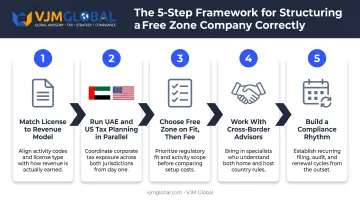
Businesses that extract the most value review the structure every year so license, tax, and disclosure obligations stay aligned as operations grow.
Conclusion
For a US business, the real value of a UAE free zone company is ownership control, a lower effective tax burden when structured correctly, and faster access to markets across the Middle East, Africa, and South Asia. The "0% tax" headline is only one piece of that picture.
Those advantages only compound when paired with disciplined US-side compliance and a free zone match that fits the actual business model, not just the lowest quote. Skip that groundwork, and the same structure that was supposed to save time and money turns into a banking delay or a compliance letter from the IRS.
A UAE free zone setup works best as an ongoing structure with advisors who understand both US and UAE rules, rather than a DIY transaction closed and forgotten. VJM Global helps US businesses with entity formation and cross-border tax compliance so that structure keeps working after day one.
Frequently Asked Questions
How much does it cost to set up a free zone company in the UAE for US businesses?
First-year costs typically include the licence fee, office or flexi-desk space, and any visas needed. Ranges vary widely by free zone and package tier—request a quote for your chosen zone and licence type.
What are the benefits of forming a free zone company in the UAE for US businesses?
Core benefits include full ownership control, a lower effective tax rate on qualifying income, and faster access to Middle East, African, and South Asian markets. Setup is largely remote, and profits can be repatriated without restriction.
Can free zone companies formed by US businesses do business in Dubai (mainland)?
Generally, free zone companies are limited to operations within the free zone and internationally. To sell directly to mainland customers, businesses typically need a local distributor, a mainland branch, or additional approvals.
Do US owners of a UAE free zone company still need to pay US taxes?
Yes. US citizens and US-owned entities must still report worldwide income, including GILTI calculations, FBAR filings, and Form 5471 for foreign corporation ownership, regardless of how tax-efficient the UAE side is.
Can a US citizen own 100% of a UAE free zone company?
Yes. Free zones have always permitted full foreign ownership with no local UAE sponsor required, unlike older mainland ownership rules.
How long does it take for a US business to set up a UAE free zone company?
Licence-only registration can move quickly, often within about ten working days once documents are complete. Setups that include visa processing and bank account opening usually take longer, since banking approval isn't guaranteed on the same timeline.