This guide covers the essentials: what Companies House is, its core responsibilities, who must register, what the public register contains, and what compliance obligations registered companies face. It also covers the key distinctions from HMRC — a source of genuine confusion for many directors.
Key Takeaways
- Companies House is the UK government's executive agency responsible for registering, maintaining, and dissolving UK companies
- Must register: limited companies, LLPs, limited partnerships, and certain overseas entities — sole traders and general partnerships are exempt
- The public register is freely accessible, covering director details, annual accounts, and filing history
- Registered companies must file annual accounts and a confirmation statement each year; penalties apply for late filing
- Under the Economic Crime and Corporate Transparency Act 2023, Companies House became a more active regulator — mandatory identity verification for directors and PSCs took effect in November 2025
What Is Companies House?
Companies House is the UK government's executive agency and official Registrar of Companies, operating under the Department for Business and Trade. Its role is not to regulate commercial activities or collect taxes — it formally records the existence and details of incorporated entities and ensures they meet statutory filing requirements.
The agency traces its origins to the Joint Stock Companies Act 1844, which established a centralised register and first enabled company incorporation, before formally becoming an executive agency on 3 October 1988. According to GOV.UK statistics, the total UK register stood at over 5.4 million companies at financial year-end 2025.
Companies House operates from three offices corresponding to the UK's legal jurisdictions:
- Cardiff — England and Wales
- Edinburgh — Scotland
- Belfast — Northern Ireland
Each office maintains its own registrar responsible for companies incorporated in that jurisdiction.
Core Functions and Responsibilities
Incorporation
When a new company applies to register, Companies House reviews the application and, once approved, issues a Certificate of Incorporation confirming the company legally exists. This certificate shows the company's unique Company Registration Number (CRN) and date of formation — both are used in all official correspondence and filings thereafter. Most online applications are processed within 24 hours.
Maintaining the Public Register
Companies House collects and stores statutory documents and makes them freely available through the Find and Update Company Information service. Anyone — investors, creditors, competitors, or members of the public — can look up any registered company at no cost.
The register is used across a wide range of contexts:
- Due diligence — verifying a company's legal status before entering contracts
- Credit checks — assessing financial filings before extending credit
- Competitive research — reviewing filing history, officer appointments, and ownership structures
- Compliance monitoring — tracking your own company's filing activity
The service also includes a Follow a Company feature, which sends free email alerts whenever a company makes new filings.
Company Dissolution
Companies House is responsible for striking companies off the register — either voluntarily at the directors' request or compulsorily when a company persistently fails to meet its filing obligations. Dissolution is not a technicality: once struck off, the company ceases to legally exist and any remaining assets are forfeited to the Crown.
Expanded Powers Under the ECCTA 2023
The functions above — incorporation, record-keeping, dissolution — have historically been administrative. The Economic Crime and Corporate Transparency Act 2023 gave Companies House active enforcement powers it previously lacked. From 4 March 2024, it can:
- Query information it believes is inaccurate
- Reject suspicious or incomplete filings
- Remove inaccurate information from the register
- Share data with law enforcement agencies
Mandatory identity verification for all directors, PSCs, and equivalent roles came into effect from 18 November 2025. For businesses, this means filings are now subject to scrutiny — not just storage. Inaccurate or incomplete information carries a real risk of rejection or investigation.
Who Must Register with Companies House?
Business Structures That Must Register
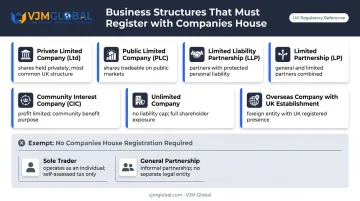
All incorporated entities — those creating a separate legal person — must register. This includes:
- Private limited companies (Ltd)
- Public limited companies (PLC)
- Limited liability partnerships (LLP)
- Limited partnerships (LP)
- Community interest companies (CIC)
- Unlimited companies
- Overseas companies with a UK establishment
Business Structures That Do Not Need to Register
Sole traders and general partnerships are not incorporated and have no legal existence separate from their owners. They do not register with Companies House. Their sole obligation is registering with HMRC for Self Assessment and tax purposes.
Once you know your structure falls under the registration requirement, the process itself is straightforward.
How to Register
Companies can register directly through the GOV.UK online portal or via a formation agent. The current digital incorporation fee is £100 (as of 1 February 2026). Most online applications complete within 24 hours.
What Information Does the Public Register Contain?
The public register is a central, freely accessible database containing legal and structural information on every UK-registered company. While anyone can access it at no cost, Companies House historically accepted filings without verifying accuracy — the ECCTA 2023 introduced new scrutiny powers to address this.
Core Company Details
Every company profile includes:
- Registered company name and unique CRN
- Company type (e.g., private limited by shares)
- Date of incorporation
- Registered office address
- SIC code indicating business activity
- Current status (active, dissolved, etc.)
People-Related Information
The register holds details on current and past officers and Persons with Significant Control (PSCs):
- Names and service addresses of directors and company secretaries
- PSC nationality, country of residence, and nature of control (e.g., percentage of shares held)
- Date of birth — month and year only; the full date is protected from public view
PSC disclosure was introduced in April 2016 specifically to increase transparency about ultimate beneficial ownership — identifying the real individuals who own or control companies.
Financial Filings
Annual accounts are filed each year and become part of the permanent public record. The level of detail varies by company size:
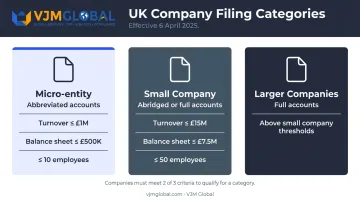
| Company Type | Filing Option | Thresholds (from 6 April 2025) |
|---|---|---|
| Micro-entity | Abbreviated accounts | Turnover ≤ £1M, balance sheet ≤ £500K, ≤ 10 employees (meet 2 of 3) |
| Small company | Abridged or full accounts | Turnover ≤ £15M, balance sheet ≤ £7.5M, ≤ 50 employees (meet 2 of 3) |
| Larger companies | Full accounts | Above small company thresholds |
The full filing history — articles of association, confirmation statements, director appointment forms, all past accounts — is viewable and downloadable as PDFs.
What the Register Does NOT Include
The register provides a legal snapshot, not a commercial health check. It does not contain:
- Operational performance data
- Credit scores
- Real-time financial health indicators
A company can be fully compliant with Companies House while trading unprofitably or carrying significant undisclosed risk.
Annual Filing and Compliance Obligations
Confirmation Statement
Every registered company must file a confirmation statement at least once every 12 months, confirming that the information Companies House holds is accurate. The current online fee is £50 (paper filing: £110). This is not the same as annual accounts — it must be filed even if nothing has changed.
Annual Accounts
Private companies have 9 months after their financial year-end to file accounts with Companies House (public companies have 6 months). Note that accounts must also be submitted to HMRC as part of the corporation tax return — these are separate obligations to two different bodies.
Event-Driven Filings
Certain changes must be reported promptly, not held until the next annual filing:
- Director appointment or resignation (form AP01) — notify within 14 days
- Registered office change (form AD01) — notify within 14 days
- PSC changes — update internal register within 14 days, then notify Companies House within a further 14 days (28 days total)
- Share capital changes — as they occur
Late Filing Penalties
Late filing penalties are automatic for annual accounts. Private company rates:
| How Late | Penalty |
|---|---|
| Up to 1 month | £150 |
| 1–3 months | £375 |
| 3–6 months | £750 |
| Over 6 months | £1,500 |
Note: these penalties double if accounts are filed late in two successive financial years. Public company penalties are significantly higher — up to £7,500 for accounts over six months late.
From October 2024, Companies House can also issue financial penalties for other breaches, including failure to file a confirmation statement. Persistent non-compliance can trigger strike-off proceedings.
For UK businesses that also operate in India, managing Companies House filings alongside Indian regulatory requirements (GST, MCA, FEMA) is a genuine operational challenge. VJM Global has worked with 250+ UK businesses in this position, helping them stay compliant across both jurisdictions without missing deadlines on either side.
Companies House vs HMRC: Key Differences
These two bodies are entirely separate, and conflating them is a common source of compliance errors.
| Category | Companies House | HMRC |
|---|---|---|
| Responsible for | Legal existence, structure, statutory filings | All tax obligations |
| Deals with | Annual accounts, confirmation statements, director changes | Corporation Tax, VAT, PAYE, Self Assessment |
| Applies to | All incorporated entities | All businesses and individuals with tax obligations |
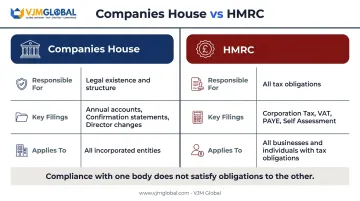
When a private limited company registers at Companies House, the registration usually triggers an automatic notification to HMRC. The company then receives a Unique Taxpayer Reference (UTR) at its registered office. However, it must still separately register for Corporation Tax and any other applicable taxes. Being compliant with Companies House does not mean being compliant with HMRC.
Who deals with which body:
- Sole traders and general partnerships — HMRC only (no Companies House registration)
- Limited companies and LLPs — both bodies, independently
Frequently Asked Questions
Is Companies House free to use?
Searching the public register and accessing company information is entirely free. Fees apply for specific transactions — for example, the confirmation statement costs £50 online, and certified document copies start at £22.
Do sole traders need to register with Companies House?
No. Sole traders are not incorporated and have no legal existence separate from their owner. Their only registration obligation is with HMRC for Self Assessment. Companies House is not involved.
What is the difference between Companies House and HMRC?
Companies House handles a company's legal registration, structure, and statutory filings. HMRC handles all tax obligations — Corporation Tax, VAT, PAYE, and more. A company must stay compliant with both bodies independently; good standing with one has no bearing on the other.
What happens if I miss a Companies House filing deadline?
Late annual accounts trigger automatic financial penalties — starting at £150 for private companies (up to one month late) and rising to £1,500 for filings over six months late, doubling if accounts are late two years running. Persistent non-compliance can result in strike-off and dissolution.
Can a non-UK resident register a company at Companies House?
Yes. There is no requirement for directors to be UK residents. The company must have a UK registered office address in the same jurisdiction where it is incorporated — for example, a Scottish-registered company must have a Scottish registered office address.
What new powers does Companies House have under the ECCTA 2023?
The ECCTA 2023 significantly expanded Companies House's role — it can now query and reject suspicious filings, remove inaccurate information, and share data with law enforcement. Mandatory identity verification for directors and PSCs came into force on 18 November 2025, with broader financial penalties now also available for compliance breaches.