But copying your US playbook won't work here. Many US companies struggle with Korea's layered regulatory approvals, hierarchical negotiation style, and platform ecosystem that looks nothing like Google or Facebook.
This guide walks through entry strategies, legal structures, compliance essentials, and the cultural nuances that determine whether your launch succeeds or stalls.
Key Takeaways
- KORUS, advanced infrastructure, and a digital-first consumer base give US firms a clear path into South Korea
- Entry mode—subsidiary, branch, liaison office, JV, or EOR—sets your liability, tax exposure, and permitted activities
- Compliance requirements vary sharply by sector, so early planning avoids costly delays
- Local partners and specialist support cut setup time and reduce early compliance missteps
Why South Korea Is a Strategic Market for US Businesses
South Korea's economy runs on exports, and manufacturing alone makes up 24.3% of GDP and 90% of exports, per the US Commerce Department's country guide. Semiconductors led 2024 exports at $141.9 billion, or 20.8% of the total, with pharmaceuticals also climbing fast. For US firms in tech, components, or biotech, this is a market built for B2B partnerships.
Investment interest backs this up. Korea recorded $36.1 billion in notified FDI in 2025, up 4.3% year over year, with $18.0 billion actually arriving — a 16.3% jump. US-origin notifications alone hit $9.8 billion, up 86.6%, according to the Ministry of Trade, Industry and Energy.
KORUS: A Real Advantage for US Firms
The Korea-US Free Trade Agreement, in force since 2012, eliminated duties on nearly 95% of bilateral consumer and industrial trade within three years. It also opened up:
- Broader access to Korean government procurement contracts
- Investor protections including due process and arbitration rights
- Services market access across nearly all major sectors
- Advance notice and comment periods on new Korean regulations
Tariff treatment still depends on your product's HS classification, so don't assume automatic duty-free status without checking.
Workforce and Incentives
Korea's workforce is highly educated and digitally connected, which matters if you sell products or services that need fast adoption or technical depth.
Invest Korea's 2025 package and Free Economic Zones can lower entry costs for qualifying projects:
- Cash-grant support up to 75% for eligible investments
- Tax exemptions on imported capital goods for up to seven years
- Extra tariff and property-tax benefits inside Free Economic Zones
Eligibility still depends on your industry and investment ratio, so confirm incentives against your planned structure before you rely on them.
Choosing Your Market Entry Strategy
Common Entry Modes for US Companies
Your first decision: how much commitment and control do you want on day one?
- Local corporation (subsidiary): A separate Korean legal entity. Best for companies planning sustained revenue, local hiring, or incentive eligibility.
- Branch office: Legally the same entity as your US parent, allowed to earn revenue, but exposes the parent to Korean liabilities directly.
- Liaison office: No incorporation, no revenue, no sales. Useful only for market research and relationship-building.
- Joint venture: Pairs your capability with a local partner's market access. Governance and IP protections need to be locked into the JV agreement.
- Employer of Record (EOR): Lets you hire Korean staff and test the market without incorporating at all.
Uber's Korea history is instructive here. After shutting down private ride-hailing in 2015 amid regulatory pushback, the company came back in 2020 through a 51%-owned joint venture with SK Telecom, backed by over $150 million in investment.
By mid-2024, Uber had grown to roughly 20% driver penetration despite Kakao's dominant taxi-app position, per Reuters. The lesson: partnership often beats going it alone against entrenched local players.
Selecting the Right Structure Based on Business Goals
| Structure | Liability | Tax Treatment | Best Fit |
|---|---|---|---|
| Subsidiary | Limited, separate entity | Worldwide income taxed as resident corp | Manufacturing, consumer brands, long-term revenue |
| Branch | Unlimited, tied to US parent | Korean-source profits taxed; branch-profits tax may apply | Direct parent-controlled operations |
| Liaison office | None (no commercial activity) | No profit activity, no tax filing | Research-stage validation |
| JV | Shared, per agreement | Depends on chosen vehicle | Local market access, shared capability |
| EOR | None (EOR is legal employer) | Standard payroll withholding | Testing demand before committing capital |
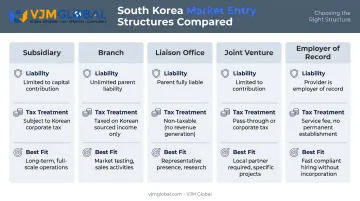
A SaaS company testing product-market fit should lean toward EOR or a liaison office first. A manufacturer needing Korean incentives and long-term hiring will likely need a subsidiary from the start.
Legal, Regulatory and Compliance Essentials
Korea's incorporation process follows a defined sequence: foreign-investment notification, capital remittance, court registration, tax registration, capital transfer, and foreign-invested-company registration. Court processing typically takes 2-3 days after a complete filing, and tax registration takes about 5 days, per KOTRA's establishment guide. These are component timelines, not a guaranteed total. Banking setup, document legalization, and sector approvals add weeks on top.
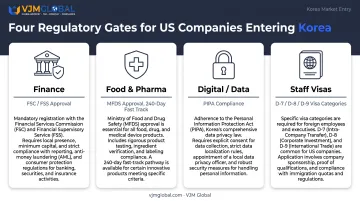
Sector-specific gates you can't skip:
- Finance — FSC/FSS authorization required before marketing or contracting financial products
- Food, pharma, medical devices — MFDS approval, with a newer expedited 240-day track for qualifying innovative products
- Digital/data — PIPA can apply even to overseas companies serving Korean users, not just locally incorporated ones
- Staff visas — D-7 (intra-company transferee), D-8 (foreign investor), and D-9 (international trade) cover most relocating US managers
Beyond sector licenses, trade and IP rules shape how US brands operate once established. Korea has been a WTO member since 1995, and IP protections under TRIPS, strengthened further by KORUS provisions on nontraditional marks and online copyright, give US brands reasonable footing. Still, IP enforcement and regulatory approval both move faster with local guidance.
Coordinating entity formation, tax registration, and sector approvals in parallel, rather than sequentially, is the single biggest lever for cutting entry timelines. VJM Global supports that coordinated approach by applying each target market's own regulators and statutory instruments to entity formation and compliance work.
Cultural and Consumer Considerations for US Businesses
Korean business culture runs on hierarchy and relationships. US Commerce Department guidance stresses formal titles, two-handed business card exchanges, and relationship-led introductions. Cold outreach is considered inappropriate.
Contracts are often treated as frameworks open to adjustment rather than fixed terms, so expect negotiation timelines longer than you'd budget for domestically.
Digital habits differ from US norms:
- Naver holds roughly 40.9% of search market share, second only to Google's 49.54%
- KakaoTalk reaches nearly 48.9 million Korean users, about 97% of the country's internet users
- Coupang dominates e-commerce, reporting 24.7 million active product-commerce customers in Q2 2026
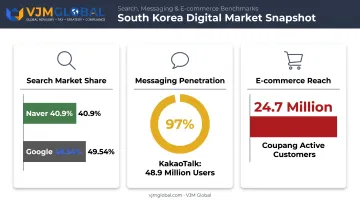
A marketing plan built around Google Ads and Facebook won't reach most Korean consumers. Localization means rebuilding your digital strategy around Naver and Kakao, not translating your US campaign into Korean.
Common Challenges and How to Mitigate Them
US companies entering Korea run into structural and operational friction. Plan for these three early.
- Entrenched conglomerates: Korean chaebols dominate many sectors. Differentiate on specialization or technology rather than price.
- Language barriers: Contracts, filings, and negotiations run in Korean. A KOTRA survey found only 26.7% of foreign executives satisfied with Korea's business environment, citing language and admin friction (Korea Herald).
- Slow, multi-level approvals: USTR's 2025 trade barrier report flagged redundant review across five agencies in agricultural-biotech alone. Build buffer time into any regulated-sector launch plan.
Bilingual local advisors often cut approval timelines from fourteen months to six.
How VJM Global Supports US Businesses Entering South Korea
VJM Global delivers entity formation, tax compliance, payroll, and ongoing compliance coordination across 16+ markets, each under that country's own regulatory framework rather than a single template. Employer of Record hiring extends to 100+ countries when you need staff before you incorporate.
For a US company evaluating South Korea, support typically covers:
- Entity structuring — Comparing subsidiary, branch, liaison office, and JV options against your goals and risk tolerance
- Cross-border tax coordination — Aligning US reporting obligations with your Korean tax footprint
- Employer of Record access — Hiring in Korea without immediate incorporation, through an EOR capability spanning 100+ countries
With 30+ years of experience and a client base built on serving American business owners expanding abroad, VJM Global sequences the work in a fixed order: purpose first, regulatory feasibility second, structure third. That order matters more than which acronym-heavy entity you pick on day one.
Frequently Asked Questions
What are the four market entry strategies?
The four common modes are exporting, licensing or franchising, joint ventures, and direct investment through a wholly owned subsidiary. Each carries different levels of commitment, control, and compliance obligation.
What is the most effective way to invest in South Korea?
Direct investment through Invest Korea programs or Free Economic Zones, paired with a local partner, often combines the strongest incentives with market access. The right fit still depends on your sector and risk appetite.
How long does it take to enter the South Korean market?
Timelines vary from a few months for a liaison office to over a year for regulated sectors requiring FSC or MFDS approval. Court and tax registration components move quickly; sector approvals and banking setup add most of the delay.
Do US companies need a local partner to enter South Korea?
No. A local partner is optional, but it significantly reduces risk and speeds up market understanding. Given Korea's relationship-driven business culture, partners often open doors that cold outreach cannot.
What licenses do foreign companies need to operate in South Korea?
Licensing depends entirely on your sector. Financial services need FSC authorization; food and pharma need MFDS approval. Any business handling Korean user data may fall under PIPA, regardless of where it is incorporated.
Can a US company hire employees in South Korea without setting up an entity?
Yes, through an Employer of Record arrangement, where a provider is the legal employer on your behalf. You can test the market and build a local team before full incorporation.