According to NAPEO, small business owners spend approximately 25% of their time on employment-related paperwork. That's one full day out of every four — not spent on customers, products, or growth.
A Professional Employer Organization (PEO) exists to fix exactly that. By entering a co-employment arrangement with your business, a PEO takes on the administrative weight of HR while you retain full operational control. This article covers what a PEO actually does, the core services it provides, who benefits most, how it compares to similar models, and what to look for when choosing one.
Key Takeaways
- A PEO co-employs your workforce, processing payroll, managing HR compliance, and filing taxes under its own EIN
- PEO clients grow 2.3x faster and are 50% less likely to go out of business than non-PEO businesses
- Most PEO clients have between 10 and 150 employees — the sweet spot for co-employment ROI
- PEOs, ASOs, EORs, and HROs serve different needs — the key difference is who holds legal employer status
- Pricing typically runs $40–$160 per employee per month or 2%–12% of total payroll
What Is a PEO? Understanding the Co-Employment Model
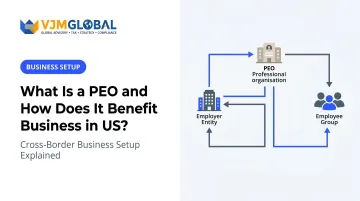
A Professional Employer Organization (PEO) is a third-party firm that enters a co-employment relationship with your business. In this arrangement, the PEO becomes the employer of record for tax and administrative purposes — processing payroll, withholding employment taxes, and issuing W-2s under its own Employer Identification Number (EIN).
Your company retains complete control over hiring decisions, daily operations, job assignments, and business strategy. Think of it as a division of labor, not a transfer of control.
How Co-Employment Works in Practice
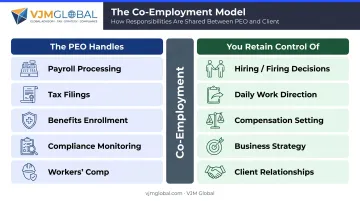
When you sign a PEO agreement, your employees technically become co-employed by both your company and the PEO. In practical terms:
- The PEO handles payroll processing, tax filings, benefits enrollment, compliance monitoring, and workers' comp
- You direct all work, set compensation, make hiring and firing decisions, and run the business
The IRS recognizes this arrangement formally through its Certified Professional Employer Organization (CPEO) designation under IRC Section 7705(a). A CPEO is treated as the sole employer for federal employment tax purposes on remuneration it pays — which simplifies tax liability and protects clients from double-payment risks.
What a PEO Does NOT Do
Many business owners worry that a PEO takes over their company. It doesn't. A PEO has no authority over:
- Employee pay rates or compensation decisions
- Business strategy or operational direction
- Day-to-day job duties or task assignments
- Sales, marketing, or client relationships
If you've heard otherwise, that's a misconception worth clearing up before evaluating any provider.
Why Accreditation Matters
Two credentials signal a PEO's legitimacy:
- IRS CPEO Certification — confirms the PEO meets federal tax compliance standards and carries a required surety bond (minimum $50,000, maximum $1,000,000 under IRC Section 3511)
- ESAC Accreditation — confirms financial stability, ethical business conduct, and regulatory compliance, including audited financials and a $15M aggregate excess surety bond under its Client Assurance Program
Always verify these before signing a contract.
The Scale of the Industry
According to NAPEO, there are 500+ PEOs operating in the US, serving 230,000+ client businesses, supporting 4.5 million+ jobs, and generating $414 billion in industry revenue. This is a mature, regulated industry with decades of established infrastructure behind it.
Core Services a PEO Provides to US Businesses
PEOs don't just handle one thing. The value comes from their integrated, all-in-one approach to HR administration.
Payroll Processing and Tax Administration
The PEO pays your employees and handles all employment tax obligations using its own EIN. This includes:
- Federal and state payroll tax withholding and remittance
- Multi-state payroll filings for businesses operating across jurisdictions
- Quarterly and year-end tax reporting (Form 941, W-2 issuance)
- IRS compliance management
For businesses with employees in multiple states — each with its own tax codes, wage laws, and filing requirements — this alone justifies the cost of PEO engagement.
Employee Benefits Administration
PEOs pool employees across their entire client base, which gives them the purchasing power to negotiate Fortune 500-level benefits that most small businesses couldn't access independently. These typically include:
- Medical, dental, and vision insurance
- Life insurance and disability coverage
- 401(k) retirement plans
- Employee assistance programs, adoption assistance, and educational benefits
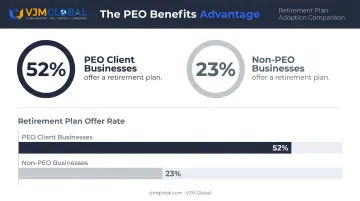
According to NAPEO, 52% of PEO client businesses with 10–49 employees offer a retirement plan, compared to just 23% of comparable non-PEO businesses — a gap that reflects the direct purchasing advantage PEOs provide.
HR Compliance and Risk Management
US employment law spans federal regulations, 50 state frameworks, and countless local ordinances. Key areas include OSHA, FMLA, ACA, anti-discrimination laws, wage and hour rules, and unemployment insurance. SHRM's Multistate Laws Comparison Tool covers 400+ HR topics across all 50 states — a useful measure of how broad that compliance surface area actually is.
PEOs employ dedicated compliance specialists who monitor legislative changes and update policies proactively. OSHA violations alone can cost up to $165,514 per willful or repeated infraction (as of 2026). For a small business without in-house legal or HR expertise, one missed update can trigger that exposure.
Workers' Compensation Insurance
Many PEOs include workers' compensation coverage under their umbrella, with pay-as-you-go options that align premiums to actual payroll figures rather than estimates. For small businesses, sourcing this independently is often expensive and administratively burdensome. The PEO handles claims processing as well — which means administrative HR support extends well beyond payroll and compliance.
HR Support and Onboarding
Beyond compliance and payroll, PEOs typically provide:
- Employee handbook creation and updates
- Structured onboarding workflows
- Performance management frameworks
- HR technology platforms with employee self-service portals
- In some cases, recruitment support
Key Benefits of Partnering with a PEO
Cost Savings Through Group Purchasing Power
Small businesses simply lack the headcount to negotiate competitive insurance rates. By joining a PEO's pooled employee group, they gain access to benefits packages that would otherwise require hundreds or thousands of employees to negotiate. NAPEO's ROI research estimates annual ROI of 27.2% for PEO clients based on cost savings alone.
Time Savings and Operational Focus
One-third of companies spend at least 11 hours per week on HR administration, according to Focus HR's 2025 Business Leader Priorities survey. For a business owner or small leadership team, that's time not spent on customers or revenue. Outsourcing these tasks to a PEO returns that capacity directly to growth-focused work.
Reduced Compliance Risk
With 88,201 new discrimination charges filed with the EEOC in FY2025 and OSHA penalties reaching six figures per violation, employment compliance isn't optional. PEOs have compliance teams specifically built to track regulatory changes across all relevant jurisdictions.
For US businesses with operations in India, that complexity multiplies. Cross-border compliance spans FEMA regulations, DTAA (Double Taxation Avoidance Agreement) structuring, and expatriate payroll — areas where firms like VJM Global specialize alongside your domestic PEO arrangement.
Improved Employee Retention
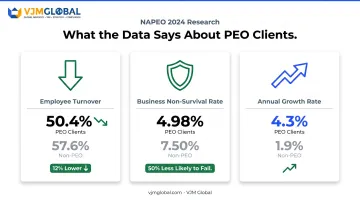
NAPEO's 2024 whitepaper found that PEO clients had a 50.4% employee turnover rate, compared to 57.6% for non-PEO businesses — a 12% lower turnover rate. That gap traces back to better benefits, reliable payroll, and HR processes that give employees confidence in their employer.
Business Resilience and Survival Rates
Lower turnover also signals something deeper: businesses using PEOs simply hold together better. The same 2024 NAPEO study found that PEO clients had a one-year non-survival rate of 4.98%, versus 7.50% for non-clients — which NAPEO summarizes as PEO clients being 50% less likely to go out of business. PEO clients also grew at 4.3% annually, compared to 1.9% for comparable non-PEO businesses.
Who Should Use a PEO?
The Primary Fit: 10–150 Employees
NAPEO reports that most businesses using a PEO have 10 to 150 employees — and nearly two-thirds of PEO clients have between 10 and 49 employees. Currently, 14% of US employers with 20 to 499 employees use a PEO.
This segment gains the most from co-employment: they're large enough to have meaningful HR needs but too small to support a full in-house HR function. The economics of group benefits purchasing also deliver the strongest ROI at this size.
Multi-State Operations
Businesses with employees in multiple states face a disproportionate compliance burden. Each jurisdiction carries its own rules around:
- Minimum wage rates and overtime thresholds
- Paid leave requirements and family leave statutes
- State income tax filings and unemployment insurance
- Employment termination and at-will exceptions
A PEO manages all of this from a single platform. Without one, most multi-state businesses must either hire specialized legal counsel per state or build significant internal HR capacity.
When a PEO Is NOT the Right Fit
PEOs aren't ideal for every business:
- Work exclusively with 1099 contractors — PEOs are built for W-2 employees and don't cover contractor relationships
- Need full internal control over every HR process and policy — the standardized platform may feel too rigid
- Have fewer than 5 employees — the per-employee cost rarely justifies the investment at that headcount
PEO vs. ASO, EOR, and HRO: What's the Difference?
These four models are frequently confused. Here's a quick breakdown:
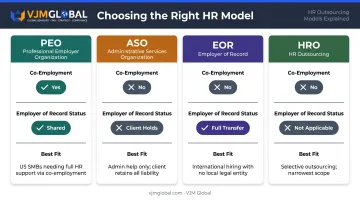
| Model | Co-Employment? | Who's Employer of Record? | Best For |
|---|---|---|---|
| PEO | Yes | Shared (PEO + client) | US SMBs wanting full HR support |
| ASO | No | Client retains sole responsibility | Businesses wanting admin help only |
| EOR | No (full transfer) | EOR is sole employer | Hiring in countries with no legal entity |
| HRO | No | Client | Outsourcing specific HR functions only |
PEO vs. ASO
An Administrative Services Organization (ASO) handles specific HR tasks — payroll processing, benefits admin — but the client remains the sole employer of record and retains all legal liability. There's no shared risk. An ASO delivers administrative relief; a PEO delivers both administrative support and shared compliance responsibility.
PEO vs. EOR
An Employer of Record assumes full legal employment responsibility for the workforce. This model is designed for companies hiring in countries where they have no registered legal entity — not for domestic US operations. For US businesses expanding internationally, an EOR handles foreign workforce compliance while a domestic PEO manages US-based employment: they're built for different problems.
PEO vs. HRO
HRO covers HR outsourcing in its broadest form — you might outsource payroll only, or benefits administration only. There's no co-employment relationship, and the coverage is narrower in scope than a PEO. If you need end-to-end HR support rather than piecemeal outsourcing, a PEO is the more complete solution.
How to Choose the Right PEO for Your Business
Not every PEO is created equal — and the wrong choice can create more compliance headaches than it solves. Use this three-step framework to evaluate your options.
Step 1: Verify Accreditations First
Before evaluating services or price, confirm two things:
- IRS CPEO Certification — means the PEO has met federal tax compliance standards and posted the required surety bond. If your PEO isn't a CPEO, you may face joint tax liability for employment taxes the PEO fails to remit.
- ESAC Accreditation — means the PEO's financials are audited annually and it operates under established ethical and compliance standards.
Both credentials together provide the strongest signal of a trustworthy provider.
Once you've confirmed credentials, dig into what the platform actually does — and whether it fits your operations.
Step 2: Evaluate Service Scope and Technology
Not all PEOs offer the same depth of service. Key questions to raise:
- Does the platform handle multi-state payroll filings?
- What HR technology is included, and does it offer employee self-service?
- Does it integrate with your existing accounting software (QuickBooks, Xero, NetSuite)?
- How thorough is the compliance monitoring for your specific states and industries?
Service scope shapes value — but pricing determines whether that value makes sense for your budget.
Step 3: Understand Pricing and Hidden Costs
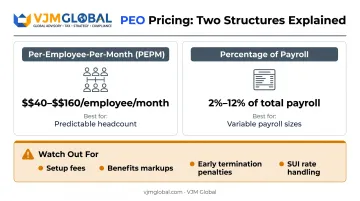
Two pricing structures are standard:
- Per-employee-per-month (PEPM) flat fee: Typically $40–$160 per employee per month, according to ADP's pricing guide. Forbes Advisor cites a $50–$150 range for most providers.
- Percentage of payroll: Generally 2%–12% of total payroll
Before signing, ask directly about:
- Setup and onboarding fees
- Benefits administration markups
- Early termination penalties
- How State Unemployment Insurance (SUI) rates are handled — some PEOs manage SUI under their own rate, which can work for or against you depending on your industry's claims history
Get an itemized quote and a sample invoice before committing.
Frequently Asked Questions
What is a PEO in the USA?
A PEO (Professional Employer Organization) is a co-employment service that handles HR, payroll, and compliance for US businesses. Over 500 PEOs currently operate in the US, serving 230,000+ client businesses and more than 4.5 million worksite employees.
What services are offered by global PEO services?
Global PEO services typically cover international payroll processing, multi-country compliance, employee benefits administration, and onboarding support. In countries where a PEO co-employment structure isn't legally recognized, providers often use an Employer of Record (EOR) model instead.
What is an example of a PEO?
Well-known US PEOs include:
- ADP TotalSource — CPEO-certified, focused on small and mid-sized businesses
- Paychex PEO — serves a broad range of business sizes
- Justworks — popular with small businesses
- TriNet — industry-specific solutions for SMBs
- Insperity — segmented service tiers for small to large businesses
What is the difference between a PEO and an EOR?
A PEO enters a co-employment relationship where both the PEO and the client share HR responsibilities — best suited for US-based W-2 employees. An EOR assumes full legal employer responsibility and is used when a company wants to hire workers in a country where it has no registered legal entity.
How much does a PEO typically cost for a small business?
PEO pricing generally ranges from $40–$160 per employee per month (flat fee) or 2%–12% of total payroll (percentage model). The right structure depends on your headcount, payroll size, and which services you need.
Can a PEO replace an in-house HR team?
PEOs complement rather than replace in-house HR staff. They handle administrative and compliance-heavy tasks, freeing your internal team to focus on culture, engagement, and strategic work that requires deep organizational knowledge.