Introduction
More UK entrepreneurs are looking past Delaware and California, and landing on Michigan. Why? Low-cost entity formation, a manufacturing and tech resurgence across Detroit, Ann Arbor and Grand Rapids, and a cost of living well below the coasts.
Most are UK e-commerce sellers, consultants, manufacturing suppliers and small tech teams—not venture-backed founders chasing Silicon Valley prestige. They want real US market access without coastal overhead.
This guide walks through entity choice, registration, tax and banking specifically for UK founders entering Michigan, step by step.
TL;DR
- Michigan LLC/corporation formation starts around $50, among the cheapest in the US
- UK citizens can register and own a Michigan business remotely with no visa or US residency required
- Registering a company does not grant work authorization; that's a separate immigration matter
- Plan beyond formation for EIN setup, a registered agent, and multi-state tax compliance
What Does Starting a Business in Michigan Involve for a UK Founder?
It means forming a legal US entity—either an LLC or corporation—registered with the Michigan Department of Licensing and Regulatory Affairs (LARA). A UK resident can own and operate this entity entirely from home.
Michigan isn't a "no-tax" haven the way Wyoming or Delaware are marketed. It suits founders who want:
- Genuine Midwest market access
- Manufacturing and supply-chain links
- Lower operating costs than New York, California or even Delaware
Two common setups:
- A remote-owned Michigan LLC for consulting or e-commerce, with no physical footprint
- A Michigan entity with local presence (inventory, staff, office) for manufacturing or retail businesses
The distinction matters because it changes your licensing, insurance and tax obligations from day one.
What UK Entrepreneurs Should Know Before Registering in Michigan
Most UK founders conflate two very different things: registering a company and being allowed to work in the US. They're unrelated. Forming a Michigan LLC gives you a legal entity. It gives you zero permission to live or work on US soil.
Plan around the points below before you file anything.
Key things to plan around
- Michigan requires a resident agent with a physical Michigan address. A UK founder cannot fill this role remotely, so you'll need a professional agent service from day one.
- Formation itself typically takes about two weeks online. Getting an EIN, opening a bank account, and registering for state tax add more time.
- A Michigan entity does not change your UK tax residency. UK-US double tax treaty rules still apply, and HMRC treats company residence as where management and control actually happen, not where you filed paperwork.
- Physical footprint drives complexity. Inventory, staff, or leased space in Michigan means heavier licensing and insurance than a remote consultancy.
Why Michigan Might Make Sense for a UK Business (and When It Doesn't)
Use this as a fit check before you commit—not a blanket recommendation.
Where Michigan wins
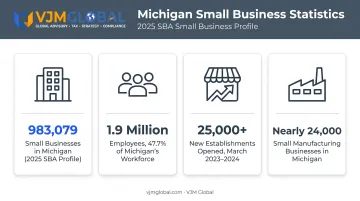
Michigan's small business sector is active. The SBA counted 983,079 small businesses in its 2025 profile, employing 1.9 million people—about 47.7% of the state workforce. From March 2023 to March 2024, over 25,000 new establishments opened.
Other advantages:
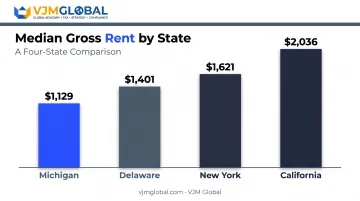
- Lower cost of living: Median gross rent is about $1,129 (Census Bureau)—roughly 44% below California's $2,036, and under New York ($1,621) and Delaware ($1,401).
- Manufacturing depth: Nearly 24,000 small manufacturing businesses, per SBA figures.
- Tech momentum in pockets: Grand Rapids added 1,300+ tech jobs in a year (4.4% growth, Crain's); Ann Arbor remains the state's VC hub.
- Midwest and Northeast proximity: Shorter logistics paths into major US population centres for UK exporters.
Where it doesn't
- No state income tax break: Unlike Wyoming or Nevada, Michigan levies a state corporate income tax. If tax minimisation is your only goal, Michigan will not deliver it.
- Less investor familiarity: VC-backed startups often still choose Delaware because investors expect it. If you plan to raise institutional capital, that expectation can outweigh cost.
How to Register a Business in Michigan from the UK – Step by Step
Here's the registration process broken into stages a UK founder can complete entirely remotely. Three mistakes come up repeatedly:
- Assuming registration grants a visa (it doesn't)
- Skipping proper research on registered agents
- Ignoring multi-state sales tax exposure once you start shipping to US customers
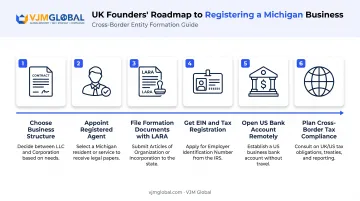
Step 1 – Choose Your Business Structure
For most solo or small UK founders, an LLC beats a corporation. It's simpler to run, has fewer formalities and offers pass-through taxation flexibility.
A corporation makes more sense if you're planning to raise institutional investment later, since investors are generally more comfortable with corporate share structures.
Naming rules matter here too:
- LLCs must include "LLC" or "Limited Liability Company" in the name
- Corporations need "Inc," "Corp," "Incorporated" or "Corporation"
- Names can't imply a purpose the entity doesn't actually have
Step 2 – Appoint a Michigan Registered Agent
Michigan law requires every entity to name a resident agent with a physical Michigan address, available during business hours to receive legal documents.
As a UK founder, you almost certainly can't meet this requirement yourself. You'll need a professional registered agent service based in Michigan. This isn't optional paperwork; without it, LARA won't accept your filing.
Step 3 – File Formation Documents with LARA
You'll file either:
- Articles of Organization (for an LLC), costing $50
- Articles of Incorporation (for a corporation), with a $60 minimum (a $10 filing fee plus at least $50 in authorized-share fees)
Standard processing generally runs about two weeks, though LARA also offers expedited paid options: 24-hour turnaround for $50, same-day for $100, and rush options up to $1,000 for one-hour processing.
Step 4 – Get an EIN and Set Up US Tax Registrations
Your Employer Identification Number (EIN) is free and comes directly from the IRS. As a non-resident without a Social Security Number, you'll enter "foreign" on the relevant form field and apply by phone, fax or mail rather than online.
Once formed, you'll also need to consider:
- Michigan Corporate Income Tax, charged at 6% for C corporations
- Sales and use tax registration, if you have nexus (a Michigan customer base, inventory or physical presence)
Step 5 – Open a US Business Bank Account Remotely
You'll typically need:
- Your EIN confirmation letter
- Formation documents (Articles of Organization/Incorporation)
- Government-issued ID
Traditional US banks often still expect an in-person visit. Fintech platforms such as Wise or Mercury have made this far easier, letting UK founders open US business accounts without ever boarding a flight.

Step 6 – Plan Cross-Border Tax and Compliance from Day One
The federal corporate tax rate is a flat 21%, applied regardless of which state you incorporate in, on top of Michigan's own obligations. Most UK founders get tripped up coordinating the Michigan entity with their UK tax residency and the UK-US treaty at the same time.
Treating formation, EIN and tax as one connected engagement, rather than three separate errands, pays off here. VJM Global, for example, runs entity formation, EIN registration and multi-jurisdiction tax planning as a single process for cross-border founders. That closes the common gap where a US entity is formed correctly but UK tax-residency and treaty implications only get addressed months later.
Conclusion
Starting a Michigan business as a UK founder is genuinely straightforward on paper. The registration itself takes two weeks and costs as little as $50. What takes real coordination is stacking the registered agent, EIN, banking and tax layers correctly, and doing it in the right order.
Michigan suits founders who prioritize cost and Midwest market access over Delaware's investor prestige. It won't suit you if you're chasing a zero-tax state or need instant VC familiarity.
Long-term success depends on getting cross-border tax and compliance right from day one, not patching gaps after the fact. VJM Global helps UK founders sequence Michigan formation, EIN, banking and ongoing US–UK tax filings so those layers stay aligned from the start.
Frequently Asked Questions
How much does it cost to start a business in Michigan?
LLC formation costs $50; corporations start at $60. Budget for a $25 annual report fee and a registered agent, plus licensing and insurance that vary by business type.
What is the best business to start in Michigan?
Manufacturing support, tech and software, consulting, and e-commerce all fit Michigan's economy well. The right choice depends on your target market and whether you're operating remotely or with local presence.
Can a UK citizen own a business in Michigan without a visa?
Yes. Remote ownership requires no visa at all. A visa only becomes necessary if you plan to physically live or work in the US.
Do I need to visit the US to register a Michigan LLC?
No. Formation, EIN applications, and bank account setup through fintech platforms can all be completed remotely from the UK.
Does Michigan require a general business license?
There's no single statewide license covering all businesses. Requirements depend on your industry and local municipality, so check LARA's license search and your local county office.
Will I need to pay UK tax on income from my Michigan business?
Possibly, depending on your UK tax residency status and how the UK-US double tax treaty applies to your situation. Get cross-border tax advice before you file in either country.