Introduction
You don't need a US address, a visa, or a local partner to own and run a US business. Many UK founders are surprised to learn that the entire formation process can be completed from the UK — and the market opportunity makes it worth understanding properly.
The numbers reflect this: at the end of 2024, UK outward foreign direct investment (FDI) in the US totalled £529.9 billion, with approximately 37,400 UK VAT-registered businesses exporting goods to the US. With 341.8 million consumers and shared legal language, the US remains the top destination for UK business expansion.
What many UK founders don't realize is that you don't need US citizenship or residency to own and operate a US business. A UK non-resident can form and run a US company entirely from the UK, provided you choose the right structure and follow the correct compliance steps.
This guide covers everything UK non-residents need to know: choosing the right business structure, completing registration, understanding visa requirements, and meeting US tax obligations.
Key Takeaways
- UK non-residents can legally register and own a US business (LLC or C-Corporation) without US citizenship or physical presence
- Delaware and Wyoming are the most popular states for foreign founders, offering low taxes, simple registration, and no local address requirement
- You'll need a registered agent with a US address, an EIN from the IRS, and a US business bank account
- Working on-site in the US requires a visa; UK nationals most commonly qualify for the E-2 Treaty Investor visa
- US tax applies at federal, state, and sometimes local levels, and the same income may also trigger UK tax reporting obligations
What UK Non-Residents Should Know Before Starting a US Business
UK nationals can legally form a US company without US residency or citizenship. The US imposes no nationality-based restriction on business ownership—only on the right to physically work within the country. This distinction matters because it separates two different questions: business formation and work authorization.
You can own a US entity and manage it remotely from the UK with no visa required. However, working on-site in the US—whether managing operations, meeting with clients, or running day-to-day activities—requires a valid work or investor visa.
Key Differences from UK Company Formation:
The US registration process differs significantly from forming a UK limited company:
- No equivalent to Companies House—registration happens at the state level, not federal
- No single national business register
- Each state has its own rules, fees, and compliance requirements
- States compete for incorporations by offering different tax structures and legal frameworks
Timeline Expectations:
Formation documents can be filed within days in states like Delaware or Wyoming. But the full setup — securing an EIN, opening a bank account, and establishing compliance structures — takes several additional weeks. Most UK founders underestimate this gap, particularly around banking access.
The typical timeline breaks down as:
- State registration: 1–3 business days
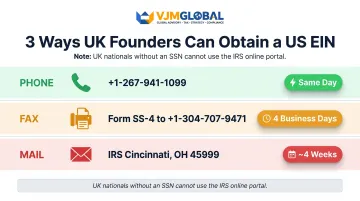
- EIN acquisition: Same day (phone), 4 business days (fax), or up to 4 weeks (mail)
- Bank account opening: 2–6 weeks, depending on provider and documentation
Choosing the Right US Business Structure as a UK Non-Resident
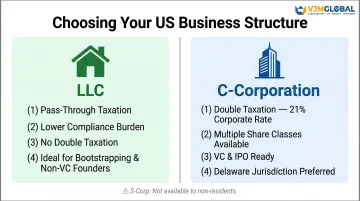
UK non-residents have two viable options when forming a US business: a Limited Liability Company (LLC) or a C-Corporation. S-Corporations are not available to non-resident foreign nationals, as IRC Section 1361(b)(1)(C) requires all shareholders to be US citizens or permanent residents.
Limited Liability Company (LLC)
The LLC is the most commonly chosen structure by UK founders due to:
- Simpler administration with fewer ongoing reporting requirements
- Lower compliance burden compared to corporations
- Pass-through taxation option (profits taxed once at the owner level, not at the entity level)
- Greater operational flexibility
An LLC broadly resembles a UK private limited company, though the tax treatment differs significantly. While a UK limited company pays corporation tax at the entity level, a US LLC can elect to be treated as a "disregarded entity" for federal tax purposes — meaning profits and losses pass through directly to the owner's personal tax return.
Important compliance note: Foreign-owned single-member LLCs must file Form 5472 annually with a pro forma Form 1120, even if treated as disregarded entities. Failure to file carries a penalty of $25,000 per related party per year, with additional $25,000 penalties for each 30-day period of continued non-compliance.
C-Corporation
The C-Corporation is the preferred structure for businesses planning to:
- Raise venture capital from US investors
- Issue multiple share classes or employee stock options
- Eventually pursue a public listing
Unlike an LLC, a C-Corporation faces double taxation: the entity pays federal corporate tax at 21%, and shareholders pay tax again when dividends are distributed. For UK shareholders, the UK-US double taxation treaty reduces dividend withholding from the default 30%. It drops to 15% for portfolio investments below 10% ownership, or 5% for direct investments at 10% ownership or above.
Registered Agent Requirement
Every US business entity must designate a registered agent—a requirement with no direct UK equivalent. The registered agent must have a physical US address (not a PO box) in the state of registration and be available during business hours to receive legal and official correspondence.
Most UK founders use a registered agent service rather than attempting to maintain a personal address. These services typically cost $100–$300 per year.
Long-Term Strategic Considerations
Your long-term goals should drive the structure decision. The table below summarises the key trade-offs:
| Your Priority | Recommended Structure | Why |
|---|---|---|
| Raising US venture capital or issuing equity to employees | Delaware C-Corporation | 67.6% of Fortune 500 companies and 81.4% of US IPOs in 2024 were Delaware entities — it's the structure US investors expect |
| Operational simplicity, bootstrapping, or non-VC fundraising | LLC | Lower compliance costs, no double taxation, and easier ongoing administration |
How to Register a US Business as a UK Non-Resident – Step by Step
The US business registration process operates at the state level, meaning there's no single federal company registration system. The steps below reflect the standard process using Delaware as a reference model, as it's the most commonly recommended state for foreign founders.
Step 1 – Choose the Right State to Register In
If your business will have physical operations in a specific US state—such as an office, warehouse, or US-based employees—you should generally register there. If your business operates online or across multiple states without physical presence, a low-burden state like Delaware or Wyoming offers significant advantages.
Delaware vs Wyoming comparison:
| Feature | Delaware | Wyoming |
|---|---|---|
| LLC formation fee | £86 ($110) | £78 ($100) |
| C-Corporation formation fee | £85 ($109) | £78 ($100) |
| Annual LLC fee | £234 ($300 franchise tax) | £47 ($60 annual report) |
| Annual C-Corp minimum fee | £136 ($175 minimum franchise tax) | £47 ($60 annual report) |
| State income tax on out-of-state revenue | None | None |
| Sales tax | None | 4% state |
| Legal framework reputation | Strong (Court of Chancery) | Standard |
Delaware offers strong shareholder protections, established corporate law, and investor familiarity. Wyoming provides the lowest ongoing costs and no corporate or personal income tax. For venture-backed startups, Delaware C-Corp remains the default expectation; for bootstrapped businesses, Wyoming offers better cost efficiency.
Step 2 – Choose and Register a Business Name
Your business name must be unique within your chosen state and include an appropriate designator:
- LLC names must include "Limited Liability Company," "LLC," or "L.L.C."
- Corporation names must include "Corporation," "Incorporated," "Company," "Corp.," "Inc.," or "Co."
Check name availability through your state's Secretary of State website. Also search the USPTO trademark database to avoid conflicts with existing trademarks.
If your legal entity name proves awkward or differs from your trading name, you can file for a DBA ("doing business as") name after formation.
Step 3 – Appoint a Registered Agent
Every US business must designate a registered agent with a permanent physical address in the state of registration. This person or service must be available during standard business hours to receive legal documents, tax notices, and official correspondence.
Requirements include:
- Physical street address in the state of formation (PO boxes are not acceptable)
- Availability during business hours (typically 9am–5pm local time)
- Authorization to accept service of process on behalf of the company
Most UK founders use a registered agent service rather than attempting to maintain a personal US address. Typical annual costs range from £75–£230. Once your registered agent is confirmed, you're ready to file your formation documents and obtain a federal tax ID.
Step 4 – File Formation Documents and Obtain an EIN
Formation Documents:
- LLCs file Articles of Organization with the state's Secretary of State
- C-Corporations file a Certificate of Incorporation
Processing typically takes 1–3 business days in both states (see the fee comparison table in Step 1).
EIN (Employer Identification Number):
The EIN is the US equivalent of a UK Unique Taxpayer Reference (UTR). It's required to:
- Open a US business bank account
- Hire employees
- File federal tax returns
- Pay federal taxes
UK nationals without a US Social Security Number cannot use the IRS online EIN application. You must apply using one of these methods:
- Telephone: Call +1-267-941-1099 (not toll-free), Monday–Friday, 6:00am–11:00pm Eastern time. The IRS will issue your EIN immediately during the call.
- Fax: Complete Form SS-4 and fax to +1-304-707-9471. The IRS typically issues the EIN within 4 business days.
- Mail: Send Form SS-4 to Internal Revenue Service, Attn: EIN International Operation, Cincinnati, OH 45999. Processing takes approximately 4 weeks.
On line 7b of Form SS-4, enter "foreign" or "N/A" if you don't have and aren't eligible for a US Social Security Number or Individual Taxpayer Identification Number.
Step 5 – Open a US Business Bank Account
Opening a US business bank account presents one of the most practically challenging steps for UK non-residents. Most traditional US banks require in-person verification, a US address, and extensive corporate documentation.
Documentation typically required:
- International passport for all beneficial owners
- EIN confirmation letter from the IRS
- Formation documents (Articles of Organization or Certificate of Incorporation)
- Operating agreement or corporate bylaws
- Proof of US business address (often the registered agent's address)
Fortunately, several fintech-first banks now support fully remote account opening for international founders. The most reliable options are:
Remote-friendly banking options for UK founders:
| Provider | Remote Opening | Key Requirements |
|---|---|---|
| Mercury | Yes, fully remote | EIN, formation docs, passport, operating agreement, US business address |
| Wise Business | Yes, fully remote | Registered US business, US operating address |
Mercury specifically supports international founders and requires no in-person visit. Wise Business allows non-US citizens to open a US business account with a registered US business.
Bank policies change frequently, so verify current requirements directly with providers before applying.
Step 6 – Register in Additional States If Conducting Business There
If your US business will have employees, a physical office, or regularly conducts transactions in a state other than where it was incorporated, you must file for "foreign qualification" in those states. This involves filing additional paperwork and paying fees in each state where you establish nexus.
What triggers foreign qualification:
- Physical office or warehouse location
- Employees working regularly in the state
- Significant in-person sales activities
- Regular attendance at trade shows or conferences
An online-only business managed remotely from the UK, without staff or physical presence in other states, typically doesn't need to register beyond the home state of formation. However, nexus rules vary by state, so consulting a cross-border tax adviser to confirm your specific state obligations is strongly recommended.
Visa Options for UK Entrepreneurs Planning to Work in the USA
No visa is required to own, register, or manage a US company from outside the US. This section applies specifically to UK founders who plan to physically relocate, travel frequently, or work on-site in the US for their business.
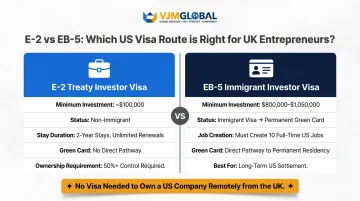
E-2 Treaty Investor Visa
The E-2 is the primary visa route for UK entrepreneurs who want to actively manage their US business on-site. The UK has been an E-2 treaty country since July 3, 1815, making UK nationals eligible for this visa category.
Key requirements:
- Make a "substantial" investment in the US business (no fixed statutory minimum, but typically $100,000 (approximately £78,000) or more in practice)
- Hold at least 50% ownership or operational control of the business
- Demonstrate the business is not marginal—it must generate income significantly beyond providing basic living expenses for the investor
- Maintain intention to depart the US when E-2 status expires
Duration and extensions:
- Initial stay: maximum 2 years
- Extensions: available in 2-year increments
- No stated limit on the number of extensions
The E-2 does not lead directly to a green card, unlike immigrant visa categories. Its renewable nature and unlimited extensions make it a practical long-term option — but if permanent residency is the goal, the EB-5 is the relevant route.
EB-5 Immigrant Investor Visa
Where the E-2 is about working in the US, the EB-5 is about living there permanently. It provides a pathway to a green card for investors who meet substantially higher thresholds:
Requirements:
- Standard investment: $1,050,000 (approximately £820,000)
- Targeted Employment Area investment: $800,000 (approximately £625,000)
- Create at least 10 full-time jobs for qualifying US employees
- Maintain the investment and jobs for a minimum period
These amounts apply to petitions filed on or after March 15, 2022, and will automatically increase on January 1, 2027, with adjustments every 5 years thereafter.
The EB-5 is suited to UK investors who have the capital, a concrete job-creation plan, and a long-term goal of US permanent residency — not those simply looking to run an active business on-site.
Other Visa Options Worth Knowing
For UK founders who don't fit the E-2 or EB-5 profile, three other routes are worth understanding:
L-1A Intracompany Transferee — transfers an executive or manager from an existing UK company to a new US subsidiary. Requires at least 1 continuous year of managerial or executive work for the UK entity within the 3 years preceding the petition.
O-1A Extraordinary Ability — for individuals who have risen to the very top of their field in business. Requires meeting at least 3 types of qualifying evidence from USCIS regulatory criteria. Highly selective.
B-1 / ESTA (Visa Waiver Program) — UK nationals can enter for business visits of up to 90 days under ESTA without a visa. Permitted activities include attending meetings, negotiating contracts, and conducting research. Neither B-1 nor ESTA permits paid work, operational management, or receiving US-sourced income. These are short-visit options only.