Here's the reality: UK entrepreneurs face a unique challenge when expanding to the US. The legal frameworks differ fundamentally from the UK's Companies House system, and critical decisions about entity structure and state selection have long-term tax and compliance implications. Total UK-US trade reached £329.5 billion in the four quarters to Q3 2025, with the US accounting for 17.5% of all UK trade. UK foreign direct investment stock in the US stood at £529.9 billion at end-2024, up 11.2% year-on-year—clear evidence that UK businesses are following a well-established capital pathway into American markets.
This guide is specifically for UK entrepreneurs and small business owners looking to register their first US entity or expand existing operations across the Atlantic. We'll walk through every step, from choosing between an LLC and C-Corporation to staying compliant with both IRS and HMRC obligations.
Key Takeaways
- UK nationals can legally register a US company without citizenship, residency, or a visa
- Choose an LLC for flexible, low-compliance operations — or a C-Corporation if you're targeting investors and funding rounds
- Delaware dominates for investment-seeking businesses (81.4% of 2024 IPOs), while Wyoming offers lowest costs
- You'll need three things to operate: a registered agent, an EIN from the IRS, and a US business bank account
- UK entrepreneurs face specific exposure: Form 5472 penalties of £25,000, HMRC offshore penalties up to 200%, and no access to S-Corp tax status as non-residents
Why UK Entrepreneurs Are Registering Companies in the USA
The post-Brexit landscape has accelerated US expansion for UK businesses. While European markets face new friction, the US offers direct access to payment processors like Stripe, venture capital networks concentrated in Silicon Valley and New York, and enterprise contracts that frequently require a US legal entity.
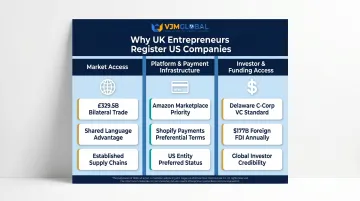
Three practical drivers push UK founders toward US registration:
- Market access: The US is the UK's single largest trading partner — £329.5 billion in bilateral trade, with UK outward FDI reaching £529.9 billion in 2024. Established supply chains, shared language, and familiar business norms lower the barrier to entry.
- Platform and payment infrastructure: US-based platforms like Amazon Marketplace and Shopify Payments offer preferential terms — or exclusive features — only to US-registered entities. International sellers routinely face higher fees, delayed payouts, or outright access restrictions.
- Investor and funding access: American institutional investors strongly prefer Delaware C-Corporations. A US entity removes structural barriers when raising venture capital or pursuing acquisition. Foreign firms invested $177 billion in the United States through acquisitions, new establishments, and expansions in a single recent year alone.
Choosing the Right US Business Structure for UK Entrepreneurs
UK entrepreneurs familiar with Private Limited Companies (Ltd) will find the US system both similar and surprisingly different. The critical distinction: S-Corporation status is unavailable to non-residents.
S-Corp Ineligibility: The Hidden Restriction
The IRS explicitly prohibits non-resident aliens from owning S-Corporation shares. This eliminates the S-Corp option entirely for UK nationals without US tax residency, narrowing your choices to LLC or C-Corporation.
LLC vs UK Ltd: The Closest Equivalent
The US Limited Liability Company mirrors the UK Ltd structure in liability protection and pass-through taxation. Both shield personal assets from business debts, and both allow profits to flow directly to owners without corporate-level taxation.
Key differences for UK founders:
- Requires only Articles of Organization to form—no shareholders' agreements or prescribed share capital
- Form 5472 filing is mandatory for foreign-owned LLCs; missing it costs $25,000 per filing
- US venture capitalists view LLCs as unconventional; conversion to C-Corp before fundraising adds cost and complexity
C-Corporation Explained for UK Entrepreneurs
Delaware C-Corporations are the default choice for investment-ready businesses. 66.7% of Fortune 500 companies and 81.4% of US-based IPOs in 2024 chose Delaware incorporation.
When to choose C-Corp:
- Planning to raise institutional funding from US VCs
- Need to issue employee stock options or multiple share classes
- Building toward acquisition by a US company
- Operating a business model that requires complex equity structures
The double taxation trade-off: C-Corps face corporate tax (21% federal) on profits, then dividend withholding tax (15-30%) when distributing to shareholders. However, the UK-US Double Taxation Convention reduces portfolio dividend withholding to 15%, with further reductions to 5% for 10%+ owners and 0% for 80%+ corporate owners.
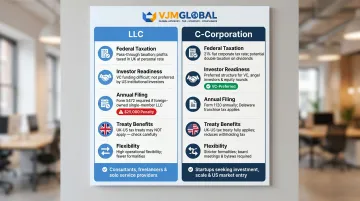
LLC vs C-Corporation Comparison
Once you've chosen your entity type, where you incorporate matters just as much. But first, here's how the two structures compare side by side:
| Feature | LLC (Single-Member, Foreign-Owned) | C-Corporation |
|---|---|---|
| Federal Taxation | Pass-through (income taxed at member level) | Double taxation: 21% corporate + dividend withholding |
| Investor Readiness | Unfamiliar to US VCs; requires conversion for fundraising | Preferred structure; standard for institutional investment |
| Annual Filing | Form 5472 + pro forma 1120 required | Form 1120 + Form 5472 if 25%+ foreign-owned |
| Treaty Benefits | Complex application for pass-through income | 15% dividend withholding (down from 30%) under UK-US DTA |
| Flexibility | Highly flexible profit distribution and management | Rigid corporate formalities and shareholder structures required |
State Selection: Delaware, Wyoming, or Nevada?
Delaware dominates for investor-ready businesses:
- 81.4% of 2024 IPOs chose Delaware
- Court of Chancery provides specialist corporate law expertise
- Established legal precedents reduce uncertainty
- Annual franchise tax: $300 for LLCs, due June 1
Wyoming suits founders who prioritise low costs and privacy:
Wyoming offers lowest costs:
- $100 formation fee (vs Delaware's $110)
- No state income tax
- Strong privacy protections (no public member disclosure)
- Processing time: up to 15 business days (no expedited filing available)
Nevada is worth considering if ongoing tax savings outweigh higher setup costs:
Nevada's tax advantages:
- No state income tax or franchise tax on LLCs
- Total formation costs: approximately $425 (Articles + License + Initial List)
- Annual renewal: $350+ (business license + annual list filing)
- Strong privacy protections similar to Wyoming
UK entrepreneurs should avoid blindly choosing their operational state. If you're based in London and selling software to US clients nationwide, registering in California solely because you have one client there creates unnecessary state tax obligations. Choose based on your growth strategy, not current operations.
Step-by-Step: How to Register a Company in the USA as a UK Entrepreneur
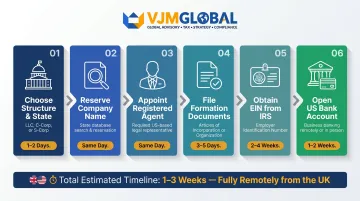
The full registration process typically takes 1–3 weeks when completed remotely from the UK. The US business bank account step creates the longest calendar delay, often requiring 2–4 weeks for non-resident verification.
Step 1: Choose Your Business Structure and State
Confirm your entity type before filing anything:
Choose LLC if:
- You're operating a bootstrapped or lifestyle business
- You don't plan to raise US venture capital
- You want the simplest tax treatment and lowest compliance burden
- You prioritise privacy and asset protection
Choose C-Corp if:
- You're seeking institutional investment from US VCs
- You plan to issue employee stock options
- You're building toward acquisition
- You need complex equity structures (multiple share classes, convertible notes)
Choose Delaware if:
- You're raising institutional funding or planning an IPO
- You want maximum legal predictability
- You can absorb the $300 annual franchise tax
Choose Wyoming if:
- You're bootstrapping with no near-term fundraising plans
- You want the lowest ongoing costs (no state income tax)
- Privacy is a priority (no public member lists)
- Formation fees are significantly lower than Delaware
Step 2: Check and Reserve Your Company Name
Search your chosen state's business registry to ensure name availability:
- Delaware: Delaware Division of Corporations
- Wyoming: Wyoming Secretary of State business search
- Nevada: Nevada Secretary of State entity search
Name requirements:
- Must include appropriate designator: "LLC," "Inc.," "Corp.," or "Corporation"
- Cannot imply government affiliation or regulated activities (bank, insurance) without licenses
- Must be distinguishable from existing registered businesses
Check trademark conflicts using the USPTO database to avoid future legal issues. A name legally available in Delaware might still infringe an existing federal trademark.
Step 3: Appoint a Registered Agent
Every US state requires a registered agent with a physical address in the formation state. You cannot serve as your own registered agent — that requires a physical US address in the state where you incorporate.
What registered agents do:
- Receive legal documents, tax notices, and official correspondence
- Forward time-sensitive materials to you in the UK
- Maintain your company's good standing with the state
Costs: Professional registered agent services typically charge $100–$300 annually. Many formation services bundle this into their packages.
Delaware requirements: Per 6 Delaware Code Section 18-104, your registered agent must be either an individual Delaware resident or a business entity authorised in Delaware with a physical Delaware office. Virtual offices or mail-forwarding addresses don't satisfy this requirement.
Step 4: File Formation Documents with the State
LLCs file Articles of Organization. Corporations file Articles of Incorporation. Both are submitted to the Secretary of State in your formation state.
Filing fees and processing times:
- Delaware LLC: $110 filing fee; 24-hour standard processing; expedited options: same-day (+$100), 2-hour (+$500), 1-hour (+$1,000)
- Wyoming LLC: $100 filing fee; up to 15 business days; no expedited filing available
- Nevada LLC: Approximately $425 total (Articles + Business License + Initial List)
You can file online directly or through a formation service — no US presence required. The entire process is remote.
Step 5: Obtain an EIN (Employer Identification Number) from the IRS
This step is the most administratively complex for UK founders. International applicants cannot use the IRS online EIN tool because it requires a US Social Security Number.
How to apply from the UK:
Phone application (fastest): Call the IRS international line at +1-267-941-1099 (not toll-free). Available during US business hours. You'll receive your EIN immediately during the call.
Information needed for the call:
- Entity legal name and formation state
- Responsible party name and foreign address
- Business purpose and structure
- Formation date
Fax or mail (slower alternative): Complete Form SS-4 and fax to 855-641-6935, or mail to Internal Revenue Service, Attn: EIN Operation, Cincinnati, OH 45999. Processing takes 4–6 weeks.
Critical detail: If you don't have a US Social Security Number or ITIN, enter "foreign" on line 7b of Form SS-4 for the responsible party's identification number.
Step 6: Open a US Business Bank Account
Traditional US banks (Chase, Bank of America, Wells Fargo) typically require in-person visits for non-resident business account opening. You have practical remote alternatives:
Mercury: Explicitly supports international founders and non-US citizens. Requires a US-formed entity, EIN, and valid identification. Account opening typically takes 1–2 weeks for verification.
Wise Business: Allows non-residents to open US accounts for US-registered entities. Cannot be used for foreign entities. Offers multi-currency accounts — useful for UK-US operations.
Requirements for both:
- US-registered LLC or Corporation
- EIN from the IRS
- Valid passport or government-issued ID
- Proof of address in the UK
- Articles of Organization/Incorporation
Stripe Atlas alternative: For businesses primarily processing online payments, Stripe Atlas enables payment processing before a full bank account is operational, though you'll still need a bank account for withdrawals.
Key Considerations for UK Entrepreneurs After Registration
Registration creates obligations in both countries — ongoing compliance in the US and UK determines whether your entity stays in good standing or faces penalties that can exceed the entire formation cost.
UK-US Tax Treaty Implications
The UK-US Double Taxation Agreement (effective 2003) prevents the same income from being taxed twice, but understanding which country has primary taxing rights requires professional guidance.
How the treaty affects you:
- Portfolio dividends (less than 10% ownership): US withholding reduced from 30% to 15%
- Direct dividends (10%+ ownership): US withholding reduced to 5%
- Substantial ownership (80%+ corporate ownership): US withholding reduced to 0%
- Interest payments: Generally 0% withholding under the treaty
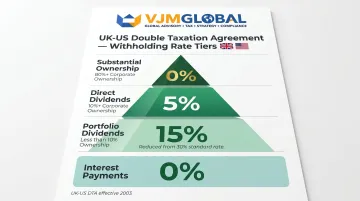
UK tax residents must still declare worldwide income to HMRC, even when treaty relief applies — the treaty removes the double tax burden, not the reporting obligation.
HMRC Reporting Obligations
UK tax residents face penalties up to 200% of tax owed for failure to disclose offshore income. Foreign income—including US C-Corp dividends and LLC pass-through income—must be reported on your Self Assessment tax return.
What counts as reportable:
- Dividends from your US C-Corporation
- Pass-through income from your US LLC
- Capital gains from selling US business assets
- Interest earned in US business accounts
Penalty tiers based on territory classification:
- Category 1 territories: Maximum 100% penalty
- Category 2 territories: Maximum 150% penalty
- Category 3 territories: Maximum 200% penalty
Additional asset-based penalties of up to 10% of relevant asset values apply when potential tax exceeds £25,000 in a single year.
Ongoing US Compliance Requirements
Form 5472: Foreign-owned LLCs treated as disregarded entities must file Form 5472 with a pro forma Form 1120. The penalty for failure to file is $25,000 per form, with an additional $25,000 for each 30-day period of continued non-compliance. There is no maximum penalty cap.
Delaware annual obligations:
- $300 franchise tax due June 1 annually
- Late payment penalty: $200 plus 1.5% monthly interest
- Failure to pay can result in administrative dissolution
State annual reports: Most states require annual or biennial reports confirming registered agent, members/officers, and business address. Filing fees and deadlines vary by state.
Banking and Financial Infrastructure
Maintain clear separation between UK and US finances to simplify both Form 5472 compliance and HMRC reporting.
For currency conversion:
- Wise offers competitive GBP-USD exchange rates
- Revolut Business provides multi-currency accounts
- Traditional bank wires work but carry higher fees
On the accounting side, clean records are non-negotiable:
- Keep separate bank accounts for US and UK operations
- Maintain separate bookkeeping systems
- Document all inter-company transactions for Form 5472 compliance
VJM Global has supported 250+ UK businesses with cross-border tax compliance, bookkeeping, and Form 5472 preparation — helping founders stay compliant in both jurisdictions without the administrative overhead of managing it alone.
Common Mistakes UK Entrepreneurs Make When Registering in the USA
Choosing the Wrong Structure or State Without Professional Advice
Many UK entrepreneurs default to Delaware because they've heard it's the best state for business without considering whether Wyoming's lower costs better suit their business model. A bootstrapped SaaS business with no fundraising plans pays £300 annually in Delaware franchise tax versus minimal fees in Wyoming—an unnecessary £250+ annual expense.
Converting from an LLC to a C-Corp for fundraising costs £2,000–5,000 in legal fees, creates tax complications, and delays funding rounds. If you plan to raise capital, choose the investment-ready structure from day one.
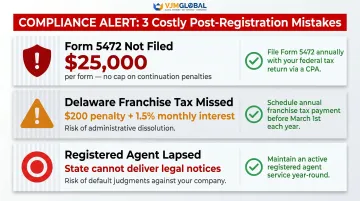
Neglecting Post-Registration Compliance
UK entrepreneurs often treat US registration as a one-time task, then face severe penalties:
- Form 5472: $25,000 penalty per unfiled form, with no cap on continuation penalties — one oversight can cost 100x the original formation fee
- Delaware franchise tax: Missing the June 1 deadline triggers a $200 penalty plus 1.5% monthly interest; continued non-payment leads to administrative dissolution
- Registered agent lapses: An expired registered agent means the state can't deliver legal notices, risking default judgments and dissolution
Assuming There Are No HMRC Implications
The compliance risks above are significant — but overlooking HMRC's reach can be even more expensive. The UK taxes residents on worldwide income, so owning a US company creates a reporting obligation, not a tax shelter.
Common errors:
- Failing to declare US dividends on Self Assessment returns
- Not disclosing US business ownership when required
- Assuming the UK-US treaty eliminates UK tax (it prevents double taxation but doesn't eliminate UK tax on your share of profits)
HMRC's offshore penalty regime reaches up to 200% of unpaid tax, with asset-based penalties adding a further 10% when amounts exceed £25,000. Getting cross-border tax advice before you register — not after — is the most cost-effective decision you can make.
Conclusion
Registering a US company as a UK entrepreneur is achievable without US residency or citizenship. The process—choosing a structure, appointing a registered agent, filing formation documents, obtaining an EIN, and opening a bank account—can be completed remotely in 1-3 weeks.
Registration is the straightforward part. The harder work is making the right structural decisions upfront and staying on top of dual compliance afterward. A Delaware C-Corp optimised for venture funding carries different obligations than a Wyoming LLC built for privacy and low costs. Form 5472 filing isn't optional, and HMRC doesn't grant exemptions for foreign business income.
The penalties for getting this wrong are significant: £25,000 for a missed Form 5472 filing, 200% HMRC offshore penalties, and administrative dissolution for missed state compliance deadlines. Working with cross-border advisors who understand both IRS requirements and HMRC obligations helps you avoid those outcomes.
VJM Global has supported 250+ UK businesses with international tax compliance and cross-border advisory — bringing the jurisdictional knowledge needed to keep your US entity and UK reporting obligations aligned.
Frequently Asked Questions
How do I register my company in the USA?
Choose a business structure (LLC or C-Corp), select a state (typically Delaware, Wyoming, or Nevada), appoint a registered agent, file formation documents with the state, obtain an EIN from the IRS, and open a US business bank account. The process can be completed remotely from the UK in 1-3 weeks.
How much does it cost to register a company in the US?
State filing fees range from USD $75-$110 (Wyoming $100, Delaware $110, Nevada approximately $425 total). Add registered agent costs ($100-$300/year) and EIN application (free). Realistic total for initial setup: $200-$800 depending on state and service providers.
Can foreigners register a company in the USA?
Yes. UK nationals and other non-residents can legally form an LLC or C-Corporation in any US state without citizenship, residency, or a visa. The key requirements are appointing a registered agent with a US address and obtaining an EIN from the IRS.
How much money do I need to start a business in the USA?
There is no federal or state minimum capital requirement — you can register with just the filing fees ($200-$800 USD). Operating capital depends on your business model; some regulated industries carry licensing requirements with minimum capital thresholds.
What are common business mistakes to avoid when registering in the USA?
The costliest errors are choosing the wrong state or structure without professional advice (leads to unnecessary fees or expensive conversions), missing post-registration compliance deadlines — particularly Form 5472 (penalty: $25,000 per failure) — and failing to report US income to HMRC (penalties up to 200% of tax owed).
Do UK entrepreneurs need a visa to own a US company?
No visa is required to own a US entity, receive distributions from it, or operate it remotely from the UK. A visa is only needed if you intend to physically work in the US. UK citizens may qualify for an E-2 Treaty Investor visa if they meet the investment threshold (commonly $80,000-$300,000+ USD).