Interest from India is growing for practical reasons. Morocco allows 100% foreign ownership with no local partner requirement, and demand is rising in sectors where Indian businesses already have expertise: textiles, pharmaceuticals, IT services and import-export trade. India-Morocco bilateral trade grew from USD 2.007 billion in 2018-19 to USD 3.597 billion in 2022-23, a trend that's hard to ignore.
This isn't just large conglomerates exploring Africa. Indian SMEs, exporters, and IT founders are all looking at Morocco. This guide walks through exactly what starting a business there involves.
TL;DR
- Morocco permits 100% foreign ownership; no local partner needed
- SARL is the go-to structure for most Indian founders, with setup typically taking 2-4 weeks
- Corporate tax, VAT and CNSS registration require ongoing local compliance
- Registration runs through the CRI (Regional Investment Center) as a one-stop shop
- Local legal and tax support speeds registration and keeps CNSS, VAT and corporate filings on track
What Is a Small Business in Morocco (For an Indian Entrepreneur)?
A small business in Morocco is a locally registered legal entity, most commonly a SARL (Société à Responsabilité Limitée)—the closest equivalent to an Indian private limited company. Through it, an Indian founder can trade, manufacture, or provide services in Morocco, or export from it.
This is a fully independent Moroccan company, not a representative office or an informal arrangement. Common setups include:
- Import-export or trading companies
- Manufacturing or assembly units (automotive, textiles)
- Service-led businesses (IT, consulting)
- A subsidiary of an existing Indian company
What to Know Before You Start a Business in Morocco from India
Many Indian founders underestimate the language, documentation and local presence requirements before entering Morocco. Plan for these constraints early so they don't stall registration or your first months of operations.
Language and Documentation Realities
French and Arabic dominate legal and administrative processes in Morocco. OMPIC's website offers English, Arabic and French interfaces, but that doesn't mean incorporation filings can happen in English. Articles of association need to be prepared in French or Arabic, and non-Arabic, non-French Indian documents will need sworn translation.
Build these logistics into your setup plan:
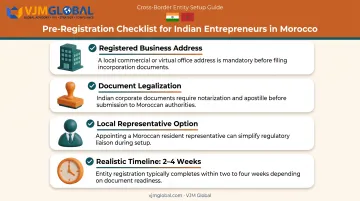
- A registered Moroccan business address is mandatory before CRI registration can proceed
- Document legalization for Indian company papers, ID and Articles of Association takes time
- Physical presence isn't always required; a local representative can handle much of the process
- Realistic timelines run 2–4 weeks for registration, though first revenue often takes longer
Why Start a Small Business in Morocco? (When It Makes Sense for Indians)
Morocco doesn't work for every Indian entrepreneur. It works best under specific conditions.
Trade access and location:
- Free-trade coverage through EU, EFTA, and bilateral agreements with the UAE, Egypt, Jordan, Tunisia, Turkey, and the US
- Tanger Med port handled 11.1 million containers, with links to 180+ ports worldwide
Sector fit for Indian expertise:
- Pharmaceuticals, backed by Morocco's large chemical manufacturing base
- Textiles, which account for 27% of industrial jobs nationally
- IT/BPO and automotive components, both government priority sectors
Incentives worth checking:
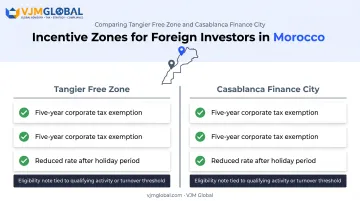
- Qualifying export activity in zones such as Tangier Free Zone or Casablanca Finance City may get a five-year corporate tax exemption
- After that holiday, Casablanca Finance City entities can face a reduced corporate rate
- Zone eligibility depends on activity type and turnover, not just address
One caveat: a Moroccan company does not automatically get duty-free EU or US access. Check product-specific rules of origin before modelling any trade benefit.
Early Decisions That Matter When Starting a Business in Morocco from India
Most friction Indian founders hit comes from underestimating compliance complexity, not lack of capital.
Areas commonly overlooked:
- Registration and capital costs. SARL capital under MAD 100,000 doesn't require bank blocking; above that threshold, you'll need a deposit certificate before filing
- Subsidiary vs branch. A subsidiary is a separate legal entity with liability generally limited to your investment. A branch stays linked to the parent company, exposing it to greater risk
- Currency and remittance. Map the India-to-Morocco fund path early, including RBI/FEMA outward remittance rules and MAD conversion costs
- VAT by sector. Morocco's 2026 standard VAT rate is 20%, with 10% applying only to specific listed transactions
- Founder dependency. With a limited on-ground network at the start, plan to stay hands-on through the early months
How to Start a Small Business in Morocco – Step by Step
Here's the practical execution path for an India-based founder. Common mistakes include skipping document legalisation, underestimating VAT complexity, and assuming English will suffice everywhere.
Step 1 – Identify the Opportunity and Choose a Business Structure
Assess real demand for your product or service, whether that's import-export, manufacturing, or services, in the Moroccan or wider regional market.
Choose between:
- SARL — simplest, most common for small operations
- SA — more capital- and governance-intensive
- Branch or subsidiary — if you already run an Indian company
Common miss: choosing an SA when a SARL would comfortably handle a small operation.
Step 2 – Reserve Company Name and Prepare Documentation
Reserve and verify name uniqueness through OMPIC, which issues a negative certificate confirming trade-name availability.
Prepare:
- Articles of Association (French or Arabic)
- Passport copies
- Proof of Moroccan business address
- Indian company documents with certified translations
Common miss: submitting non-legalized documents, which stalls registration for weeks.
Step 3 – Secure a Moroccan Business Address
A registered address, physical or virtual, is mandatory before CRI registration proceeds. If you're not yet physically present in Morocco, virtual office arrangements exist to satisfy this requirement.
Step 4 – Register with the Regional Investment Center (CRI)
File for the trade registry (RC), tax identifier (IF) and CNSS registration through the CRI one-stop shop. Deposit share capital in a Moroccan bank where required, and obtain the deposit certificate.
Common miss: delaying bank account setup, which stalls the entire registration chain behind it.
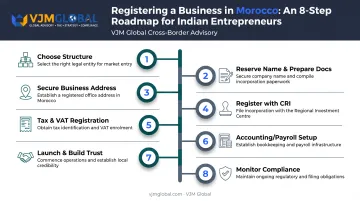
Step 5 – Complete Tax, VAT and Compliance Registration
Register for corporate tax and VAT based on your activity and expected turnover. VAT filing becomes monthly once prior-year taxable sales hit MAD 1 million; below that, quarterly filing usually applies.
This is where cross-border compliance gets tricky. Coordinating Moroccan registration with India-side tax and FEMA obligations is a different skill set than running either jurisdiction alone. VJM Global supports founders with entity formation and tax compliance across both tracks, so requirements on neither side get missed.
Step 6 – Set Up Accounting, Payroll and Local Banking
Establish bookkeeping systems that follow Moroccan accounting standards, not Indian ones. If hiring local staff, complete CNSS registration and set up payroll processes.
Common miss: assuming Indian accounting practices transfer directly. They don't, and the gap shows up during your first tax filing.
Step 7 – Launch, Build Local Trust and Distribution
Morocco runs on relationships. Build connections with local distributors, partners or clients, and factor in a relationship-first business culture rather than a purely transactional one.
Set up basic tracking to understand which channels actually bring in leads.
Common miss: relying solely on remote or digital outreach without any local relationship-building on the ground.
Step 8 – Monitor Compliance and Stabilise Operations
Track monthly or quarterly VAT filings, annual financial statements, and corporate tax return deadlines, which fall due within three months after fiscal year-end.
Fix compliance gaps early. Don't scale hiring or operations before your compliance systems are stable. Small issues become expensive when they compound across a growing team.

Conclusion
Starting a small business in Morocco from India is entirely feasible. The country allows full foreign ownership, and the CRI's centralised registration process removes much of the bureaucratic maze other markets impose.
Success comes down to getting three things right the first time:
- Documentation
- Business address
- Tax registration
Get these wrong, and everything downstream slows.
An unfamiliar jurisdiction's language, tax code and regulator structure is easier to navigate with specialists who have handled multi-country entity formation before. VJM Global helps founders manage tax, accounting and compliance on both the India side and in the new market, so dual reporting obligations stay aligned from day one.
Frequently Asked Questions
Can a foreigner start a business in Morocco?
Yes. Indians and other foreign nationals can own 100% of a Moroccan company without needing a local partner, provided documentation and address requirements are met.
What work can a foreigner do in Morocco?
Foreigners can operate most business activities, including trading, manufacturing and services. Regulated sectors like travel agencies or private education require specific licences beyond company registration.
Which business is most profitable in Morocco?
Automotive components led exports at MAD 77 billion in H1 2025. Phosphate-linked industries, textiles and tourism also show strong sector growth, though profitability varies by specific niche.
What is the best investment in Morocco?
Automotive manufacturing, logistics/import-export, and renewable energy stand out, supported by government incentives and Morocco's strategic port infrastructure.
How long does it take to register a company in Morocco?
Typically 2-4 weeks, covering name reservation, documentation, CRI registration and bank setup. Foreign-shareholder cases involving translations and KYC checks can take longer.
Do I need to be physically present in Morocco to register a company?
Not necessarily. With a local representative or accountant and a virtual business address, much of the process can be managed remotely from India.