for US Businesses in 2026](https://file-host.link/website/vjmglobal-l8s6go/assets/blog-images/b6cde773-1a02-4f2e-988d-14dcccca8ea1/1784586593424357_a28e5a52f5494885ad10b1e6ae084a9a/360.webp)
Introduction
Choosing where to form your LLC is one of the first decisions you'll make as a business owner — and more consequential than most expect. The wrong state can trigger dual registration requirements, unexpected tax obligations, and compliance costs that far outweigh any initial savings.
Wyoming, Delaware, and Nevada dominate most "best states" lists. They're heavily marketed and legitimately useful for certain business structures — but the wrong choice for a large portion of owners. For most US-based small businesses, the home state wins by default once you factor in the real cost of operating across state lines.
This guide covers the top five states for LLC formation in 2026, a practical decision framework for choosing between them, and specific guidance for non-US residents — including Indian, UK, and Australian entrepreneurs — who have more flexibility but face unique compliance obligations.
Key Takeaways
- Home state formation is the simplest, most cost-effective option for most US-based businesses
- Wyoming leads on low cost ($100 filing fee, $60 minimum annual fee), privacy, and charging order protection
- Delaware is the default for venture-backed startups due to its Court of Chancery and investor familiarity
- Nevada offers strong asset protection but costs significantly more annually ($350/year in recurring fees)
- Non-US residents face additional IRS obligations, including a $25,000 penalty for failing to file Form 5472
Why the State You Form Your LLC In Matters
Most formation guides skip over the structural issue that makes state selection genuinely consequential: the difference between your formation state and your home state.
Formation State vs. Home State
If your LLC is formed in Wyoming but you run it from Texas, you're operating a Texas business that's legally registered in Wyoming. Texas will require you to register as a foreign LLC, which means:
- Filing fees in two states
- Two registered agents
- Two sets of annual reports and compliance deadlines
This dual-registration reality is where the appeal of "Delaware/Wyoming formation" falls apart for most small business owners.
The State Tax Myth
Forming in a no-income-tax state doesn't eliminate your state income tax liability. Taxes are owed where income is earned and where the owner resides — not where the LLC is registered. California makes this concrete: any LLC doing business there owes the $800 annual LLC tax regardless of where it was formed.
What "Doing Business" Actually Means
Having a physical presence — office, employees, warehouse, or property — in a state triggers registration requirements there, no matter where your LLC was formed. Selling online into a state is a separate question. Most state statutes exclude interstate commerce and out-of-state-accepted orders from the definition of "transacting business." That said, the analysis is fact-specific — it's not a universal safe harbor.
Best States for LLC Formation in the US in 2026
These states were selected based on formation costs, annual fees, privacy protections, tax environment, legal framework, and suitability for specific business types.
Wyoming
Wyoming passed the first LLC statute in the country on 4 March 1977 and has maintained its reputation as the most business-friendly state for small businesses ever since. It imposes no individual or corporate state income tax, making it attractive — provided you actually operate there or run a location-independent business.
What sets Wyoming apart is its combination of strong privacy and low cost. Member names are not required in public filings, and its charging order statute (W.S. 17-29-503) explicitly makes the charging order the exclusive creditor remedy — including for single-member LLCs, which most states don't protect as strongly.
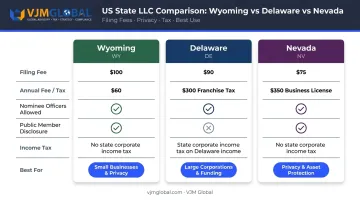
| Wyoming | |
|---|---|
| Filing Fee | $100 |
| Annual Report Fee | $60 minimum (or $0.0002 per dollar of Wyoming assets) |
| Best For | Online businesses, privacy-focused owners, holding companies, non-US residents |
Delaware
Over half of all US publicly traded companies and 66.7% of the Fortune 500 are incorporated in Delaware. That concentration reflects one thing: the Court of Chancery, a non-jury equity court with centuries of consistent business case law that gives investors and attorneys predictable outcomes.
For most LLCs, the practical advantages are flexible operating agreement structures and anonymous ownership (member names aren't required in public filings). The $300 annual LLC tax is flat and applies regardless of revenue. Note that Delaware doesn't automatically exempt LLCs from income tax on outside income — tax treatment follows the LLC's federal classification and activity.
| Delaware | |
|---|---|
| Filing Fee | $110 |
| Annual LLC Tax | $300 (due June 1; no separate annual report) |
| Best For | Venture-backed startups, companies seeking institutional investment, complex ownership structures |
Nevada
Nevada's appeal is asset protection. Its charging order statute (NRS 86.401) makes the charging order the exclusive creditor remedy against member interests, covering both single-member and multi-member LLCs.
There's no personal income tax and no traditional corporate income tax — though Nevada's Commerce Tax applies when gross revenue exceeds $4 million annually.
The catch is cost. Nevada's mandatory initial package totals $425 ($75 Articles + $150 initial list + $200 state business license), and recurring annual fees run $350. That's significantly higher than Wyoming for comparable privacy protections.
| Nevada | |
|---|---|
| Filing Fee | $425 total ($75 Articles + $150 initial list + $200 business license) |
| Annual Fees | $350 ($150 annual list + $200 business license renewal) |
| Best For | High-revenue businesses, real estate holding companies, privacy-sensitive industries |
Florida
Unlike Wyoming or Nevada — where the appeal is tax structure and privacy regardless of where you live — Florida makes sense for business owners who actually live and operate there. The Florida Constitution bars state income tax on natural persons, and Florida's economy ranked second among states for annualized real GDP growth in Q1 2025 — a signal of a healthy commercial environment.
Formation is straightforward, fees are moderate, and the state supports a strong consumer economy across services, retail, real estate, and tourism. If you're not in Florida, none of this matters.
| Florida | |
|---|---|
| Filing Fee | $125 ($100 Articles + $25 registered agent) |
| Annual Report Fee | $138.75 (late filing adds $400 penalty after May 1) |
| Best For | Florida residents and operators, service businesses, hospitality and tourism |
Your Home State
For roughly 95% of small business owners with a fixed location, the home state is the right answer. It eliminates foreign LLC registration, reduces annual compliance overhead, and simplifies banking and local licensing.
The only way to avoid home-state obligations is to have no physical presence, employees, property, or operational nexus in that state. Most owners running a business from a home office or local workspace already have that nexus — whether or not they've thought through the implications.
| Home State Considerations | |
|---|---|
| Hidden Cost Risk | Out-of-state formation + home-state operation = dual registration: two filing fees, two annual reports, two registered agents |
| When to Reconsider | Consider out-of-state formation only when raising investment (Delaware), prioritizing privacy with no local nexus (Wyoming), or running a truly location-independent operation |
How to Choose the Right State for Your LLC
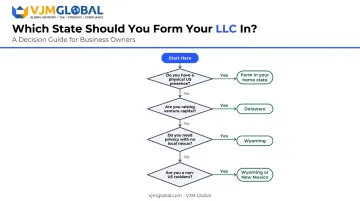
Step 1: Establish Your Physical Footprint
Where does the business actually operate? If you have an office, employees, warehouse, or property in a specific state, that state needs to be your formation state — or you'll register there as a foreign LLC anyway, defeating the purpose of forming elsewhere.
Step 2: Factor In Your State's Tax Environment
Forming in a no-income-tax state only saves you money if you actually live and earn income there. Forming in Wyoming while living in California doesn't reduce California taxes.
States with no personal income tax include Florida, Texas, Wyoming, Nevada, South Dakota, and Alaska — but that benefit follows your residency, not your LLC's paperwork.
Step 3: Consider Your Capital Plans
- Seeking venture capital or angel investment: Form in Delaware. Institutional investors expect it — the Court of Chancery, flexible operating agreements, and deep investor familiarity make other states a harder sell.
- Bootstrapped with no external funding planned: Delaware's $300 annual franchise tax adds cost without a real benefit for your structure.
Step 4: Weigh Privacy Requirements
Privacy is a separate consideration from taxes and funding. Wyoming and New Mexico offer the strongest member privacy — neither requires member names in the Articles of Organization.
One important limit: if your LLC must also register as a foreign LLC in a state that mandates member disclosure, that state's rules apply regardless of where you formed.
Step 5: Calculate the Real Cost of Out-of-State Formation
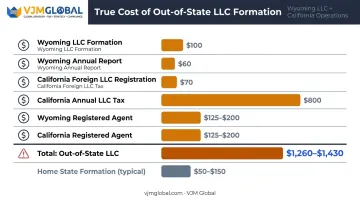
The $400–$900 "dual-registration cost" estimate you'll see in many guides is incomplete. A Wyoming LLC operating in California, for example, faces:
- $100 Wyoming formation + $60 annual Wyoming report
- $70 California foreign LLC registration
- $800 California annual LLC tax
- $125–$200 Wyoming registered agent + $125–$200 California registered agent
Total first-cycle costs reach $1,260–$1,430, which exceeds what straightforward home-state formation costs in most states.
Forming a US LLC as a Non-US Resident: Special Considerations
No US state requires citizenship or residency to form an LLC. Non-residents can legally own and operate a US LLC, but the compliance picture is more complex than domestic formation.
Choosing the Right State as a Non-Resident
For LLCs with no US physical presence:
- Wyoming — most popular for non-residents: $100 filing fee, $60 minimum annual fee, strong privacy, no state income tax
- Delaware — recommended if raising US venture capital or requiring a corporate structure familiar to investors
- New Mexico — the most budget-friendly option: $50 filing fee, no annual report requirement under its LLC Act
Critical IRS Compliance for Foreign-Owned LLCs
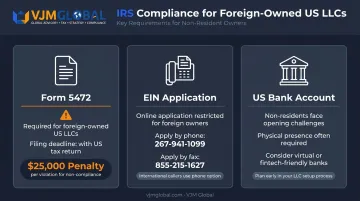
This is where non-resident owners most often get caught off-guard:
- Form 5472 — foreign-owned US disregarded entities must file Form 5472 attached to a pro forma Form 1120 annually. The base failure-to-file penalty is $25,000, with additional $25,000 increments for continued non-compliance after IRS notice
- EIN without a US SSN — international applicants can call 267-941-1099 or fax 855-215-1627 (US fax) or 304-707-9471 (international fax). Online EIN application requires a US principal place of business
- US bank account — opening a US business bank account as a non-resident is possible but operationally challenging without guidance from someone who has navigated the process
Tax Treatment for Non-Resident Owners
The "only ECI" framing common in online guides is incomplete. Non-resident alien LLC owners are taxed on:
- Effectively connected income (ECI) — income from US trade or business, taxed at graduated rates
- FDAP income — US-source fixed, determinable, annual, or periodic income not connected to a US business, generally taxed at 30% or applicable treaty rate
Tax treaty benefits are fact-specific. Article 7 of the India-US treaty, for example, generally reserves business profits to India unless the LLC has a US permanent establishment — but the analysis depends on LLC classification and the nature of the business. Treaty status also does not eliminate the Form 5472 filing requirement.
Indian, UK, and Australian entrepreneurs navigating these requirements need advisors who understand both US compliance and the cross-border tax implications from their home country. VJM Global's team has worked with 500+ US-based clients on exactly this — cross-border tax structuring, Form 5472 compliance, and EIN setup — and can map out the right approach for your specific situation.
Conclusion
The state selection decision comes down to a few clear variables:
- You operate from a fixed US location → form in your home state
- You're raising venture capital → Delaware
- You want low cost, privacy, and location independence → Wyoming
- You're a non-US resident with no US physical presence → Wyoming, Delaware, or New Mexico depending on your goals
Getting this decision wrong isn't just administratively inconvenient. Reclassification, foreign LLC catch-up filings, and late fees can run into thousands of dollars — particularly in high-cost states like California or New York.
For international business owners — particularly those with cross-border operations, India-side entities, or multi-jurisdiction compliance needs — the US LLC decision is only one piece of a larger structure. VJM Global's team of Chartered Accountants and international tax advisors helps businesses navigate the full picture: from US entity coordination to India-entry, FDI compliance, and cross-border accounting support. Reach out at [email protected] to discuss your specific situation.
Frequently Asked Questions
What state is best for starting an LLC?
For most US-based businesses, the home state is the most practical and cost-effective choice. If you need an out-of-state option, the right choice depends on your priorities:
- Wyoming — lowest ongoing costs and strongest privacy protections
- Delaware — the standard for investor-backed startups
- Nevada — suited to high-revenue businesses focused on asset protection
Which state has the lowest taxes for an LLC?
Wyoming, Nevada, Florida, Texas, and South Dakota have no state personal income tax. However, forming in these states only provides a tax benefit if you live and earn income there — LLCs owe tax where they generate income and where the owner resides, not solely where the LLC is registered.
Which state is best for forming an LLC as a non-resident?
Wyoming is the most popular choice — $100 filing fee, $60 minimum annual fee, strong privacy, and no state income tax. Delaware suits businesses seeking US investment. New Mexico is the lowest-cost option at $50 to file with no annual report requirement.
Do I need to register as a foreign LLC if I form in a different state from where I operate?
Yes. If your LLC is formed in one state but conducts business — through physical presence, employees, or property — in another, you must register as a foreign LLC in the operating state. That means dual compliance obligations: annual reports and registered agent fees in both states, plus filing costs in each.
Can a non-US citizen form an LLC in the United States?
Yes — there are no citizenship or residency requirements to own or form a US LLC. Foreign-owned single-member LLCs must file IRS Form 5472 annually (failure carries a $25,000 penalty). Obtaining an EIN without a US Social Security Number requires submitting Form SS-4 directly to the IRS by phone or fax.