An anonymous LLC is a standard LLC structured so the owner's name never appears on publicly accessible state documents. No separate legal category exists for it; it's an ordinary LLC formed in a state whose statutes simply don't require member or manager names on formation documents. The privacy comes from careful state selection and using the right services — not from any special entity type.
This guide covers who benefits from this structure, which four states actually deliver meaningful privacy protection, and exactly how to form one step by step.
Key Takeaways
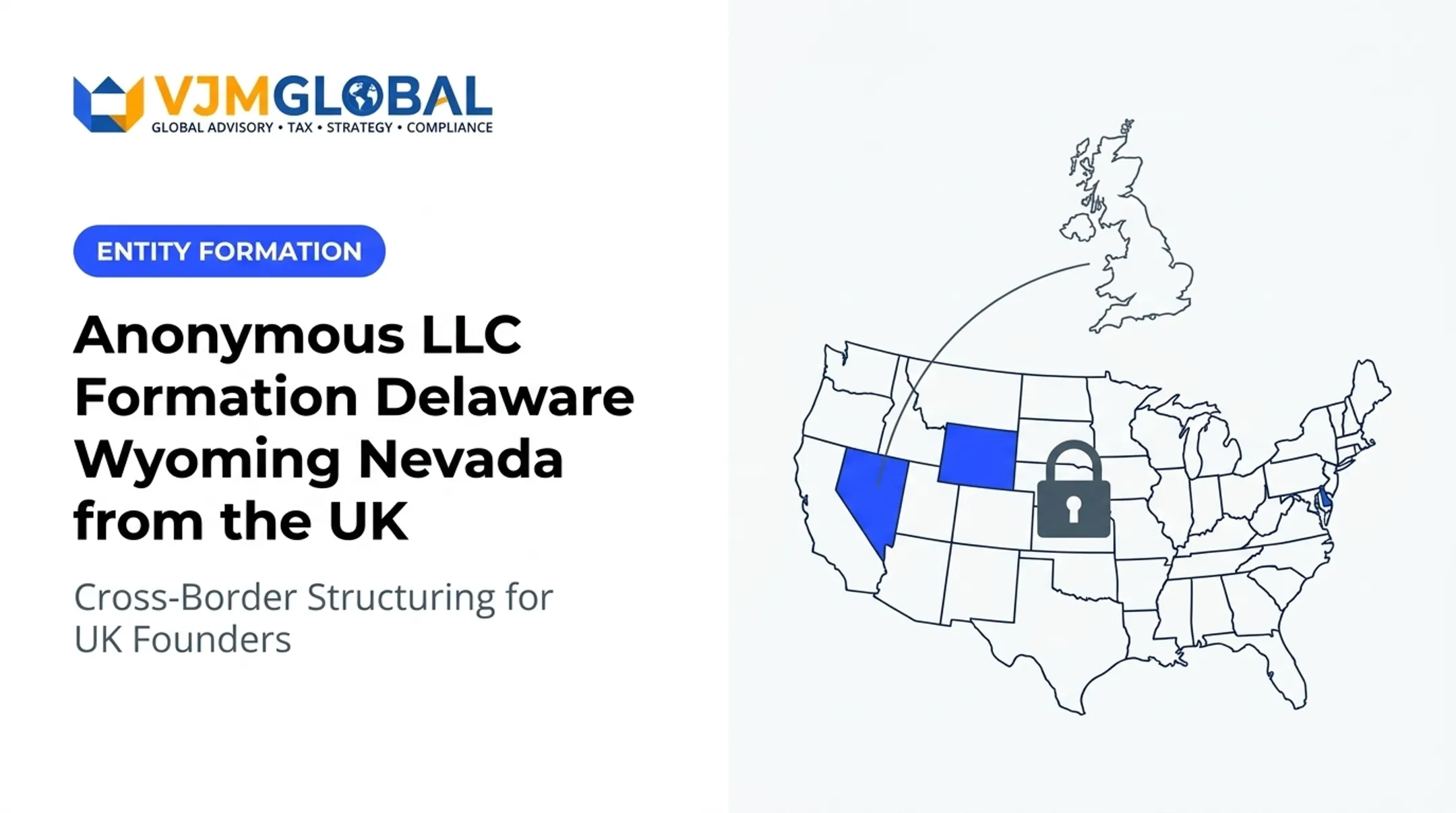
- Wyoming, Delaware, and New Mexico offer genuine formation-document privacy — Nevada requires member or manager names upfront, making it the weakest option
- Using a professional registered agent keeps the owner's name off all public filings — the foundation of LLC anonymity
- The March 2025 FinCEN rule exempts all US-created LLCs (including those with foreign owners) from Beneficial Ownership Information reporting
- Anonymity shields you from public records searches only — the IRS, courts, and law enforcement still have full access
- Registered agent services typically cost $125–$200 per year, on top of state fees
What Is an Anonymous LLC?
An anonymous LLC is a standard limited liability company for which member or manager identities are not included in publicly available state records. No US state has created a formal legal category called an "anonymous LLC" — the term describes a filing configuration, not a distinct entity type.
Most states require owner names on formation documents, which become searchable public records. The four states this guide covers either don't collect that information at all or don't require it on documents filed publicly.
Discreet vs. Truly Anonymous
Two distinct privacy levels apply here:
- Discreet formation: Government authorities have owner details, but the public cannot access them through standard record searches
- Truly anonymous formation: Even public-facing state records show only the registered agent's information, with no owner names anywhere in the filing
Wyoming, Delaware, and New Mexico come closest to the truly anonymous category at the state level. No formation is fully anonymous from the IRS, federal courts, or law enforcement — those entities access ownership data through separate channels regardless of what a state publishes.
The legal protections, tax treatment, and operational structure of an anonymous LLC are identical to any other LLC. The only difference is what appears in public filings.
Why Business Owners Choose an Anonymous LLC
When you form a standard LLC, your name and address become part of the public record. Journalists, opposing attorneys, disgruntled tenants, and scammers running records searches can all find that information. An anonymous LLC eliminates that exposure.
Removing your name from public filings reduces the risk of targeted harassment, fraud, and identity theft. There's a secondary benefit too: when potential plaintiffs can't easily identify what assets you own or how many properties are tied to your name, frivolous lawsuits become less appealing. This complements the LLC's liability shield but doesn't replace it.
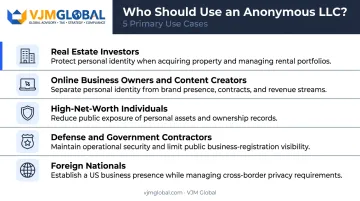
The most common use cases:
- Real estate investors who hold multiple properties and don't want tenants tracing them all back to one name
- Online business owners and content creators operating in politically or socially sensitive niches
- High-net-worth individuals who want to reduce their profile as a litigation target
- Defense and government contractors who need to keep client relationships and project details out of public records
- Foreign nationals seeking a US business presence with a degree of privacy
Best States for Forming an Anonymous LLC
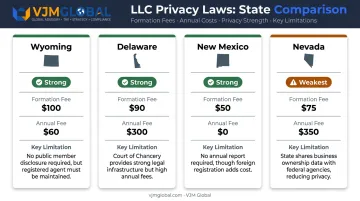
Not all states protect LLC owner privacy equally. Four states stand out for their formation rules — but each has trade-offs worth understanding before you file.
| State | Formation Privacy | State Annual Fee | Key Limitation |
|---|---|---|---|
| Wyoming | Strong | $60 minimum | Organizer name visible |
| Delaware | Strong | $300 | Registered-agent records |
| New Mexico | Strong | No annual fee | Management status disclosed |
| Nevada | Weakest | $350 | Initial members/managers disclosed |
Wyoming
Wyoming is the most commonly recommended state for anonymous LLC formation. Its Articles of Organization require only the LLC name, designated office address, and registered agent — no member or manager names. Annual reports also omit ownership information.
Additional advantages:
- Formation fee: $100
- Annual report minimum: $60 (or $0.0002 per dollar of Wyoming assets)
- Wyoming gives creditors charging-order protection as their exclusive remedy — even against sole-member LLCs
- No state income tax
Delaware
Delaware's Certificate of Formation requires only the LLC name, registered office, and registered agent. Member and manager names are not required. The LLC operating agreement is never filed with the state, keeping ownership details entirely private.
Delaware's Court of Chancery handles more business-entity disputes than any other U.S. court, which makes legal outcomes more predictable for LLC owners. Formation fee: $110; annual LLC tax: $300.
New Mexico
New Mexico is the most cost-effective option. Member names are not required on Articles of Organization, and — unlike Wyoming and Delaware — no annual report is required, eliminating a recurring public disclosure obligation entirely.
Formation fee: $50. Note that the Articles do disclose whether the LLC is member-managed or manager-managed and whether it has a single member — status is public even if identity isn't.
Nevada
Nevada's privacy protections are weaker than the other three. Under NRS 86.161, the Articles of Organization must list the names and addresses of all initial managers or, if member-managed, each initial member. For anyone prioritizing formation-document privacy, that requirement makes Nevada a poor starting point.
Nevada also carries the highest ongoing costs:
- Annual list fee: $150
- State business license: $200
- Total: $350 per year
The state has no corporate income tax but does impose a Commerce Tax when Nevada gross revenue exceeds $4 million.
For most owners, Wyoming or New Mexico will cover the privacy requirements at a lower cost. Once you've identified your target state, the next step is understanding exactly how to file.
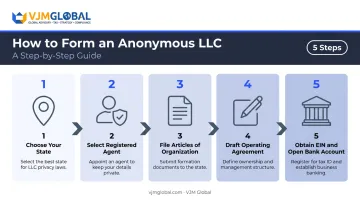
How to Form an Anonymous LLC: Step-by-Step
Forming an anonymous LLC follows the same legal steps as any standard LLC — the difference is that privacy-preserving tools replace personal information at every step where it would otherwise become public record.
Step 1: Choose Your State
Select from Wyoming, Delaware, or New Mexico based on:
- Cost sensitivity: New Mexico ($50 formation, no annual fee) wins on price
- Asset protection priority: Wyoming's charging-order exclusivity is the strongest statutory protection
- Legal predictability: Delaware's Court of Chancery offers the most developed case law
- Operating location: You don't have to form in the state where you operate, but operating elsewhere may trigger foreign LLC registration requirements (covered below)
Step 2: Select a Registered Agent
The registered agent's name and address appear on public documents in place of the owner's. This is the core mechanism that creates the anonymity.
Use a professional registered agent service and never list yourself. What to look for:
- Physical address in your chosen state
- Experience with privacy-focused formations
- Secure correspondence forwarding
- Transparent annual renewal process
Two widely used providers post fees of $125/year (Northwest Registered Agent) and $200/year (Registered Agents Inc.), giving a reasonable benchmark of $125–$200 annually.
Step 3: File the Articles of Organization
The Articles of Organization (or Certificate of Formation in Delaware) legally create the LLC and become public record, so avoid including your personal name or home address anywhere in this document.
- Use the registered agent's address throughout
- In states that allow it, a nominee organizer can sign and file on your behalf
- The organizer's name may appear on the filing even when member names don't — this is why nominee organizer services exist
Step 4: Draft an Operating Agreement
Operating agreements are not filed with the state in any of the anonymous LLC states; they remain entirely private. This is where the actual ownership structure, member rights, profit distribution, and management rules are documented.
Because it's private, the operating agreement is typically where the true owner's identity and ownership percentage are recorded. Professional assistance at this stage is worth the cost, especially for foreign entrepreneurs or complex multi-member structures where the agreement must be legally sound and correctly drafted for the applicable jurisdiction.
Step 5: Obtain an EIN and Open a Business Bank Account
Both steps involve identity disclosure that no LLC structure can avoid:
EIN: The IRS requires an Employer Identification Number for tax filing. The IRS will have the owner's information on file. For foreign nationals without a Social Security Number, Form SS-4 instructions permit entering "foreign" or "N/A" on line 7b (a passport is not an EIN substitute).
Business banking: Banks must verify the beneficial owner's identity under Know Your Customer (KYC) rules. True banking anonymity is not possible. This is a firm limitation that no LLC structure can work around.
Key Limitations and Misconceptions
What Anonymity Does Not Cover
An anonymous LLC does not protect ownership information from:
- The IRS and federal tax authorities
- Federal law enforcement
- Courts (ownership can be subpoenaed)
- Banks (KYC verification is mandatory)
Anonymity applies to public records searches — nothing more. Courts can compel registered agents to disclose the true owner via subpoena.
Foreign LLC Registration Can Undermine Privacy
If your business physically operates in a state other than where the LLC is formed, you'll likely need to register as a foreign LLC in that operating state. Some states — Texas is a verified example — require foreign LLCs to disclose governing persons on their registration forms. This can effectively undo the anonymity established in the formation state.
Anonymous LLCs Are Entirely Legal
Forming an anonymous LLC is legal. Real estate investors, content creators, and privacy-conscious professionals use them every day for entirely legitimate reasons. Privacy is not the same as concealment for illegal purposes. The LLC remains subject to all tax obligations and legal responsibilities.
The Corporate Transparency Act: March 2025 Update
FinCEN's March 2025 interim final rule redefined "reporting company" to cover only entities formed under foreign law and registered in a US state. Every US-created LLC — including those owned by foreign nationals — became exempt from Beneficial Ownership Information reporting.
This exemption effectively restored BOI privacy for most anonymous LLC owners. The rule was interim as of its effective date, though — later rulemaking or legislation could alter it. Check FinCEN's rule updates at least annually to stay current. Budget the time for this alongside the financial costs below.
Ongoing Costs to Budget For
Maintaining anonymity requires consistent use of third-party services:
- Registered agent fees: $125–$200/year
- State annual fees: $0 (New Mexico) to $350 (Nevada)
- Nominee organizer fees if applicable: varies by provider
- Business address (not personal): required across all business documents
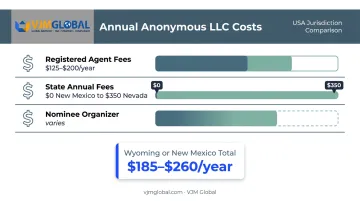
Total ongoing cost for a Wyoming or New Mexico LLC, including registered agent, typically runs $185–$260/year before any professional advisory fees.
Frequently Asked Questions
Is forming an anonymous LLC legal in the United States?
Yes, it's legal. Wyoming, Delaware, New Mexico, and Nevada all permit LLC formation without publicly disclosing owner names. These structures exist for privacy protection, not to circumvent taxes or legal obligations — both of which still apply in full.
What happened to anonymous LLC privacy after the Corporate Transparency Act?
FinCEN's March 2025 interim final rule exempted all US-created LLCs — including those with foreign owners — from Beneficial Ownership Information reporting. This effectively reinstated the privacy protections anonymous LLCs held before the CTA. Foreign-law entities registered in the US may still have reporting obligations.
Can a foreign national form an anonymous LLC in the US?
Yes. None of the four anonymous LLC states require a Social Security Number for formation. Foreign owners of US-created LLCs are also exempt from CTA BOI reporting under the March 2025 rule. Federal tax obligations still apply, and the IRS will require identity disclosure for EIN purposes.
What is the role of a registered agent in an anonymous LLC?
The registered agent serves as the official public-facing contact for the LLC. Their name and address appear on formation documents and state filings in place of the owner's. Using a professional third-party registered agent is essential — listing yourself eliminates the anonymity entirely.
Does an anonymous LLC protect an owner from all lawsuits?
No. Anonymity makes it harder for potential plaintiffs to identify ownership, which can deter frivolous claims. But courts can compel disclosure through legal process, and the LLC's liability shield operates independently of its anonymity. Privacy and legal protection are separate things.
Is there an LLC equivalent in Australia?
Australia doesn't have a direct equivalent to the US LLC. The closest structure is a proprietary limited company (Pty Ltd), registered through ASIC. Australian entrepreneurs can also form a US anonymous LLC remotely — no US residency is required for state formation in Wyoming, Delaware, or New Mexico.