That distinction trips up many Australian-owned businesses with Texas operations. Common questions include whether a report was still required, whether pandemic losses changed liability, whether an extension was valid, and how PPP or ERC activity affects the records.
This guide covers the franchise tax basics, the Report Year 2020 relief, exemptions and no-tax-due reporting, federal relief interactions, and a review checklist. Dollar amounts are USD. Spelling follows Australian convention.
Key Takeaways
- COVID-19 relief changed filing and payment timing, not underlying liability.
- An exemption, a no-tax-due report, a valid extension and a missed report are four different things.
- PPP, ERC and other federal programs need separate analysis from Texas reporting.
- Confirm current deadlines with the Texas Comptroller, not archived COVID guidance.
Texas Franchise Tax Basics and the COVID-19 Impact
What the Texas franchise tax is
The Texas franchise tax is a privilege tax on each taxable entity formed in Texas or doing business there, calculated on margin. It differs from US federal income tax and from Texas sales tax.
Taxable entities include corporations, LLCs, partnerships, banks and business trusts. A US federally disregarded LLC still has its own Texas franchise tax identity.
Key mechanics for report year 2026:
- Rates: 0.75% generally, 0.375% for qualifying retailers and wholesalers.
- Margin methods: 70% of revenue, revenue less cost of goods sold, revenue less compensation, or revenue less $1 million.
- EZ computation: 0.331% for entities with annualised revenue of $20 million or less, with no margin deductions.
- Apportionment: Texas gross receipts divided by gross receipts everywhere.
For Australian readers, "foreign" in the Comptroller's nexus rule means not organised in Texas, not merely non-US. Under Rule 3.586, a foreign entity without physical presence has nexus at $500,000 or more in Texas-sourced gross receipts.
How COVID-19 affected businesses and tax records
Closures, remote work, payroll changes and supply disruption made it harder to assemble the US federal and financial data that feeds the report. That is a records problem, not an exemption.
Lower receipts, an operating loss or paused trading did not automatically excuse anyone. The tax uses revenue and statutory margin, not accounting net profit. A net loss is not the threshold measure.
Why business structure and Texas activity matter
Structure changes the filing picture:
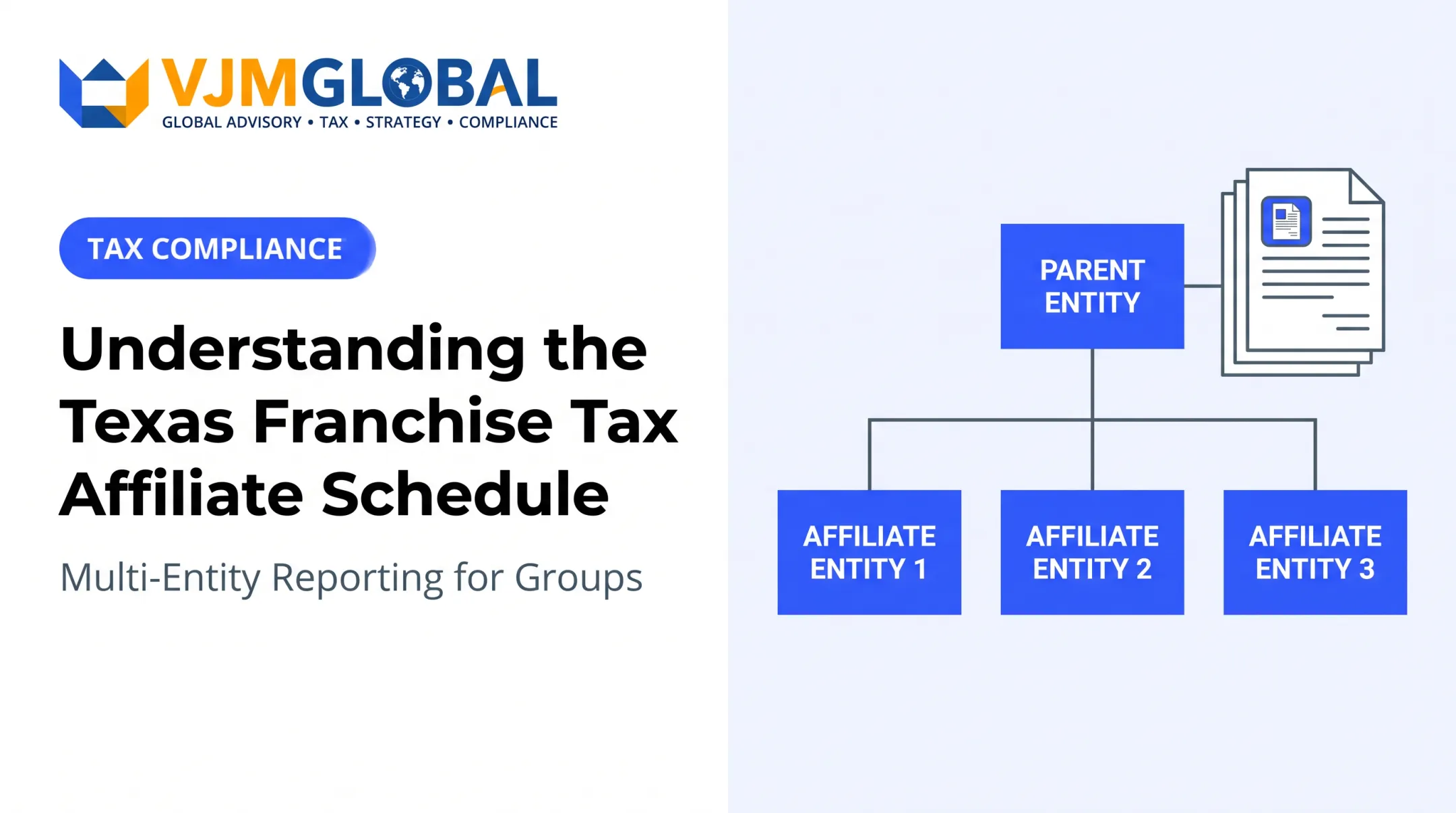
- Affiliated entities in a unitary business file one combined report, tested on collective revenue. Common control generally means more than 50% ownership.
- A member's own below-threshold revenue does not exclude it from the group.
- Entities entering or leaving Texas have different nexus dates and final-report rules.
- Foreign-owned groups may qualify for the 80% foreign property and payroll exclusion, but must test it.
COVID-19 Filing Relief: What Texas Actually Changed
The Report Year 2020 automatic extension
The Comptroller's May 2020 announcement moved the May 15, 2020 deadline to July 15, 2020 for all franchise taxpayers. No extra form was needed for that first postponement.
Additional extensions
| Taxpayer type | Request and payment | Endpoint |
|---|---|---|
| Non-EFT | Request by July 15 with 90% of current-year tax or 100% of prior-year tax | Report and balance due Jan. 15, 2021 |
| Mandatory EFT, step one | Request by July 15 with the same 90%/100% payment | Aug. 15, 2020 |
| Mandatory EFT, step two | Request by Aug. 15 and pay the remaining tax | Report due Jan. 15, 2021 |
Mandatory EFT status applied where prior state fiscal year payments were $10,000 or more. Payments after Aug. 15 attracted penalty and interest.
Payment requirements, penalties and interest
An extension is tentative until the payment condition is met. If the 90% or 100% benchmark was underpaid, penalty and interest applied to the unpaid portion.
Generally, late payment attracts 5% for 1 to 30 days and 10% after that. Interest starts on day 61. The annual rate was 5.75% for calendar 2020 and is 7.75% for calendar 2026. A late report carries a $50 penalty, though not for a late PIR or OIR alone.

Historical relief versus current compliance
Do not treat COVID dates as current deadlines. The current annual deadline is May 15 (next business day if it falls on a weekend or holiday). For 2026, extended filing runs to Nov. 16. Mandatory EFT payers at $500,000 or more in prior-year payments must use TEXNET. Check the Comptroller's extension page before relying on any date.
Filing Duties, Exemptions and No-Tax-Due Reporting
Who may be subject to the tax
Test whether the entity was organised in Texas or doing business there in the reporting period. Customers alone do not create nexus. Factors that do create nexus include:
- Texas employees
- Texas contract performance, even via subcontractors
- Services performed in Texas by employees, contractors or agents
Texas nexus rules contain no COVID telework waiver.
Exempt versus no tax due
Exemption is statutory (Chapter 171, Subchapter B) and applies to categories such as religious, charitable and educational organisations, homeowners' associations and certain insurers. It is not automatic and requires an application, such as AP-204.
No-tax-due is a revenue test. Thresholds by report year:
| Report years | Annualised revenue threshold |
|---|---|
| 2018-2019 | $1,130,000 |
| 2020-2021 | $1,180,000 |
| 2022-2023 | $1,230,000 |
| 2024-2025 | $2,470,000 |
| 2026 | $2,650,000 |

Filing obligations even when no tax is owed
For 2020-2021, required reports stayed due despite no payment. From report year 2024, below-threshold entities no longer file Form 05-163, but generally still file the PIR or OIR. Below-threshold combined groups skip the group form, yet each Texas-organised or Texas-nexus member files its own.
Missed reports can lead to forfeiture after notice and a 45-day cure period. Consequences can include:
- Loss of the right to sue or defend in Texas courts
- Possible director liability for certain debts
Zero tax is not zero compliance.
Final reports and changes in Texas activity
A final report is due within 60 days of ceasing business. Texas entities must file and pay in the year of planned termination, conversion or merger. Out-of-state entities ending Texas nexus file within 60 days. A termination or withdrawal certificate requires outstanding reports and amounts to be resolved.
Federal Relief vs. Texas Franchise Tax Treatment
Federal programs and Texas relief are separate systems. Federal treatment does not automatically control Texas.
- PPP: Texas law (HB 1195) excludes qualifying forgiven proceeds from total revenue for reports originally due on or after Jan. 1, 2021.
- Other proceeds: Section 171.10131 covers specified federal loans and grants, including shuttered-venue and restaurant-revitalization grants. Eligible expenses paid with them stay deductible. It is not a blanket grant exclusion.
- ERC: Whether Texas follows the IRS on ERC is unconfirmed by any ERC-specific Comptroller ruling. The IRS says the credit reduces the wage deduction, and its March 2025 FAQ allows an alternative to amending. That is federal guidance, not a Texas ruling.
When an amended federal return or IRS adjustment changes margin, Section 171.212 requires a Texas amendment within 120 days. Non-compliance can add a 10% penalty. Treat pitches for COVID "Texas franchise tax relief" credits with caution, and get professional advice before amending or claiming anything.

COVID-Era Texas Franchise Tax Compliance Checklist
- Identify the entity and report year (a 2020 report covers a Dec. 31, 2019 accounting year end).
- Confirm Texas nexus under current rules.
- Locate the original report and extension request.
- Verify payments against the 90%/100% benchmarks.
- Compare the filing with the Comptroller account history and status.
Gather these records:
- Federal returns and revenue schedules
- Compensation and cost records
- Ownership or combined-group information
- PPP and ERC documentation
- Payment confirmations, notices and Comptroller correspondence
VJM Global supports accounting reconciliation, tax-compliance documentation and financial reporting for foreign-owned and multinational businesses. It does not provide legal advice or Texas-local representation.
Frequently Asked Questions
Who is exempt from franchise tax in Texas?
Exemptions are limited and tied to specific statutory categories. They differ from no-tax-due status, which is a revenue test. Check current Comptroller criteria.
Do you still have to file franchise tax in Texas?
Often yes. Filing can continue even when no tax is due, typically through a PIR or OIR. Confirm the report type, entity status and reporting year.
What COVID-19 relief did Texas provide for franchise tax?
Temporary Report Year 2020 filing and payment extensions, starting with an automatic move to July 15, 2020. It was not a universal exemption.
Did COVID-19 losses automatically eliminate a business's Texas franchise tax liability?
No. Liability depends on Texas status, report-year rules, revenue and filing method. A net loss is not the threshold measure.
Did PPP or the Employee Retention Credit eliminate Texas franchise tax obligations?
No. Qualifying PPP forgiveness is excluded from revenue, but reporting duties remain. Review ERC treatment of wages and amended returns for the relevant year.