Given those figures, it's no surprise thousands of UK founders register US entities every year. Most guides stop at one question: should I set up a US company at all? That's the easy part. The harder decision, which of the 50 states to register in, gets skipped almost entirely.
State choice drives your franchise tax bill, your annual compliance workload, and whether US investors take your cap table seriously. This guide ranks the states that actually work for UK founders, and covers what still needs planning once you've picked one: visa status, tax layering and banking.
Key Takeaways
- Delaware is the default for venture-backed startups; Wyoming, Nevada, Texas and Florida fit cost, privacy and market needs
- State choice shapes franchise tax, annual fees and investor perception—not just registration cost
- UK citizens can form and run a US LLC or C-Corp remotely with no visa or residency required
- Align state selection, EIN, banking and cross-border tax from day one to avoid compliance gaps
Why the Choice of US State Matters for UK Entrepreneurs
The UK has a single companies registry. Companies House handles every business in the country under one set of rules. The US doesn't work that way.
Each of the 50 states runs its own corporate statutes, its own filing agency, and its own tax regime. "Registering a business in the US" isn't one decision. It's 50 separate ones bundled under a single label.
That choice shows up in the filing data. The Census Bureau recorded 578,926 new business applications in July 2026 alone, up 8.1% from the previous month, according to its Business Formation Statistics release. Every one of those filings started with a state.
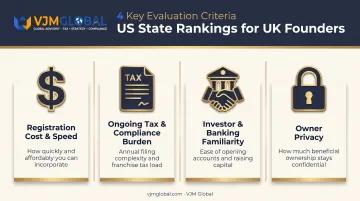
For UK founders, the states below aren't ranked on reputation or size. They're ranked on four things that affect your bottom line:
- Registration cost and speed
- Ongoing tax and compliance burden
- How familiar US investors and banks are with the state
- How much privacy it offers non-resident owners
Best US States for UK Entrepreneurs to Start a Business
We assessed each state against formation cost and speed, annual tax and compliance load, investor and banking recognition, and owner privacy.
Delaware
Delaware handles more corporate law disputes than any other state, largely because more than two-thirds of the Fortune 500 are incorporated there. The state now holds over 2.28 million registered entities and added 334,461 new ones in 2025 alone, per the Delaware Division of Corporations.
Its Court of Chancery deals exclusively with corporate disputes, giving investors a legal backdrop they already trust. For UK founders, that shows up in three practical ways:
- No requirement to visit the US or hold a physical address to incorporate
- LLC formation documents don't ask for member names, keeping ownership off the public record
- US investors and lawyers default to Delaware paperwork without hesitation
Cost and compliance at a glance:
| Factor | Delaware |
|---|---|
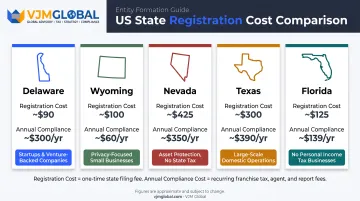
| Registration cost & timeline | LLC: $110; corporation from $109. Filed within days |
| Annual compliance burden | LLC: flat $300 tax. Corporation: $50 report plus franchise tax (minimum $175–$400) |
| Best suited for | VC-track startups, C-Corp structures |
Wyoming
Wyoming has become the go-to state for solo UK founders running e-commerce or consulting businesses with no plans to raise institutional capital. It has neither corporate nor personal income tax, and its annual fees sit among the lowest of any popular incorporation state.
Its charging-order statute is also stricter than most: creditors of a member can't force a sale of company assets, only claim distributions if and when they're made. That's a meaningful protection for a solo owner.
Cost and compliance at a glance:
| Factor | Wyoming |
|---|---|
| Registration cost & timeline | LLC: $100 filing fee, processed quickly |
| Annual compliance burden | $60 or 0.0002 of Wyoming-based assets, whichever is higher |
| Best suited for | E-commerce, consulting and service businesses with no near-term fundraising plans |
Nevada
Nevada built its reputation the same way Delaware did decades earlier: no state corporate or personal income tax, plus strong statutory protection for LLC members and managers.
Where it differs from Wyoming: Nevada's LLC filings require an initial and annual list disclosing every manager or managing member. That means less anonymity than the "no state tax" reputation suggests.
Cost and compliance at a glance:
| Factor | Nevada |
|---|---|
| Registration cost & timeline | Articles $75, plus initial list $150 and business license $200 |
| Annual compliance burden | Annual list $150 plus license renewal $200 |
| Best suited for | Holding structures and founders prioritising no state income tax over filing anonymity |
Texas
Texas offers something the other three don't: a genuinely large domestic market to sell into. No personal income tax, a population that passed 31.7 million in 2025, and a business-friendly regulatory posture make it attractive for founders planning US-based operations rather than a purely remote structure.
Cost and compliance at a glance:
| Factor | Texas |
|---|---|
| Registration cost & timeline | LLC or corporation: $300 filing fee |
| Annual compliance burden | Franchise tax applies above a $2.65m revenue threshold (0.375%–0.75%) |
| Best suited for | Businesses with physical US operations or regional customer concentration |
Florida
Florida pairs no state income tax with one of the fastest-growing consumer populations in the country, up 8.9% since 2020. Formation costs sit in the middle of the pack, and the state's mix of tourism, retail and services demand suits consumer-facing ventures well.
Cost and compliance at a glance:
| Factor | Florida |
|---|---|
| Registration cost & timeline | LLC $125; corporation $70 |
| Annual compliance burden | LLC report $138.75; corporation report $150 |
| Best suited for | Consumer-facing and service businesses targeting the south-eastern US |
How We Chose the Best States
The most common mistake we see UK founders make is picking a state purely because the headline filing fee looks cheapest. Nevada's $75 LLC filing fee looks appealing next to Delaware's $110, until you factor in Nevada's $200 business licence and $150 annual list, which push its real first-year cost higher than it first appears.
We weighted four factors instead, each tied to a real business outcome:
- Incorporation cost and speed — affects how quickly you can open a bank account and start trading
- Ongoing compliance cost — determines your predictable annual overhead, not just the one-off setup fee
- Investor and banking familiarity — reduces scrutiny from US VCs and fintech banking platforms (a Delaware C-Corp faces less friction than an unfamiliar state entity)
- Privacy protections — limits how easily competitors or customers can search your ownership details
No single factor works in isolation. A founder chasing US venture capital who registers in Wyoming to save a few hundred dollars a year may find that same choice slows down their first funding round.
Beyond the State: What UK Entrepreneurs Must Also Plan For
Picking a state is one part of a bigger puzzle. Four other decisions determine whether your US business actually functions day to day.
Entity Type Still Drives the Outcome
State and entity type work together, not separately.
A Delaware C-Corp suits founders planning to raise venture capital, since US investors expect this structure and its stock mechanics. An LLC in any state suits founder-operated, pass-through businesses that want simpler taxation and no external equity investors.
Registering an Entity Doesn't Give You a Visa
This catches out more UK founders than any pricing detail. Forming a US LLC or C-Corp gives you legal ownership, nothing more. It doesn't grant work authorisation.
If you want to live in the US and run the business hands-on, you'll need an E-2 Treaty Investor visa or an L-1 intracompany transfer visa, regardless of which state you picked. Running the business remotely from the UK requires no visa at all.
Tax Applies in Layers
Federal corporate tax sits at a flat 21% for every C-Corp, no matter the state. State-level tax is where things vary, and it's not as simple as "no income tax means no tax."
Following the Supreme Court's Wayfair ruling, a state can require you to collect and remit sales tax once you cross an economic activity threshold there, even without physical presence. Sell into California or New York from a Wyoming LLC, and you may still owe sales tax in those states.
Banking doesn't require a US visit. Once you have an EIN and formation documents, fintech platforms such as Mercury, Wise and Relay let non-resident founders open a US business account entirely online. Traditional banks still generally expect an in-person visit, which is where most UK founders get stuck.
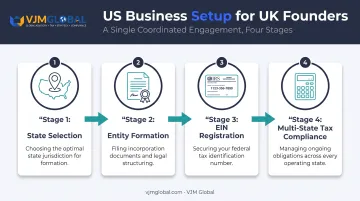
Handled separately, state selection, formation paperwork, EIN applications and multi-state tax compliance become a drawn-out loop across different advisers. A cross-border firm such as VJM Global can run those steps as one engagement—state choice, entity formation, EIN registration and ongoing multi-state tax compliance—rather than several disconnected ones.
Conclusion
There's no single "best" state, only the one that matches your growth plan. A founder chasing Series A funding needs Delaware's investor familiarity. A solo consultant selling services online may never need anything beyond Wyoming's low annual cost.
Before you file anything, weigh three things:
- How fast you plan to scale
- What US investors will expect to see
- What your compliance bill looks like five years out—not just in year one
If you're a UK founder weighing up US entry, VJM Global's cross-border team handles entity formation, EIN applications and multi-state tax compliance as one coordinated process. You don't have to untangle state paperwork and IRS requirements alone—get in touch to map which state fits your plan.
Frequently Asked Questions
Can a UK citizen start a business in the USA?
Yes. UK citizens can register a US LLC or C-Corp remotely, without a visa, US residency, or Social Security Number. Physically running the business day-to-day requires a separate work visa.
Which state is most LLC-friendly?
Wyoming and Delaware rank among the most LLC-friendly states. Wyoming offers low annual fees and strong privacy protections, while Delaware adds investor recognition that matters if you plan to raise capital.
Do I need a US visa to register a business in the US from the UK?
No. You can register and own a US entity from the UK without a visa. A visa is only required if you want to live in the US and manage the business in person.
How much does it cost to register a business in the US as a UK citizen?
Costs vary by state, but expect $75–$300 in state filing fees, plus a registered agent fee and $60–$400 in typical annual compliance costs, depending on the state and entity type.
Can I open a US business bank account without visiting the US?
Yes. Fintech platforms such as Mercury, Wise, and Relay let you open a business account remotely once you have an EIN and formation documents. Traditional banks usually still require an in-person visit.
Do I need to pay UK tax on my US business income?
It depends on your UK tax residency status and how the UK-US double tax treaty applies to your situation. Get professional cross-border tax advice to confirm your actual exposure.